
Maximising Efficiency with Bulk Employee Screening Services
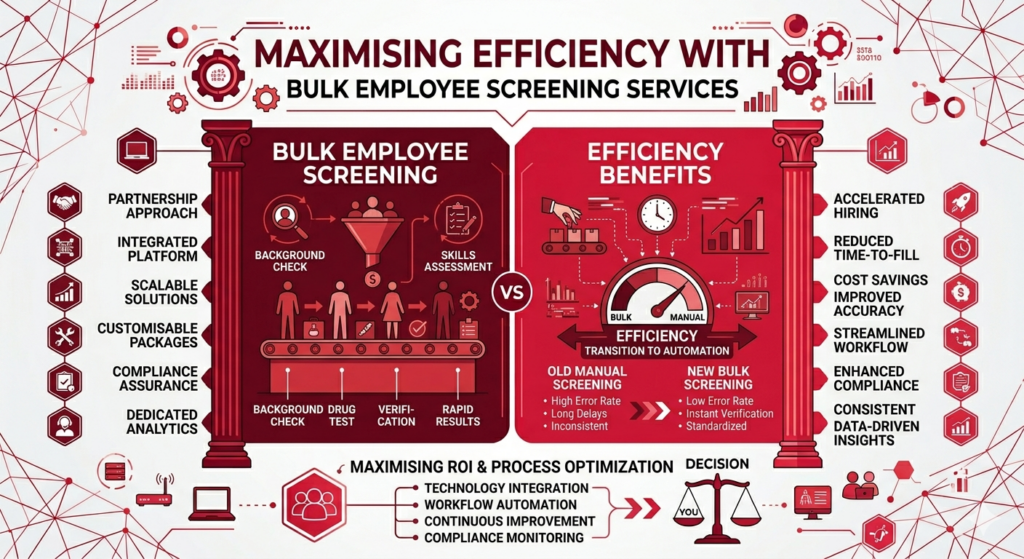
In the fast-paced Australian business environment of 2026, hiring at scale requires more than just a streamlined recruitment process; it demands a robust, secure, and rapid background checking system. For HR managers and business owners, the challenge often lies in balancing speed with compliance. This is where bulk employee screening services become an indispensable asset. Whether you are onboarding a seasonal workforce, expanding your retail team, or managing a large-scale infrastructure project, understanding how to leverage these services can significantly reduce your time-to-hire and operational risk. What are Bulk Employee Screening? Bulk employee screening services are specialised solutions designed for organisations that need to conduct background checks on multiple candidates or employees simultaneously. Unlike individual checks, which can be administrative-heavy when handled one by one, bulk services utilise advanced technology and centralised dashboards to manage high volumes of applications efficiently. In Australia, this typically involves Nationally Coordinated Criminal History Checks, reference checks, and right-to-work verifications, all processed through a single, secure portal. How do bulk screening services differ from individual checks? The primary difference lies in the workflow and management. While an individual check is a linear process for one person, bulk employee screening services allow for the parallel processing of hundreds or even thousands of applicants. These services often include features like bulk data uploads, automated candidate invitations, and real-time status tracking across the entire cohort. For an Australian business, this means moving away from manual data entry and towards a system where compliance is managed at scale, ensuring no candidate falls through the cracks. Why Should Your Business Use Bulk Employee Screening Services? The decision to implement bulk screening is often driven by the need for operational efficiency and risk mitigation. As Australian regulations around workplace safety and Working with Children checks become more stringent, having a centralised system ensures that your business remains compliant without slowing down your growth. What are the primary benefits of screening at scale? Using bulk employee screening services offers several transformative benefits for your organisation: •Reduced Time-to-Hire: By automating the invitation and follow-up process, you can cut days off your onboarding timeline. •Cost Efficiency: Many providers offer tiered pricing for high volumes, making it more economical than individual checks. •Centralised Compliance: A single dashboard provides a source of truth for all background checks, making audits and reporting seamless. •Enhanced Candidate Experience: Professional, automated systems reflect well on your brand and make it easier for candidates to provide their information securely. •Consistency: Every candidate is screened against the same rigors standards, eliminating manual errors and bias. How Do Bulk Employee Screening Services Ensure Australian Compliance? Compliance is the cornerstone of any background checking process in Australia. The Australian Criminal Intelligence Commission (ACIC) and the Australian Federal Police (AFP) have strict guidelines on how identity is verified and how criminal history information is handled. What regulatory standards must bulk screening providers meet? Top-tier bulk employee screening services in Australia must be ACIC-accredited. This accreditation ensures that the provider has the necessary security protocols to handle sensitive personal data and direct access to the National Police Checking Service (NPCS). Furthermore, these services must comply with the Australian Privacy Principles (APPs) and the Privacy Act 1988, ensuring that candidate data is encrypted, stored securely, and only used for the intended purpose of employment screening. What Industries Benefit Most from Bulk Employee Screening Services? While any business hiring more than a few people at once can benefit, certain sectors in Australia have a higher reliance on bulk screening due to high turnover, seasonal peaks, or strict regulatory requirements. Which sectors require high-volume background checks? •Healthcare and Aged Care: With the ongoing demand for frontline workers, bulk screening ensures that all staff meet the necessary safety standards quickly. •Retail and Hospitality: During peak seasons like Christmas, these industries need to onboard hundreds of staff in a matter of weeks. •Construction and Mining: Large-scale projects often require rapid mobilisation of a diverse workforce, all needing site-specific clearances. •Education and Childcare: Ensuring the safety of vulnerable people requires consistent Working with Children and police checks. •Logistics and Supply Chain: As e-commerce continues to grow, the need for verified drivers and warehouse staff remains at an all-time high. How to Choose the Right Provider for Bulk Employee Screening Services? Not all background checking providers are equipped to handle high volumes effectively. When selecting a partner for your bulk employee screening services, you need to look beyond just the price per check. What features should you look for in a bulk screening partner? When evaluating providers, consider the following essential features: 1. ACIC Accreditation: This is non-negotiable for Australian police checks. 2. User-Friendly Dashboard: Can you see the status of all checks at a glance? 3. Bulk Upload Capability: Can you invite 100 candidates with a single CSV upload? 4. Integration Options: Does the service integrate with your existing Applicant Tracking System (ATS) or HRIS? 5. Mobile-First Design: Can candidates complete their checks on their phones? This significantly increases completion rates. 6. Local Support: Is there an Australian-based support team to help with complex queries or technical issues? 7. Speed of Results: Look for providers that return a high percentage of results within hours, not days. What is the Process for Implementing Bulk Employee Screening Services? Transitioning to a bulk screening model is simpler than many HR professionals realise. Most modern platforms are designed for rapid deployment, allowing you to start screening your workforce within a few days. What are the steps to get started with bulk screening? The implementation process typically follows these steps: •Account Setup: Registering your business and verifying your authority to conduct checks. •Customisation: Setting up your specific screening requirements (e.g., Police Check + Reference Check). •Candidate Invitation: Uploading your candidate list and sending automated invitations via email or SMS. •Real-Time Monitoring: Tracking progress through your dashboard and receiving notifications as results are returned. •Review and Onboard: Securely viewing results and moving successful candidates to the next stage of hiring. How Do Bulk Employee Screening Services Handle
AFP Police Check Code 33: What It Is & How to Apply (2026)
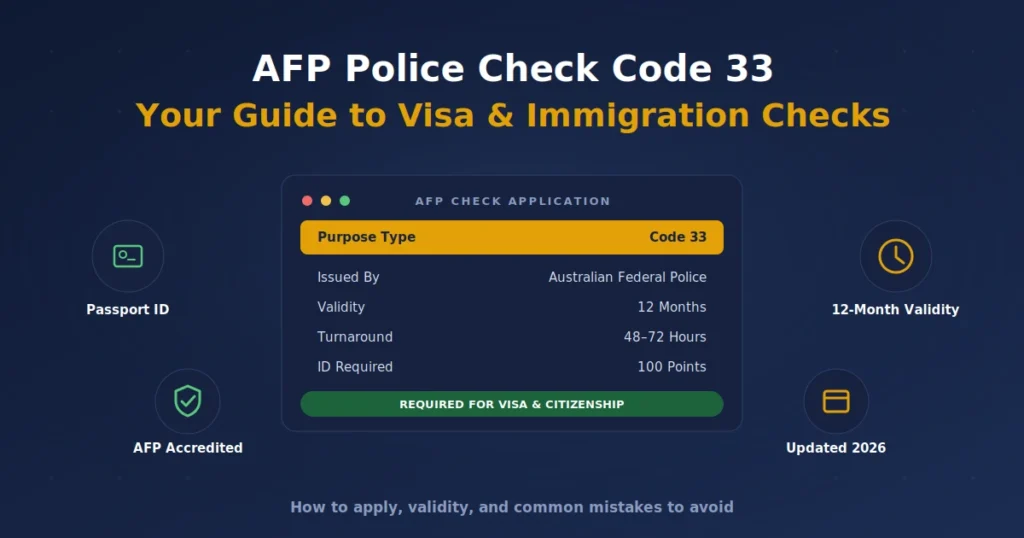
Last updated:August 24, 2026 Introduction: Why the Right Code Matters for Your Future Navigating the Australian immigration landscape in 2026 is a journey filled with excitement, but it is also one paved with administrative rigours and requirements. For many visa applicants, the character requirement is the most daunting hurdle. Whether you are transitioning from a student visa to a 485 Graduate visa or finalising your path to permanent residency, you will inevitably encounter the requirement for an Australian Federal Police (AFP) certificate. If you’re unsure how this differs from a standard police check, see our NPC vs AFP Check comparison. However, a simple police check isn’t enough. The Department of Home Affairs (DHA) is highly specific about the information it requires. This is why the AFP police check code 33 is a term every prospective migrant needs to understand. Selecting the wrong code can lead to application delays, additional costs, and in the worst cases, visa refusals due to non-compliance. At Rapid Screening, we believe that clarity is the first step towards a successful application. This guide covers what a code 33 police check actually involves, AFP police check validity, and how to ensure your submission is perfect the first time. What is the AFP Police Check Code 33? In the world of Australian background screening, purpose codes act as a filter. They tell the police agencies what type of information needs to be released and to whom. When applying for an AFP police check code 33, you are specifically requesting a check for the purpose of immigration/citizenship, for supply to the Department of Home Affairs. Also Known As Because this requirement isn’t always described the same way twice, you’ll see it referred to under a few different names depending on where you look. Whether the form or a guide calls it an afp code 33 police check, an afp national police check code 33, a code 33 afp police check, an afp national police check code 33 immigration citizenship check, an afp national police check application form code 33, an afp national police check purpose code 33, an afp national police check purpose code 33 immigration citizenship selection, an afp national police check purpose code 33 immigration/citizenship option, or an afp police check application form code 33, it’s the exact same requirement: Code 33 – Immigration/Citizenship, on the official AFP application. The Scope of Code 33 Unlike standard employment checks, Code 33 is comprehensive. It is designed to meet the strict character test set out in Section 501 of the Migration Act 1958. When you order an AFP police check code 33, the resulting certificate will include: The primary reason Home Affairs requires this specific code is that it ensures no relevant information is withheld under standard employment privacy filters. It provides the full disclosure necessary for the government to assess your suitability to remain in the Australian community. AFP Code 33 vs. NCCHC AFP Code 33 Police Check Standard NCCHC Issued by Australian Federal Police State/territory police via an ACIC-accredited body Used for Visas, citizenship, immigration purposes Employment, licensing, volunteering Accepted by Home Affairs? Yes, this is the only accepted format No, not accepted for migration purposes Validity No formal expiry, but generally treated as valid for 12 months No formal expiry; the employer sets their own acceptable timeframe. Turnaround 48–72 hours (digital certificate) 70% within 2–4 hours A common mistake: state or territory police checks, and standard NCCHC checks, are not accepted for migration purposes. The Department of Home Affairs will only accept an AFP-issued code 33 police check. If you submit the wrong document, you’ll need to reapply and pay again, so double-check the purpose code before submitting. Why the AFP Police Check Code 33 is Non-Negotiable for Visas Many applicants ask, Can’t I just use a standard National Police Check from my employer? The short answer is: no. The Department of Home Affairs specifically mandates an AFP-issued National Police Certificate. While Rapid Screening is an accredited body for Nationally Coordinated Criminal History Checks (NCCHC), which are perfect for 99% of Australian jobs, the AFP police check code 33 is a specialised stream required for federal immigration. Common Visas Requiring Code 33 If you are applying for any of the following, you will likely need to provide an AFP police check code 33 alongside confirming your right to work eligibility: Visa / Application Type Why Code 33 Is Required 485 Graduate Visa The most common entry point for international students moving into the workforce 189, 190 & 491 Skilled Visas Character assessment for the points-based skilled migration system Partner Visas (820/801, 309/100) Required for the applicant, and sometimes the sponsor, as part of character clearance Australian Citizenship The final character check before citizenship is granted By selecting this code, you are authorising the AFP to release a certificate that is legally recognised by DHA case officers. Using Code 30 or Code 35 will often result in a Request for Further Information (RFI), stalling your visa for weeks. Step-by-Step Guide: Applying for Your AFP Police Check Code 33 In 2026, the application process is almost entirely digital, designed to be completed in under 15 minutes. However, precision is your best friend when submitting your AFP police check code 33 application. 1. Preparation of Identity Documents You must meet the 100-point identity check. For visa applicants, this usually involves: 2. The Application Form When you reach the Purpose Type section, you must navigate the dropdown menus carefully. You should select Commonwealth Employment/Purpose and then specifically choose Code 33 – Immigration/Citizenship. 3. All Names Disclosure This is a critical area where many applicants fail. You must disclose every name you have ever been known by. This includes: If the name on your visa application does not match the name on your AFP police check code 33 certificate, Home Affairs may reject the document. Turnaround Times and Digital Delivery in 2026 The efficiency of the AFP has improved significantly. Most digital certificates for an AFP police check code
Guide to the AFP Check: The Clearance Process
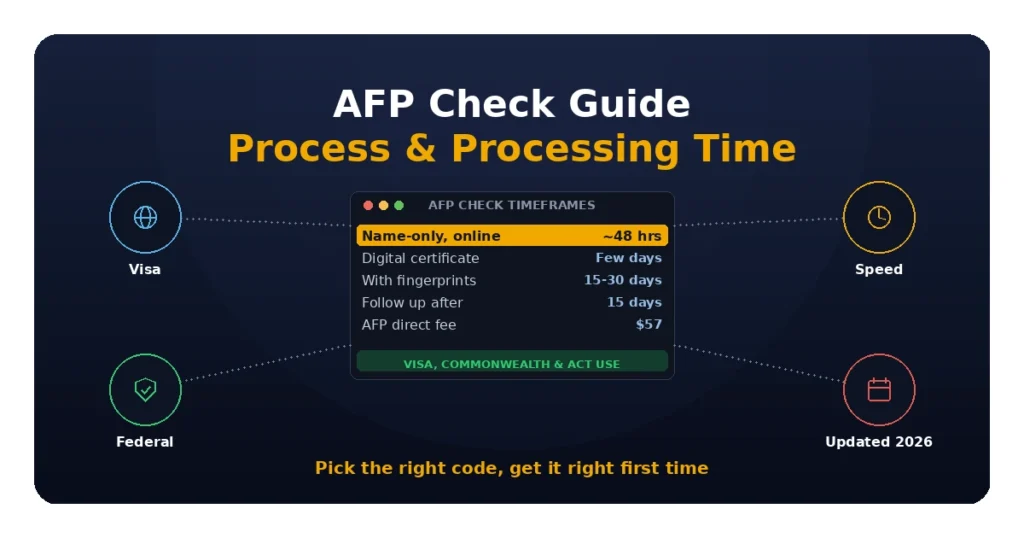
Last updated:October 6, 2026 Quick Answer An AFP check is a National Police Certificate issued by the Australian Federal Police. You need one for visas, citizenship, Commonwealth jobs and ACT purposes. Applying online costs $57, and the AFP completes most name-only checks within 48 hours. Checks that need fingerprints cost $114 and take 15 to 30 business days. If you have been asked for one, you are probably on a deadline: a visa application, a Commonwealth job offer, or a move to the ACT. The good news is that the process is mostly online and usually fast. The catch is that small mistakes on the form, or choosing the wrong type of check, can cost you weeks. This guide covers who actually needs one, how the application works, realistic processing times, how to track your status, and what shows up on the certificate. What Is an AFP Check? An AFP check, officially called a National Police Certificate (NPC), is a summary of your disclosable court outcomes across every Australian state and territory, issued by the Australian Federal Police. It is sometimes called an Australian Federal Police check or AFP national police check, and they all mean the same document. It is different from the standard Nationally Coordinated Criminal History Check (NCCHC) that most employers ask for. Both search national police records, but the AFP issues its own certificate, and it is the only version accepted for certain purposes. Our guide to the difference between an NPC and an AFP check covers this in more detail. Is an AFP check the same as a security clearance? No, and this is one of the most common mix-ups. It is a police history certificate. A security clearance (Baseline, NV1, NV2 and so on) is a much deeper vetting process run by the Australian Government Security Vetting Agency (AGSVA) for roles that access classified information. A security clearance assessment may look at your police history, but a police certificate on its own is not a security clearance. Who Needs an AFP Check? The AFP can only issue a National Police Certificate for specific purposes. The main ones are: For most private-sector jobs, volunteering, or occupational licensing, a standard National Police Check is what you need instead. If you are unsure, our article on when you need an AFP clearance police check walks through each scenario. AFP check for visa and immigration The Department of Home Affairs only accepts an AFP-issued certificate for migration purposes, which includes employer-sponsored migration. If you are applying for a visa, you will usually need to select purpose code 33 on the application. Our guide to AFP police check Code 33 explains exactly how to complete that section. AFP police check in NSW and other states Your state does not change which check you need. An AFP police check NSW residents apply for is identical to one issued to someone in Perth or Hobart. What matters is the purpose: a visa or Commonwealth role needs the AFP version, while most state-based employment needs a standard National Police Check. AFP Check (National Police Certificate) Standard National Police Check (NCCHC) Issued by Australian Federal Police ACIC-accredited body Main uses Visas, citizenship, Commonwealth roles, ACT Most employment, volunteering, licensing Accepted by Home Affairs for migration? Yes No Fingerprint option Yes, if requested No Typical turnaround Most name-only checks within 48 hours 70% within 2-4 hours via Rapid Screening How to Apply for an AFP Check You can apply for an AFP check directly online or through a provider such as Rapid Screening, which lodges and tracks it for you. Either way, the process follows the same steps: The most common reason an application is delayed is a mismatch between the form and the ID documents, such as a missing middle name or a previous surname that was not listed. Our guide to what documents are needed for a police check shows which combinations reach 100 points. AFP Check Processing Time How long does an AFP check take? According to the Australian Federal Police, most National Police Certificates are completed within 48 hours of receiving the application. That can stretch when the AFP needs records from several states and territories. Check type Typical AFP police check processing time Name-only check, applied online Most completed within 48 hours Digital certificate Usually in your inbox within a few days Hard-copy certificate Processing time plus postage Name and fingerprint check 15 to 30 business days When to follow up with the AFP After 15 business days with no result These are the AFP’s own published timeframes, not guarantees. If you have a common name, have lived in several states, or have any court history, budget extra time. Our guide on how to avoid delays in a police check covers the practical steps that keep an application moving. How to Check Your AFP Check Status The AFP runs a Status Portal where you can track your National Police Certificate using your application details. You will also receive emails when your application is received and when it is finalised. If you applied through Rapid Screening, contact our team with your order details, and we will follow up on your behalf. Rapid Screening allows 10 to 25 business days in case manual checks are needed, and most are finalised within 5 business days. AFP Check Cost The AFP check cost depends on where you apply and whether fingerprints are needed. <!– Insert afp-cost-comparison-table-navy.html here (Rapid Screening row is the featured row) –> Applying directly with the AFP is cheaper. Going through Rapid Screening costs a little more, but our team reviews your form and purpose code before it is lodged. For a visa application with a fixed deadline, getting it right the first time is usually worth more than the price difference. You can apply for an AFP check through Rapid Screening online. Option Cost What you get Rapid Screening $72.90 (GST free, includes postage) Application checked by our team before lodgement, certificate posted on secure paper AFP direct,
Decoding the Differences: When You Need an AFP Clearance Police Check vs A Standard NPC

In the world of Australian background screening, clarity and compliance are everything. When an employer, a government agency, or an overseas body asks you for an Australian police check, they are generally referring to the National Police Check (NPC). However, the exact body issuing this certificate, be it an ACIC-accredited provider like Rapid Screening or the Australian Federal Police (AFP), can make a critical difference. The term AFP clearance police check refers specifically to the National Police Certificate issued directly by the Australian Federal Police. While the result contains the same core information as other Nationally Coordinated Criminal History Checks (NCCHCs), its issuer and accepted purpose are highly specific. Understanding this distinction is vital to avoid application errors and costly delays, especially if you are applying for immigration, a Commonwealth job, or work overseas. This guide breaks down the essential differences and outlines exactly when you must choose the AFP clearance police check path. The Australian Police Check Landscape: Two Paths to a National Check The goal of every Australian criminal history check is the same: to provide a summary of an individual’s Disclosable Court Outcomes (DCOs) across all Australian states and territories. This process is managed at a national level through the Australian Criminal Intelligence Commission (ACIC). What is the Standard Nationally Coordinated Criminal History Check (NCCHC)? The Nationally Coordinated Criminal History Check (NCCHC) is the most common police check used for general employment, volunteering, and licensing purposes within Australia. Defining the AFP Clearance Police Check (The AFP NPC) An AFP clearance police check is simply the National Police Certificate issued specifically by the Australian Federal Police. While the core database searched is the same national index, the AFP is the mandated provider for checks intended for certain high-stakes and federally regulated purposes. When is an AFP Clearance Police Check Mandatory? If you are an employer or an individual needing an official criminal history report, the purpose of the check dictates which provider you must use. If your need falls into any of the following categories, you must apply directly through the AFP to obtain the specific AFP clearance police check. 1. Immigration and Visa Purposes (The Most Common Requirement) The Department of Home Affairs (Immigration) requires an AFP clearance police check for anyone applying for Australian citizenship, permanent residency, or certain visas (partner, skilled, or temporary). This is the single largest driver for people requiring the AFP certificate. 2. Commonwealth Government Employment and Licensing Any role related to the Commonwealth of Australia government, its agencies, or entities operating under Commonwealth legislation often mandates the AFP check. This includes: 3. Overseas Applications For Australian citizens or residents seeking employment, volunteer work, or adoption overseas, the receiving international body frequently requires an AFP check because the AFP is the federal policing body recognised globally. 4. Australian Territories Applicants who are residents of, or require the check for purposes within, the Australian Capital Territory (ACT) or the Jervis Bay Territory must use the AFP. AFP Check vs. ACIC Check: A Comparative Table While both documents are technically National Police Checks, their specific application and acceptance criteria differ significantly. This table illustrates the key differences to help you decide which AFP clearance police check path you need to follow. Feature ACIC-Accredited Check (e.g., Rapid Screening) Australian Federal Police (AFP) Check Common Name National Police Check (NPC) or NCCHC AFP Clearance Police Check Issuing Authority ACIC-Accredited Provider Australian Federal Police (AFP) Primary Use General employment, volunteer work, state/territory licenses Mandatory for Visa/Immigration, Commonwealth employment, ACT residents, Overseas purposes. Turnaround Time Up to 70% instant Generally within 48 hours for instant checks Speed Advantage Designed for maximum speed and bulk employer use. Processing is often slightly slower due to the high volume of manual checks for immigration. Cost Varies by provider, often highly competitive for employer clients. Fixed fee set by the AFP. The crucial takeaway is that for general employment in the private sector or for state/territory licensing in New South Wales, Victoria, Queensland, etc., the check provided by an ACIC accredited service like Rapid Screening is usually all that is required and is significantly faster. Only specific, federally driven purposes require the AFP clearance police check. The Importance of Accuracy When Applying for Your AFP Clearance Police Check Whether you apply for the standard NCCHC or the specific AFP clearance police check, accuracy in your application is the single most important factor determining turnaround time. Identification and Vetting All police checks, regardless of the provider, require strict identity verification to a 100-point check standard. This ensures the check is run against the correct person. Inaccurate or incomplete ID submission will immediately halt the process and result in a manual review request. Consent is Mandatory You must provide explicit consent for the check to be conducted. No entity, private or federal can legally proceed with an AFP check or any other NCCHC without the applicant’s formal, signed permission. This protects the applicant’s privacy and rights under Australian law. Choosing the Right Screening Partner For employers managing a high volume of recruits who require the standard Nationally Coordinated Criminal History Check for general, non-Commonwealth employment, speed and efficiency are key. Rapid Screening’s ACIC accreditation means we use the same national database as the AFP but deliver the legally equivalent, required certificate rapidly through our dedicated online portal. We understand that applicants needing an AFP clearance police check for immigration purposes cannot use our service for that specific goal, but we are here to support every other common employment screening need across Australia. For those specific Commonwealth requirements, applicants must apply directly to the AFP. Conclusion The term AFP clearance police check should serve as a signal: it indicates the necessity of using the Australian Federal Police to obtain your National Police Certificate, typically reserved for immigration, federal roles, or overseas applications. For the vast majority of Australian employment and volunteer needs, a standard, efficient National Police Check from an ACIC-accredited provider like Rapid Screening is all you need. We provide the comprehensive criminal