- Last updated:September 4, 2026
Quick answer: A police check in Australia typically takes anywhere from a few hours to 15 business days, depending on the provider and whether manual review is needed. With Rapid Screening, 70% of results are returned in 2–4 hours, while the remaining 30% are referred for manual police review and take 1–15 business days. An AFP-issued National Police Certificate typically takes up to 48 hours for the fast tier, extending to 15+ business days if a manual or multi-state check is required.
In the critical moments of hiring or applying for a new role, time is money. That’s why the most common question we hear is: How long does a police check take in Australia?
With an ACIC-accredited provider like Rapid Screening, we deliver results for the majority of people within hours, not days or weeks.
Rapid Screening’s advanced technology and direct system integration mean we offer industry-leading speed. Our platform returns 70% of all police check results to applicants within 2–4 hours of submission.
This guide breaks down the process, explains the rapid turnaround, and details the factors that cause the remaining checks to take longer.
The Rapid Screening Advantage: Fast-Tracked Results
Every police check in Australia is officially known as a Nationally Coordinated Criminal History Check (NCCHC). All applications must pass through the same central government database and police agencies. However, the way you submit and we receive your application determines the final turnaround time.
Tier 1: The Express 2-4 Hour Turnaround (70% of Checks)
The national system finalises the vast majority of applications almost immediately.
- Average Turnaround: 70% of results within 2-4 hours (during business hours).
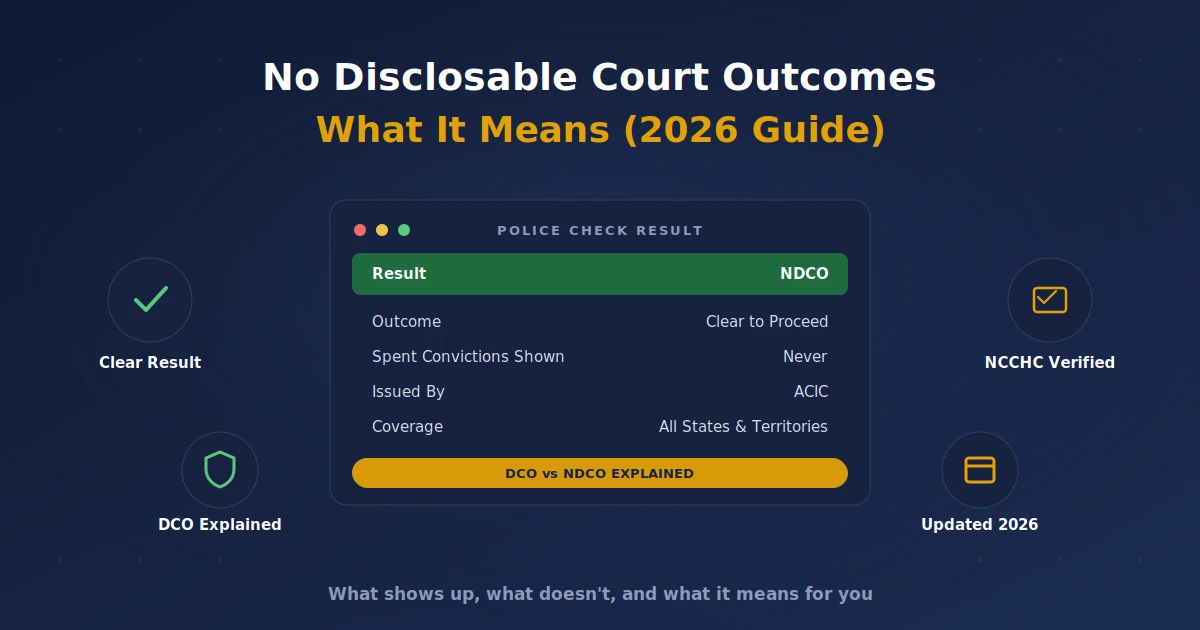
- The Process: When you lodge your details via our secure, 100% online portal, the system instantly matches them against the national criminal database. If your application details don’t match a record or if the system quickly rules out a potential match, it generates a No Disclosable Court Outcome (NDCO).
- Why It’s So Fast: Because we are an ACIC-accredited body, we receive and electronically release your digital certificate the very minute the central system finalises it. There is no postal delay, no manual handling, and no unnecessary waiting time. You receive the result directly in your inbox within hours. This is the fastest way to get your police check certificate and answers the question of how long does a police check take in Australia.
Tier 2: The Manual Police Referral (30% of Checks)
Approximately 30% of applications are flagged as a ‘potential match’ and require manual review by a police officer. This is the only factor that extends how long does a police check take in Australia.
- Average Turnaround: 1 to 15+ Business Days. The majority of these are completed within 10 business days, but complex cases may take longer.
- The Process: A referral means a potential match was found with a person of interest in the police records. The police agency must manually cross-reference all the details to confirm the identity. If the identity is confirmed, the police then vet the records, applying all relevant Spent Convictions legislation to determine what information, if any, is legally disclosable.
- Crucial Point: A manual referral is a verification step, not a conviction. Most checks referred for manual review still return an NDCO result.
AFP Police Check Processing Time: How It Compares
A lot of applicants searching “how long does a police check take” are actually asking about an AFP police check, also called a National Police Certificate, specifically. It’s a fair question, because AFP processing time works a little differently from a standard NCCHC.
According to the Australian Federal Police’s own guidance, most National Police Certificates are completed and posted within 48 hours of the AFP receiving a correctly completed application. That’s the AFP police check processing time you’ll see quoted most often. The catch: that 48-hour figure can extend significantly, sometimes past 15 business days, if the AFP needs to request information from state or territory police (the same manual-referral trigger covered in the NCCHC breakdown above).
So why does your AFP national police check processing time sometimes blow out? The three most common reasons applicants ask “why is my AFP taking so long”:
- Multi-state history – the AFP has to coordinate with every state or territory you’ve lived in.
- A common name or DOB overlap – same identity-matching issue that triggers manual referral on a standard NCCHC.
- Incomplete or unclear ID documents – the single most avoidable cause of delay, and the easiest to fix before you submit.
Here’s the part worth knowing before you apply: an AFP check and an NCCHC processed by an ACIC-accredited body like Rapid Screening both search the exact same national database. You don’t need to apply directly through the AFP just because a form says “national police check.” If you’re not sure which one your employer or visa application actually needs, our NPC vs AFP Check comparison breaks it down, and our AFP check page covers the direct-application route in full.
Police Check Processing Time by Provider
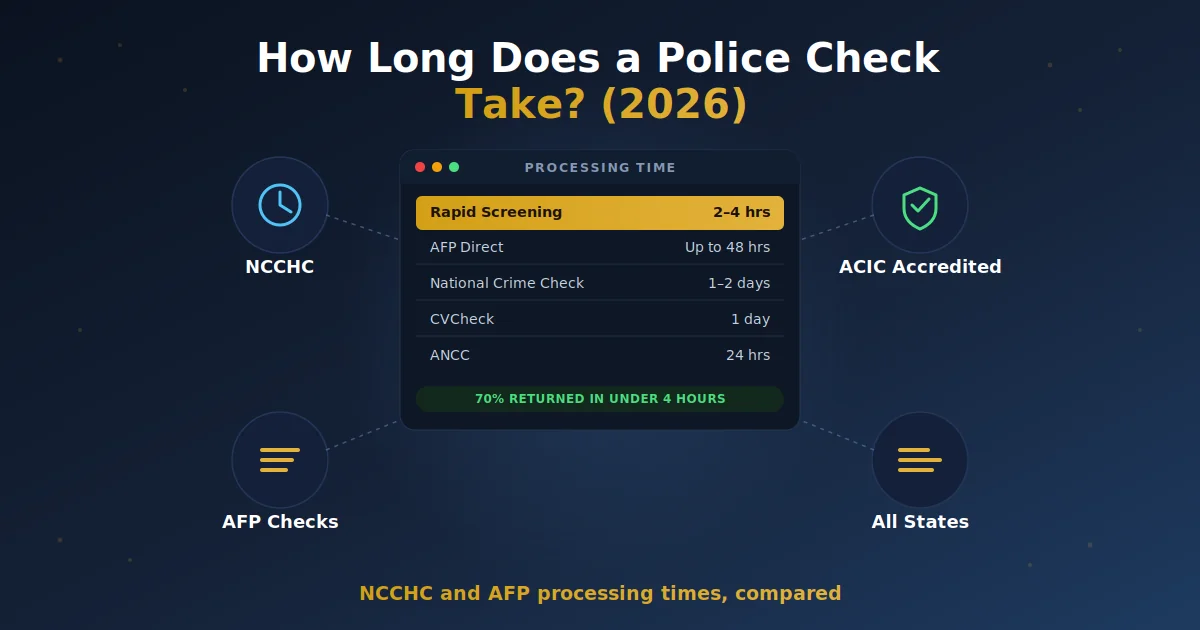
If speed is what matters most, here’s how Rapid Screening’s fastest tier stacks up against other ACIC-accredited providers and the AFP’s own direct service:
| Provider | Fastest tier | If referred / manually reviewed |
|---|---|---|
| Rapid Screening (NCCHC) | 70% in 2–4 hours | 1–15 business days |
| AFP direct (NPC) | Up to 48 hours | 15+ business days |
| National Crime Check | 70–75% in 1–2 business days | 10–12 business days |
| CVCheck | Majority within 1 business day | Up to 15 business days |
| ANCC | 70% in 24 hours | 15+ business days |
| Checked | 1 hour–1 business day | Up to 15 business days |
Figures sourced from each provider’s published FAQ/help pages and the AFP’s official guidance, current as of September 2026. All accredited providers use the same National Police Checking Service, so referral timeframes are governed by police agencies, not the provider.
Factors That Delay Your Police Check Processing Time
While Rapid Screening processes your application instantly, the police referral process is outside the control of any accredited body. You can get these checks in NSW, QLD, SA, TAS, and every other state and territory. These factors increase the likelihood of your application falling into the 30% that require manual vetting:
Identity Complexity and Common Names
The primary cause of a delay is a name/date of birth combination that is similar to an individual on the criminal database.
- Common Names: Individuals with common names (e.g., David, Sarah, Smith, Chen) have a much higher chance of being flagged for a potential match, regardless of their own record.
- Multiple Jurisdictions: Having lived in many different states or territories across Australia can increase the complexity, as the system must search for records across multiple police agencies.
- Previous Names: Using a maiden name, a former married name, or an alias in the past requires the system to search under all possible identifiers, increasing the chance of a match being flagged.
Existing Criminal History or Complex Records
If the applicant has a Disclosable Court Outcome (DCO), the manual vetting is mandatory.
- Record Complexity: The process takes time because a police officer must retrieve the record, verify the accuracy of the data, and apply the specific state/territory laws regarding spent convictions and information release policies.
- Old or Inaccurate Data: If an old record contains incomplete or inaccurate data, the police agency must investigate and reconcile the information before releasing the certificate.
How to Guarantee the Fastest Possible Police Check
You cannot eliminate the risk of a police referral, but you can control every step of the submission process to ensure maximum speed and efficiency.
The Three Golden Rules for a Rapid Police Check
- Choose an ACIC-Accredited Body: Always apply online through a trusted, accredited service like Rapid Screening. Our direct electronic link to the national system ensures your application is instantly submitted, cutting out the typical 3-5 day delay associated with paper applications and post office lodgement.
- Ensure 100% Data Accuracy: The single most common reason for a delay is human error. Double-check that every detail of your current legal name, any former names, date of birth, and address history perfectly matches your official identity documents. Inaccurate or inconsistent data is an immediate trigger for a manual review.
- Use the Document Verification Service (DVS): Rapid Screening uses DVS to verify your identity documents in real-time. Use documents that can be instantly verified (like an Australian passport or driver’s licence) and ensure the scans/photos are clear and legible.
By following these steps, you position your application to join the 70% of police checks returned within 2–4 hours, answering the question of how long does a police check take in Australia.
The Bottom Line
So, how long does a police check take in Australia? For most people applying through an ACIC-accredited provider like Rapid Screening, the honest answer is a few hours, not days. Choose a trusted, accredited body, get your ID details exactly right, and you’ll put yourself in the fastest-moving 70%. If you do land in the 30% that’s referred, it’s a routine identity-matching step, not a red flag, and most referred checks still return a clear result.
Frequently Asked Questions (FAQs)
Q1: Does a delay mean I failed my police check?
No, a delay simply means a police agency has flagged your application for manual verification. This is usually due to common names or other administrative complexities. The majority of referred checks still result in a No Disclosable Court Outcome (NDCO).
Q2: What is the maximum time a police check can take?
While we return 70% of results within 2–4 hours, we refer approximately 30% for manual vetting, which can take anywhere from 1 to 15 business days. In rare and highly complex cases (e.g., very old records or complex interstate history), it may take longer.
Q3: How long is the certificate valid for?
A police check is a point-in-time document, meaning it is only current on the date of issue. It does not technically expire. However, the organisation requesting the check (employer, volunteer group, etc.) will have its own policy, typically requiring a new check every 3 to 12 months.
Q4: Can I apply for a police check if I’m not an Australian citizen?
Yes. If you have been a resident of Australia, you can apply for an NCCHC. You simply need to meet the 100-point identity verification requirements using your passport, visa, and other valid identity documents.
Q5: How long does a national police check take compared to a state police check?
They’re the same thing. A “national police check” and an NCCHC both search the same National Police Checking Service database, so the how-long-does-a-national-police-check-take answer is identical: 70% in 2–4 hours through Rapid Screening, with referred applications taking 1–15 business days.
Q6: How long does a police check take in NSW or QLD specifically?
The same national timeframes apply regardless of state, since every application runs through the same central system. See our NSW police check and Queensland police check pages for state-specific pricing and requirements.
Q7: How long does a police check take for employment purposes?
Employment checks follow the same processing tiers as any other NCCHC purpose. Most employers accept the digital certificate the moment it’s finalised. See our pre-employment checks page for what’s included.
Q8: What is the AFP police check processing time?
Also called AFP processing time, AFP check processing time, or AFP NPC processing time, this refers to how long the Australian Federal Police takes to issue a National Police Certificate. Their own guidance states most are completed within 48 hours, extending to 15+ business days if a manual or multi-state review is triggered.
Q9: How long does it take for AFP results to come back?
If your AFP check has cleared the automated matching stage, results are usually emailed back within 48 hours. If it’s been referred, allow up to 15 business days, and check your email for any request for further information, since that’s the most common reason AFP results are delayed.
Q10: Why is my AFP check taking so long?
The same three factors that delay a standard NCCHC apply here: a common name or DOB overlap, multi-state residency history, or an ID document the system couldn’t verify automatically. None of these mean anything is wrong with your application; they just require a human to confirm the details.
Q11: Can I fast-track a police check?
Not officially; no accredited body or the AFP offers a paid express lane for a referred check. The fastest reliable route is applying online through an ACIC-accredited provider with accurate ID details, which maximises your chance of landing in the instant 70% rather than the manual 30%.
Q12: What shows up on a police check in Australia?
Your certificate will show either a No Disclosable Court Outcome (a clear result) or a Disclosable Court Outcome, meaning convictions or findings of guilt that are legally required to be released for your stated purpose. Spent convictions are excluded by law. See our full NDCO explainer for details.
Q13: Does a police check expire, or can I reuse one?
There’s no official expiry date; a police check is a point-in-time document. Most organisations, however, want one issued within the last 3–12 months. See our guide to the validity of police checks in Australia for how long yours will realistically be accepted.
Q14: How much does a police check cost in Australia?
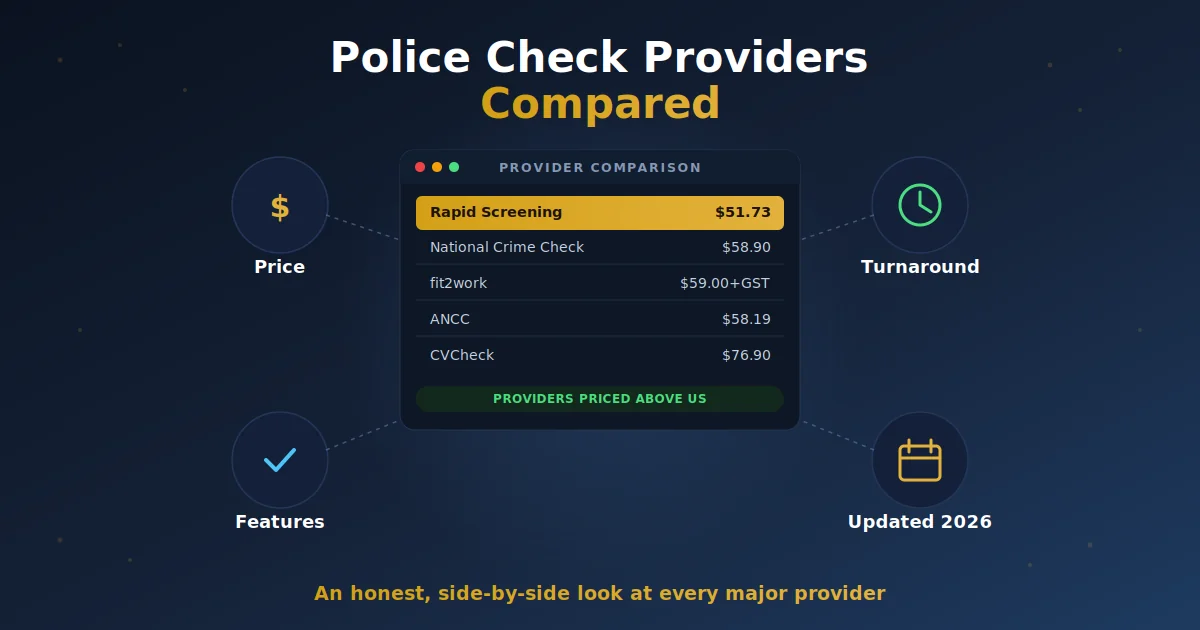
Accredited providers typically charge $45–$65, depending on the check type. See our full cost guide for a state-by-state and provider breakdown.
Stay Informed
Get updates on police check requirements and processing times, straight to your inbox.
Get Your Police Check Now