In the old days of the early 2020s, landing a new job meant a predictable, if slightly tedious, pilgrimage. You would print out a form, hunt down a working pen, gather your physical documents, and head to your local retail hub for a post office police check. It was a rite of passage for every teacher, nurse, and delivery driver in Australia.
Fast forward to 2026, and the landscape has shifted beneath our feet. While the local post office remains the heart of many communities for parcels and passports, the way we handle our criminal history clearances has evolved. The digital revolution hasn’t just touched background screening; it has completely redesigned it. At Rapid Screening, we’re seeing a massive migration of professionals moving away from the traditional post office police check in favor of 100% online, biometric driven solutions.
But is the traditional route still valid? And why is the digital alternative suddenly the gold standard for Australian employers? Let’s dive into the state of police checks in 2026.
The Traditional Route: What is a post office police check?
Historically, the post office police check served as the primary intermediary between the Australian public and the National Police Checking Service (NPCS). It offered a face to face verification service that felt official and secure.
Why the post office police check Was the Standard
For decades, the physical presence requirement was seen as the only way to truly verify a person’s identity. You would present your 100 points of ID to a staff member who would manually cross-check your face against your passport or driver’s licence. It was a reliable system for a world that wasn’t yet fully comfortable with digital identity.
The Challenges of the Manual Process
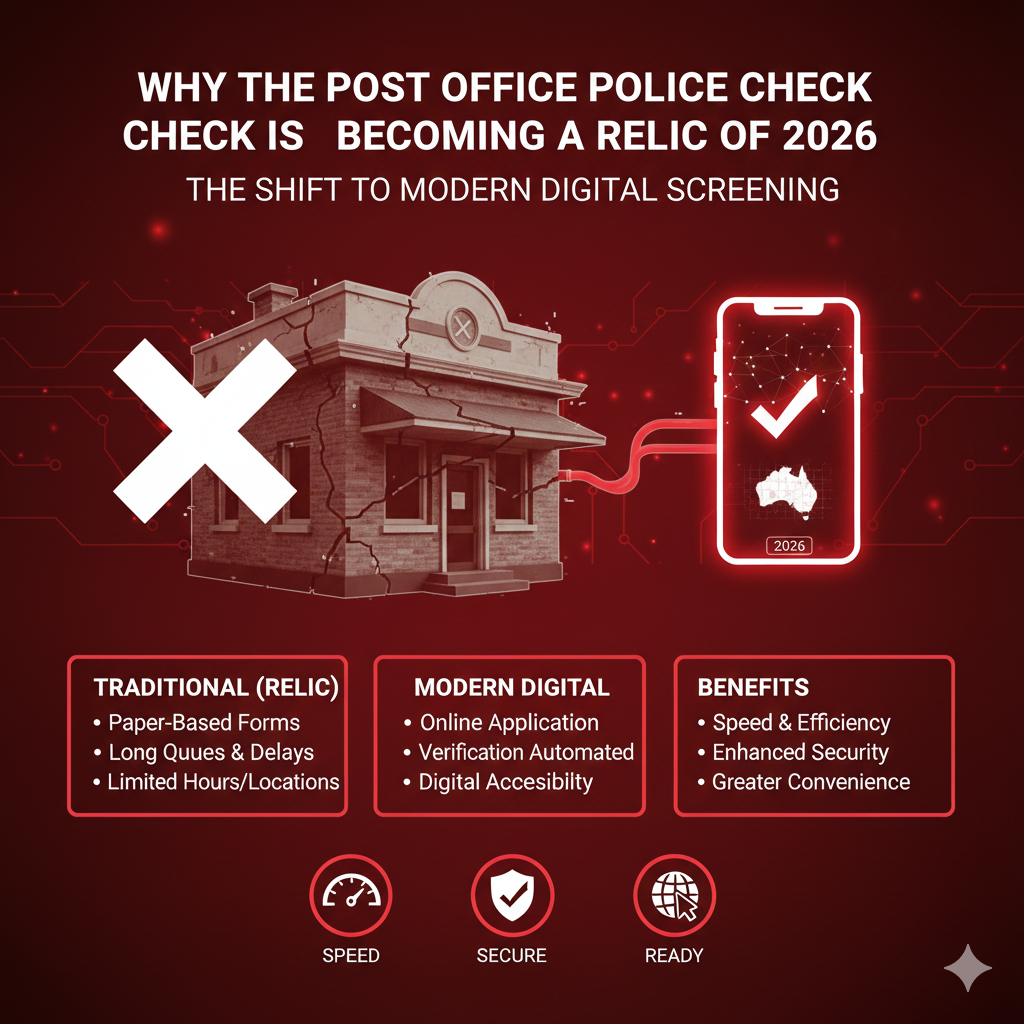
In 2026, time is our most valuable currency. The manual nature of a post office police check involves several friction points:
- Travel and Queues: You are limited by store opening hours and potential lunch-hour rushes.
- Paperwork Risk: Hard copy forms can be misread, leading to data entry errors that trigger unnecessary manual referrals.
- Postage Delays: Even if the check is processed digitally in the background, many people still wait for a physical certificate to arrive via mail, adding days to their onboarding timeline.
Comparing Speed: Online vs. The post office police check
The biggest differentiator in 2026 is velocity. When a hiring manager says, I need your clearance by Monday, the method you choose matters.
The Rapid Screening Advantage
At Rapid Screening, we operate on the 70/30 Rule. About 70% of our checks are returned in as little as 1 to 2 hours. Because our system is directly integrated with the Australian Criminal Intelligence Commission (ACIC), there are no middle-men holding up the data. Your application goes from your phone to the police servers in milliseconds.
The Post Office Timeline
While the post office police check has improved its digital interfaces, it often still involves a transit period for data and ID verification. Most retail based checks estimate a 5 to 10 business day window for completion, especially if a hard copy certificate is requested. In a competitive job market, a week long delay can be the difference between starting your new role on Monday or losing the shift to a work ready candidate.
The 100 Point ID Check: Digital vs. Manual
Whether you choose a digital provider or a post office police check, you must satisfy the 100-point identity requirement. However, the way you prove who you are has changed.
| Feature | Post Office Police Check | Rapid Screening Online |
| Verification | Manual (Staff Review) | Biometric (AI Match) |
| Documents | Physical Originals Required | Digital Scans/Photos |
| Location | In-store Only | Anywhere (Home/Office) |
| Time Spent | 20–40 Minutes (inc. travel) | 5–10 Minutes |
The Rise of Biometrics
In 2026, Rapid Screening uses advanced Liveness testing. Instead of a person looking at your ID, our AI analyzes the security features of your document and matches it to a real time selfie. This is actually more secure than a manual check at a counter, as it eliminates human error and detects sophisticated fraudulent documents that the naked eye might miss.
Cost and Convenience: Why the post office police check is Losing Ground
Let’s be candid: budget matters. In 2026, a standard post office police check often carries a slightly higher price tag due to the overheads of maintaining physical retail locations and staffing.
At Rapid Screening, we’ve stripped away the bricks and mortar costs. By focusing exclusively on a high tech digital platform, we can offer some of the most competitive rates in Australia. For a student or a volunteer, the convenience of not having to pay for parking or petrol to get to a post office, makes a digital check the logical choice.
Why Business Owners are Ditching the post office police check
If you are an HR manager in 2026, managing a paper based workforce is a nightmare. Relying on employees to go out and get a post office police check independently creates a compliance black hole.
The Transparency Gap
When an employee goes to the post office, the employer has no visibility. Did they actually go? Is the check pending? Was there a match? With Rapid Screening’s business dashboard, HR teams can:
- Initiate Checks: Send an invite link directly to the candidate’s phone.
- Track Status: See exactly when the ID is verified and when the police have the application.
- Secure Storage: Automatically receive the digital certificate in a secure, encrypted vault.
This level of control is simply not possible with a decentralized, store based model.
Security and Data Privacy in 2026
A common concern we hear is, Is my data safer with a post office police check? It’s a fair question. Physical documents feel safe because you can see them. However, in the digital age, a piece of paper is a vulnerability, it can be lost, photocopied, or filed incorrectly.
Rapid Screening uses 256 bit encryption, the same level used by Australian banks. Once your ID is verified and the check is complete, your sensitive data is handled according to strict ACIC guidelines and Australian Privacy Principles. Our servers are located right here in Australia, ensuring your information never leaves our borders.
Conclusion: The Future is Rapid
While the post office police check will always have a place for those who prefer a traditional, face to face experience, the professional world of 2026 has moved toward speed and digital integrity. Your career shouldn’t have to wait for the mail or a store to open.
By choosing Rapid Screening, you’re choosing a partner that understands the urgency of modern employment. We’ve turned a week long administrative chore into a 10 minute task you can finish before your morning coffee is cold.
Frequently Asked Questions (FAQs)
Q) Is an online check as official as a post office police check?
Absolutely. Rapid Screening is an ACIC accredited body. The certificate you receive is a legal document sourced from the same National Police Checking Service used by the post office and state police.
Q) What happens if my ID is rejected online?
Don’t worry! If our AI can’t verify a document, our Australian based support team manually reviews it within the hour to get you back on track.
Q) Can I use my Rapid Screening check for a visa?
Generally, no. Most visa and immigration matters require an AFP issued check. However, for 99% of jobs, including NDIS, aged care, and corporate roles, our check is exactly what you need.
Q) Do I need to print my certificate?
In 2026, almost all employers will prefer the digital PDF. It’s easier to store, harder to lose, and can be verified digitally to ensure it hasn’t been tampered with.
Q) Why is Rapid Screening faster than the post office?
We specialize in one thing: background checks. Our systems are optimized for instant data transmission and biometric matching, cutting out the logistical delays of a retail environment.
Q) What if I don’t have a smartphone for the biometric check?
While a smartphone makes it easiest, you can also use a tablet or a computer with a webcam. If you have no camera access at all, our support team can guide you through alternative verification steps.
Q) Does the online check cover all states?
Yes. Both the online check and the post office police check are Nationally Coordinated. This means they search databases in every state and territory in Australia.
Q) Can I get a refund if I change my mind?
Once an application is submitted to the ACIC, the government fees are locked in and the search begins. Therefore, we cannot offer refunds once the process is underway.
Stay Informed
Get updates on police check requirements and processing times, straight to your inbox.
Get Your Police Check Now