Welcome to the professional landscape of 2026, a world where the speed of trust is measured in megabytes and biometric pings. Whether you are a seasoned HR director, a freelance contractor in the gig economy, or a recent graduate entering the healthcare sector, you likely understand that background screening is no longer a nice to have, it is the bedrock of safety and accountability. In Australia today, one of the most common requirements for starting a new venture is obtaining an Australian police report.
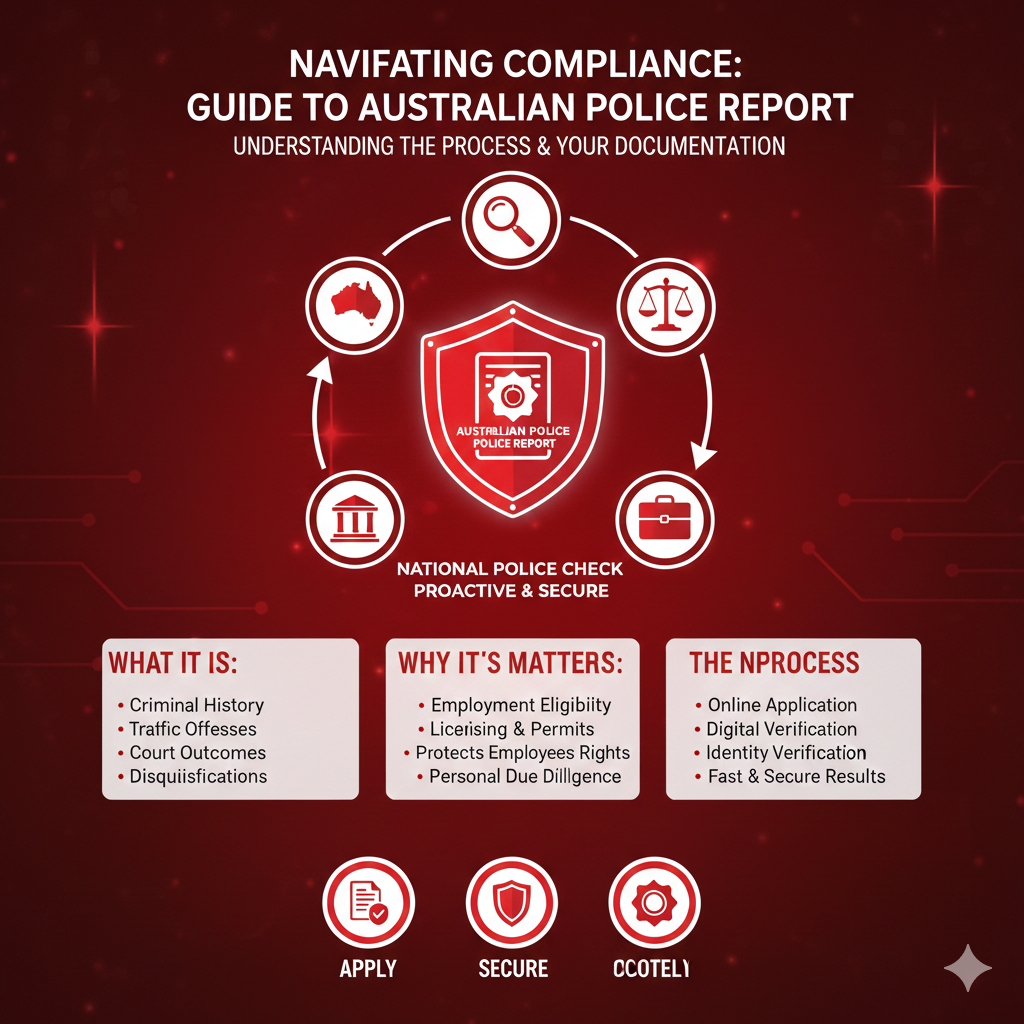
While the term report might evoke images of a detective’s notebook, in the professional sphere, it refers to the comprehensive Nationally Coordinated Criminal History Check (NCCHC). It is the official document that bridges the gap between a candidate’s claims and a company’s security requirements. At Rapid Screening, we’ve spent years perfecting the art of the instant check, moving past the paper-cluttered desks of the past into a streamlined, high tech future.
What Exactly is an Australian police report for 2026?
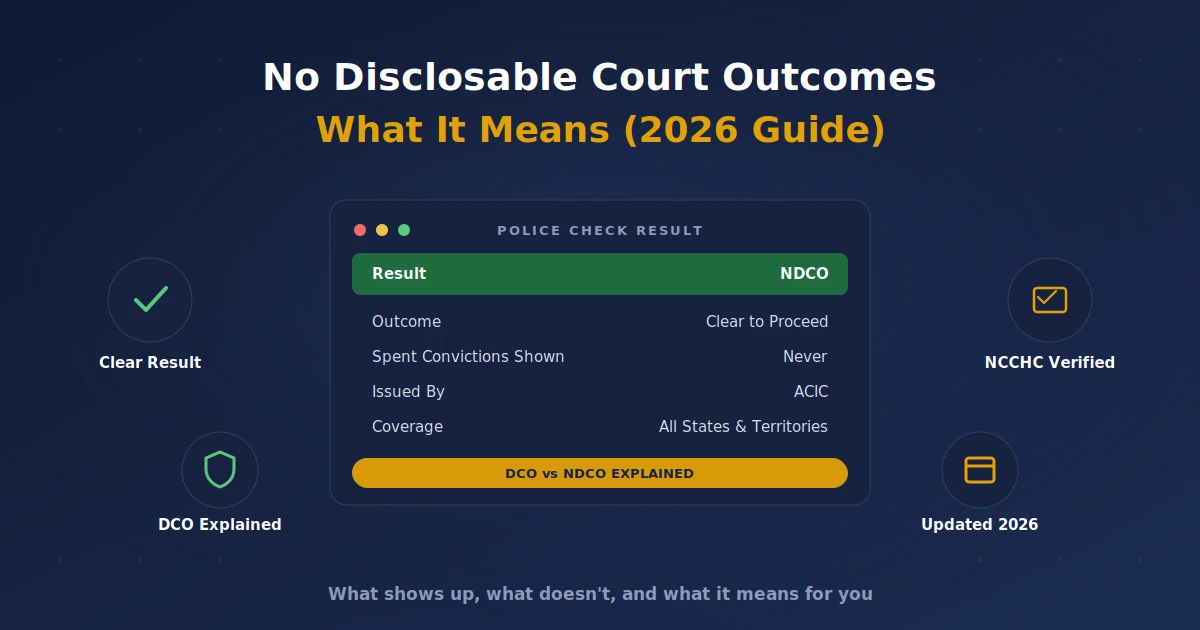
Terminology in the legal and compliance sectors can sometimes be a labyrinth. Some people call it a Police Clearance, others a National Police Check, and many search for it as an Australian police report. Regardless of the name, the function remains the same: it is a search of the National Police Checking Service (NPCS) to identify any disclosable court outcomes (DCOs) against an individual.
Clarifying the Terms
It is important to distinguish between a report of a crime and a professional criminal history check. When an employer asks for an Australian police report, they are requesting a verified summary of your history across all Australian states and territories. This ensures that a person moving from Perth to Sydney carries their professional record with them, creating a seamless national safety net.
The Evolution of the Document
In 2026, these reports have moved far beyond the static PDF. Modern reports are often issued as secure digital certificates with QR codes for instant verification. This prevents the Photoshopping of results and ensures that when a hiring manager looks at your Australian police report, they are seeing the unvarnished, up to the minute truth.
Who Needs to Provide an Australian police Report?
In the current economic climate, high trust roles have expanded significantly. While it was once just the police and teachers who required screening, today, almost every sector has a compliance mandate.
Healthcare and the NDIS
The Royal Commissions of the early 2020s led to a permanent shift in how we protect the vulnerable. If you work in aged care, disability support (NDIS), or childcare, an Australian police report is a legal prerequisite. In 2026, many of these roles require continuous monitoring, where an initial check is just the beginning of an ongoing compliance relationship.
Finance, Fintech, and Cybersecurity
With the rise of sophisticated financial crimes and data breaches, the tech sector has tightened its belt. If you are handling sensitive customer data or managing digital assets, your employer will almost certainly require an Australian police report to ensure there are no history markers related to fraud or dishonesty.
The Gig Economy and Freelancing
Even the decentralized world of freelancing has caught on. Ride-share drivers, delivery partners, and even high end consultants are finding that having a current, proactive check makes them more marketable. Presenting a clear Australian police report at the start of a contract negotiation removes friction and speeds up the time to hire.
The 70/30 Rule: Understanding Processing Times
One of the most frequent questions we receive at Rapid Screening is: How long will it take? In 2026, the answer is usually \minutes, but there is a nuance known as the 70/30 rule.
The 70%: The Instant Success
About 70% of all applications submitted through our platform are returned within 1 to 2 hours. These are cases where the system finds a No Disclosable Court Outcome immediately. For these lucky applicants, the Australian police report is generated by the ACIC servers and delivered to their inbox before their next coffee break.
The 30%: The Manual Referral
The remaining 30% of checks are referred to one or more police agencies for manual vetting. This typically happens if:
- The applicant has a common name.
- There is a name match with a person of interest in the police database.
- There is a complex history across multiple states.
When a manual referral occurs, the timeframe shifts from hours to business days. It is important to remember that a referral does not mean you have a record; it just means a human officer needs to verify that you aren’t the other person with your name.
The Technology Behind the Check: Biometrics and AI
How did we go from 10-day wait times to 2 hour results? The answer lies in the integration of biometric technology. In 2026, Rapid Screening uses Liveness testing, a sophisticated AI process that ensures identity integrity.
Biometric Identity Matching
When you apply for your check, you no longer need to find a Justice of the Peace to sign your documents. Instead, you use your smartphone to take a high resolution selfie. Our AI then compares your facial features against your uploaded ID. This 1 to 1 match ensures that the person requesting the Australian police report is the person the documents belong to.
The 100 Point ID Requirement
While the tech has changed, the legal requirement hasn’t. You still need to provide 100 points of ID.
- Commencement Document
- Primary Document
- Secondary Documents
Our digital portal makes uploading these documents as simple as taking a photo, with real-time feedback if the image is too blurry or a document is expired.
Security and Privacy in an Interconnected World
In 2026, data security is the ultimate priority. At Rapid Screening, we handle some of the most sensitive personal data in the country. We treat your Australian police report with the same level of security as a bank treats your savings.
256 Bit Encryption
Every piece of data, from your birth certificate scan to the final police result, is encrypted using the highest industry standards. We are strictly governed by the Australian Privacy Principles and the Australian Criminal Intelligence Commission (ACIC) guidelines.
Australian Based Support
While our technology is world class, our heart is local. If you have a question about your result or the status of your check, you can call us and speak to a real person in Melbourne. We believe that in a world of AI, the human touch is what truly builds trust.
Conclusion: Empowering Your Career Path
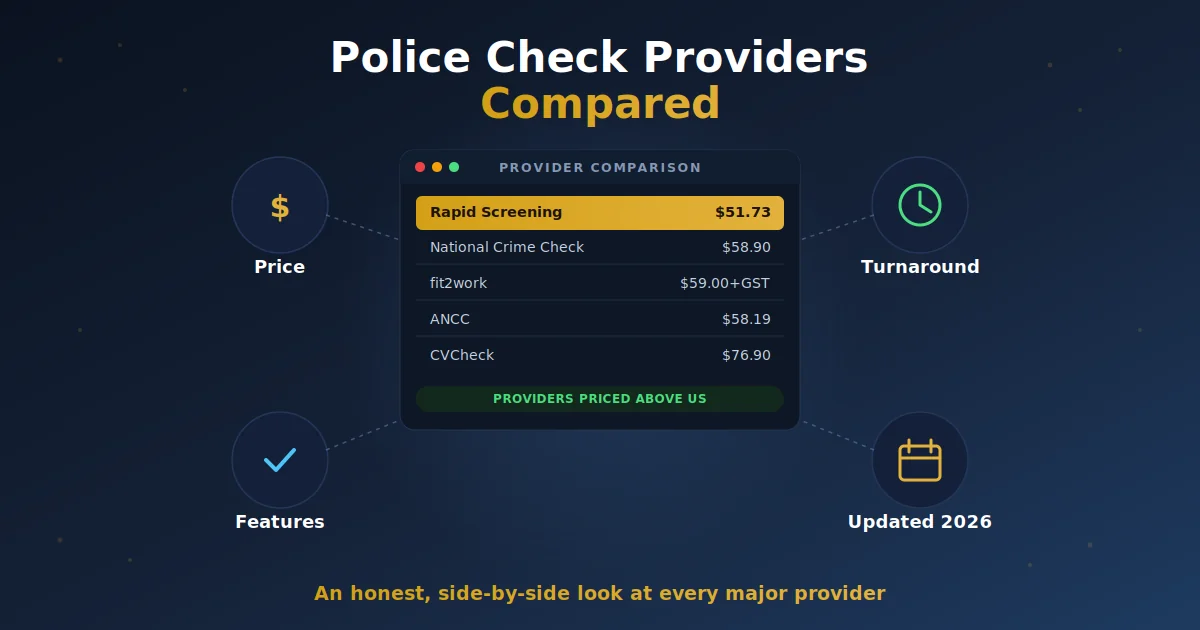
The modern professional journey is paved with checkpoints, and the Australian police report is perhaps the most significant one. By choosing a partner like Rapid Screening, you aren’t just fulfilling a bureaucratic requirement, you are choosing speed, security, and a local team that understands the Australian professional landscape.
As we move through 2026, the demand for transparency will only grow. Being proactive about your compliance doesn’t just protect your employer; it protects your career. When you can provide a verified, biometric-backed clearance in under two hours, you aren’t just a candidate, you are a professional who is ready to work.
Frequently Asked Questions (FAQs)
Q) Can I use this check for a volunteer role?
Yes. Rapid Screening offers discounted rates for volunteer checks, provided the role is 100% unpaid and for a community based organization.
Q) What if I have a common name?
If you have a common name, your check is more likely to be referred for manual vetting by the police. Don’t worry, this is a normal part of the process to ensure the accuracy of the final report.
Q) Is the digital certificate accepted by all employers?
Yes. In 2026, digital certificates with secure verification links or QR codes are the industry standard and are accepted by almost all Australian government departments and private companies.
Q) Can I get a check if I’m overseas?
Absolutely. Since our process is 100% online and uses biometric ID verification, you can apply from anywhere in the world as long as you have the required Australian or international identity documents.
Q) Will my spent convictions show up?
Usually, no. Spent convictions are generally not disclosed. However, there are exceptions for certain high risk roles, such as working with children or the elderly.
Q) What if my ID is expired?
To meet the 100 point requirement, your documents must be current. The only common exception is an Australian Passport, which can often be used if it has expired within the last 2 years.
Stay Informed
Get updates on police check requirements and processing times, straight to your inbox.
Get Your Police Check Now