
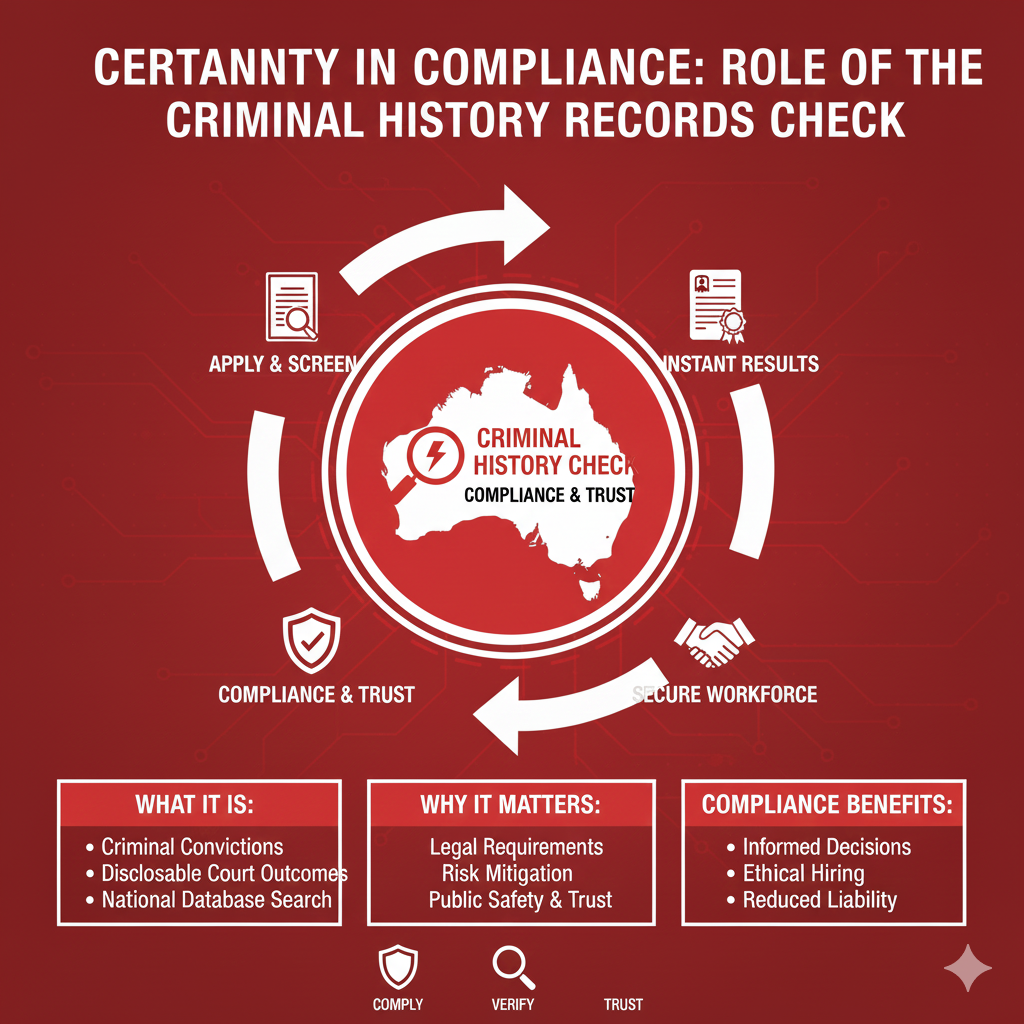
The Foundation of Australian Screening
In Australia, the pursuit of a new job, a volunteer position, or professional licensing is often accompanied by a requirement for a Criminal History Records Check. This document, formally known as a Nationally Coordinated Criminal History Check (NCCHC) or often just a National Police Check, is an indispensable tool for organisations seeking to uphold safety, manage risk, and comply with regulatory standards.
The good news is that obtaining a Criminal History Records Check has evolved from a slow, paper-based process into a fast, secure, and entirely online procedure. Rapid Screening, as an ACIC-accredited provider, simplifies this process, ensuring both individuals and employers receive fast, valid, and legally compliant results nationwide.
Defining the Criminal History Records Check
Before you apply, you need to understand the nature and scope of the document being requested.
One Check, Many Names
The official source of the check is the Australian Criminal Intelligence Commission (ACIC), which administers the National Police Checking Service (NPCS). The various names; Criminal History Records Check, National Police Check, or NCCHC, all refer to the same standardised document that details an individual’s disclosable court outcomes (DCOs) recorded across all Australian police jurisdictions.
What the Check Discloses
When authorities process a Criminal History Records Check, they produce a summary of the applicant’s disclosable criminal history up to the date of issue. This typically includes:
- Disclosable Court Outcomes: Charges and convictions, including the penalty or sentence given.
- Findings of Guilt: Even if no conviction was recorded by the court.
- Pending Charges: Offences currently awaiting a court hearing.
- Outstanding Warrants: Warrants or court orders that are active.
Crucially, the law requires authorities to process the check in strict accordance with Australian legislation, including the relevant Spent Convictions Schemes, which filter out certain older, minor offences from disclosure.
The Advantages of an Online Criminal History Records Check
The transition to a fully digital platform has revolutionised the speed and accessibility of the screening process.
Speed: Minutes, Not Weeks
The most significant benefit of using an ACIC accredited online provider is the dramatic reduction in processing time.
- Fast Results for Clear Records: Approximately 70% to 80% of applications result in a No Disclosable Court Outcome. These checks are generally completed and returned in under 1 business day, often within minutes.
- Eliminating Manual Delays: The secure, digital submission of the application and identity documents bypasses the manual handling, postal transit times, and data entry errors associated with traditional paper forms.
Security and Accuracy via Digital ID Verification
To ensure the check is valid and reliable, identity verification must be stringent. Online providers have adopted advanced digital systems to meet the strict 100 point check requirement:
- Seamless Verification: Applicants use a secure portal to upload images of their government issued identity documents.
- Protected Data: This process complies with the Australian Privacy Principles and protects all sensitive personal data by handling it according to the highest standards.
The Process Explained: How Your Check is Conducted
Understanding the official steps ensures clarity, especially when an application takes longer than expected.
Step 1: Application and Consent
The process begins with the applicant providing their personal details and, most importantly, their informed consent. A Criminal History Records Check cannot legally proceed without the explicit permission of the individual, outlining how the information will be used and disclosed.
Step 2: Submission and Matching
The accredited body verifies the applicant’s identity and electronically submits the details to the ACIC’s National Police Checking Service (NPCS). The NPCS system performs an automatic name-based search against the national police database.
Step 3: The Referral Process (Manual Vetting)
If the system finds a potential match between the applicant’s details and a database record, even due to a common name, it refers the check to the relevant police agency for manual processing.
- Why Referral Happens: It may be due to a common name, complex identity history, or a genuine, older police record that requires manual confirmation.
- Vetting by Police: The police agency manually reviews the record, confirms the individual’s identity, and applies all relevant Australian legislation (such as Spent Convictions laws) to determine what information it can legally release for the specific purpose of the check. This manual process is why referred checks can take 10 to 15 business days or longer.
Step 4: Result Release
Once the vetting process is complete, authorities release the final result, either NDCO or DCO, to the accredited provider, which then securely delivers it to the applicant and/or the requesting organisation.
Legal Compliance: Spent Convictions and Filtering
A critical factor that differentiates a Criminal History Records Check in Australia from similar checks in other countries is the application of conviction filtering.
The Role of Spent Convictions
Australian law uses Spent Convictions Schemes to support rehabilitation. When a conviction is minor and the required crime free waiting period has passed, the law treats that conviction as spent.
The system must filter the conviction out of the final report for most employment and volunteer purposes. For an applicant, this means the Criminal History Records Check will show an NDCO, and they can legally state they have no criminal record.
Exempt Roles and High-Risk Sectors
It is important to note that the filtering rules have exceptions. Certain high risk roles, such as those involving children, aged care, or national security, are often legally exempt from the Spent Convictions Schemes.
Conclusion: Confidence in Your Compliance
The Criminal History Records Check is a necessary security measure that underlies trust in the Australian workforce and community. When you choose an ACIC accredited online provider, you ensure they handle this mandatory compliance step with maximum speed, security, and legal accuracy. Whether you are a job seeker looking for a swift result or an employer requiring robust risk management, the modern online check provides the certainty you need.
Frequently Asked Questions (FAQs)
Q) What is the difference between a Criminal History Records Check and a Working with Children Check?
A Criminal History Records Check provides a national police check for general employment. State authorities manage a separate Working with Children Check that assesses an individual’s suitability to work with children and is often required in addition to the national check.
Q) If I have a common name, will my check take longer?
Your check is more likely to trigger a potential match, prompting authorities to refer it for manual processing. While the majority of these referrals quickly confirm that the record is not yours, the need for manual confirmation by police agencies does add to the processing time, typically extending it to 10 to 15 business days.
Q) How long is the certificate considered valid?
A Criminal History Records Check is a record at the date of issue and has no official expiry date. However, most Australian organisations require a current check, which typically means they accept only certificates issued within the last three to six months of an employment or licensing application.
Q) Can I get an overseas Criminal History Records Check through Rapid Screening?
Rapid Screening specialises in the Australian Nationally Coordinated Criminal History Check. For roles that require checks from countries outside of Australia, you would need to contact the relevant national police authority or use a specialised international screening agency.