Welcome to 2026, where the new normal of the professional world is built on a foundation of verified trust. Whether you’re a nurse entering a busy Melbourne hospital, a tech consultant in Sydney, or a volunteer in rural Queensland, you’ve likely encountered the background check hurdle. In today’s fast-moving economy, navigating the maze of police check requirements shouldn’t be the hardest part of landing your new role.
At Rapid Screening, we know that compliance can feel like a chore. However, in an era where digital identity and cybersecurity are paramount, these checks are the vital safeguards that protect our workplaces and communities. Understanding the current landscape of a Nationally Coordinated Criminal History Check (NCCHC) is the first step to ensuring your career stays on the fast track.
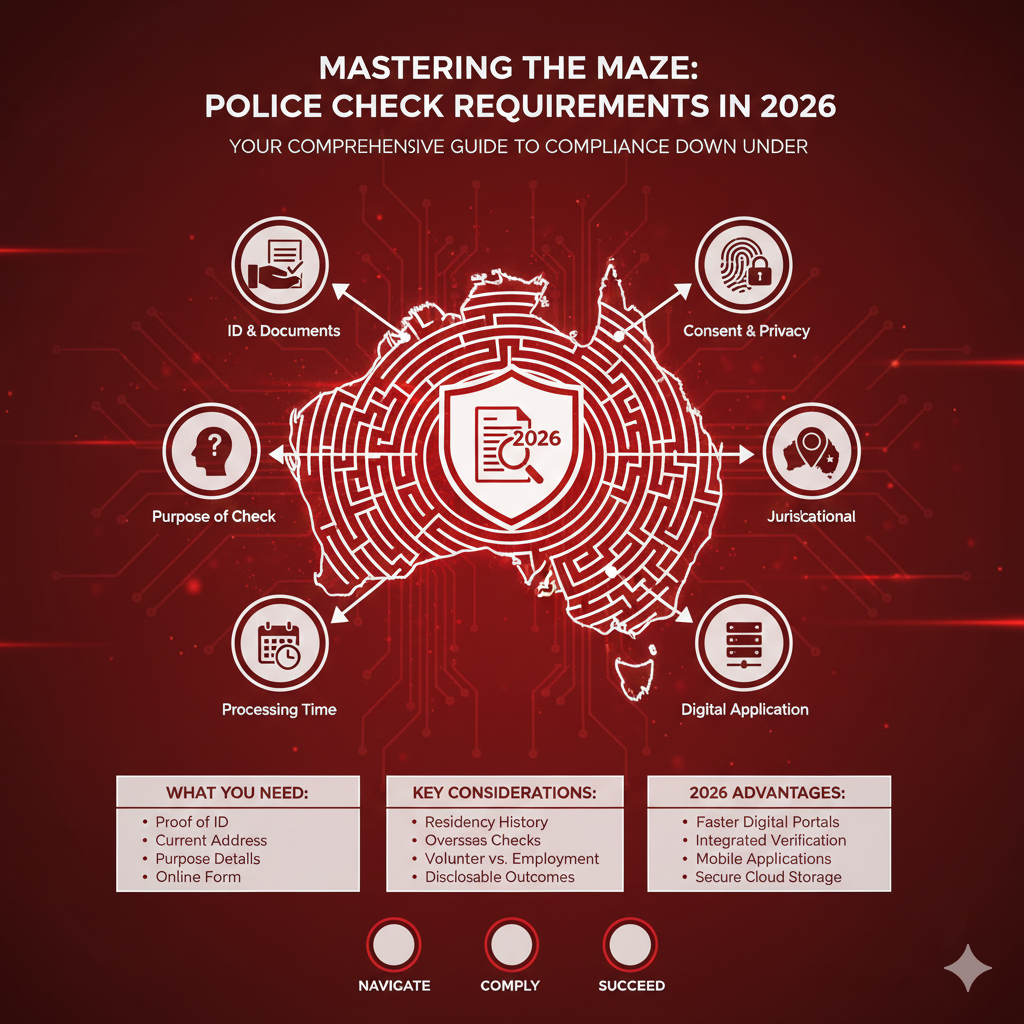
Modern police check requirements: A 2026 Overview
The way we verify identity has changed significantly over the last few years. While the core mission remains the same, identifying disclosable court outcomes (DCOs), the method is now almost entirely digital. In 2026, paper forms and physical witnesses are relics of the past.
At its heart, meeting police check requirements is about proving two things: who you are and that your history is compatible with your intended role. The Australian Criminal Intelligence Commission (ACIC) oversees the national system, ensuring that a check in Tasmania carries the same weight as one in the Northern Territory.
Essential police check requirements
The 100 point ID system is the backbone of identity security in Australia. To fulfill your police check requirements, you must provide a combination of documents that prove your identity beyond a shadow of a doubt.
The Identity Document Hierarchy
The ACIC requires documents from four distinct categories. You must provide one commencement document, one primary document, and two secondary documents.
| Category | Points | Examples of Acceptable Documents |
| Commencement | 70 | Australian Passport, Full Birth Certificate, or ImmiCard. |
| Primary | 40 | Australian Driver’s Licence, Marriage Certificate, or Proof of Age Card. |
| Secondary | 25 | Medicare Card, Bank Statement, Credit Card, or Utility Bill. |
| Secondary | 25 | Australian Student ID, Foreign Passport (with valid visa). |
Failure to meet these police check requirements perfectly is the number one reason applications are delayed. The names on all four documents must be consistent. If your passport is in your maiden name and your driver’s licence is in your married name, you must provide a marriage certificate as a linking document to bridge the gap.
Biometric Verification: The New Frontier of police check requirements
In 2026, we’ve moved beyond the need to visit a Justice of the Peace or a police station for identity verification. Rapid Screening utilizes cutting edge Liveness technology.
How It Works
When you apply, you will be prompted to take a selfie or a short video of your face using your smartphone or webcam. Our AI then compares this real-time biometric data against the photo on your passport or driver’s licence. This ensures:
- Identity Integrity: No one else can apply for a check in your name.
- Speed: Verification happens in seconds, not days.
- Convenience: You can meet these modern police check requirements from your living room at 2:00 AM if you need to.
The 70/30 Rule: Managing Your Timeline
If you’re in a rush to start a new job, the waiting game can be stressful. To manage your expectations, it is vital to understand the 70/30 Rule used by the ACIC.
The 70% (Instant): Most applicants (roughly 70%) have a unique name and no criminal record. For these individuals, results are usually returned within 1 to 2 hours of submission.
The 30% (Manual Referral): About 30% of checks are flagged for manual referral. This happens if you have a common name or if a potential match is found in the police database.
If your application is referred, it is sent to one or more police agencies for a human officer to review. This can take anywhere from 1 to 15 business days. While different states might have subtle variations in police check requirements for certain roles, the referral process is a standard national safety measure. No provider can speed this up once it is in the hands of the police.
Industry Specific Needs: Why the Purpose Matters
When you fill out your application, you must specify the Purpose of the Check. This isn’t just a survey; it legally dictates what information the police are allowed to release to you and your employer.
1. NDIS and Aged Care
Following the regulatory updates of 2025, those working in aged care or with the NDIS face some of the strictest scrutiny. These checks often look specifically for exclusionary offenses related to the safety of vulnerable persons.
2. Finance and Fintech
With the rise of sophisticated digital fraud in 2026, the finance sector requires checks that specifically include Dishonesty offenses. An employer in this field needs to know that the people handling their digital assets have a verified history of integrity.
3. Volunteers
Did you know that police check requirements are slightly different for volunteers? If you are working for a 100% unpaid, community based role, you may be eligible for a discounted Volunteer Check. Note that you cannot use a volunteer check for a paid position later, it is role specific.
Common Pitfalls: Why Applications Get Stuck
Even with the best technology, human error is the biggest hurdle. To ensure you breeze through your application, avoid these common mistakes:
- Missing Middle Names: If your Medicare card has your middle name but your application doesn’t, the system may flag it as a mismatch.
- Blurry Photos: If your ID scan is blurry or has glare from the camera flash, our AI won’t be able to verify the security features.
- Address History Gaps: You must provide a full 5 year residential history. If you spent a year backpacking overseas, you need to list those international addresses too!
- Expired ID: Except for Australian Passports.
Why Choose Rapid Screening in 2026?
We know you have choices when it comes to compliance. Rapid Screening police check stands out because we balance lightning fast tech with authentic, local human support.
- Speed: 70% of results in 1 to 2 hours.
- Support: Our Australian based team is available to help if your check gets stuck in a manual referral.
- Security: We use 256 bit encryption to ensure your sensitive data is as safe as a bank vault.
- Business Tools: For HR managers, we offer a centralized dashboard to track all staff clearances in real-time.
Conclusion
Mastering police check requirements doesn’t just get you through the hiring process, it demonstrates your professional readiness and commitment to safety. By preparing your documents, understanding the biometric process, and choosing a trusted partner like Rapid Screening, you turn a complex administrative task into a quick win for your career.
Frequently Asked Questions (FAQs)
Q) Can I use a digital copy of my Medicare card?
In 2026, most digital government IDs are accepted. However, we recommend having a clear photo of the physical card as a backup for our biometric scanner.
Q) Why was my check referred to the police?
About 30% of checks are referred. This is usually due to a name match where your name is similar to someone else in the database. It is a routine security check and does not necessarily mean you have a record.
Q) Can I get a refund if I change my mind?
Once an application is submitted to the ACIC, the government fees are processed and the search is initiated. Therefore, we cannot offer refunds once the check is in Progress.