The Power of Proactivity
Whether you’re starting a new job, volunteering, or simply seeking clarity on your personal history, knowing how to check my criminal record is a crucial step in taking control of your professional narrative. For Australian citizens and residents, this process has been simplified and digitised, allowing individuals to obtain their official document, the Nationally Coordinated Criminal History Check (NCCHC), quickly and securely.
A personal police check provides you with the exact information that an employer, licensing body, or volunteer organisation would receive. This allows you to verify its accuracy, understand what the law allows to be disclosed, and prepare for any questions that may arise during the hiring process. As an ACIC accredited provider, Rapid Screening offers the fastest and most compliant way to achieve this essential compliance goal.
Understanding the Official Document
When you ask how to check my criminal record, you are referring to the Nationally Coordinated Criminal History Check, commonly known as a National Police Check or a police clearance certificate.
The Single Source of Truth
The NCCHC is a document sourced from the National Police Checking Service (NPCS), which is overseen by the Australian Criminal Intelligence Commission (ACIC). This system draws on police records from all state and territory jurisdictions in Australia.
Who Can Conduct the Check?
You have two primary options for obtaining your personal check:
- ACIC Accredited Bodies (Like Rapid Screening): The ACIC has audited and authorised these private organisations to access the NPCS system and process checks on the public’s behalf. This is the fastest, most popular method for individuals and businesses.
- Australian Police Agencies: You can apply directly through the state or territory police in your location (e.g., NSW, Victoria) or the Australian Federal Police (AFP) for specific purposes like immigration.
For speed and convenience, you should use an accredited online body for standard employment and personal checks.
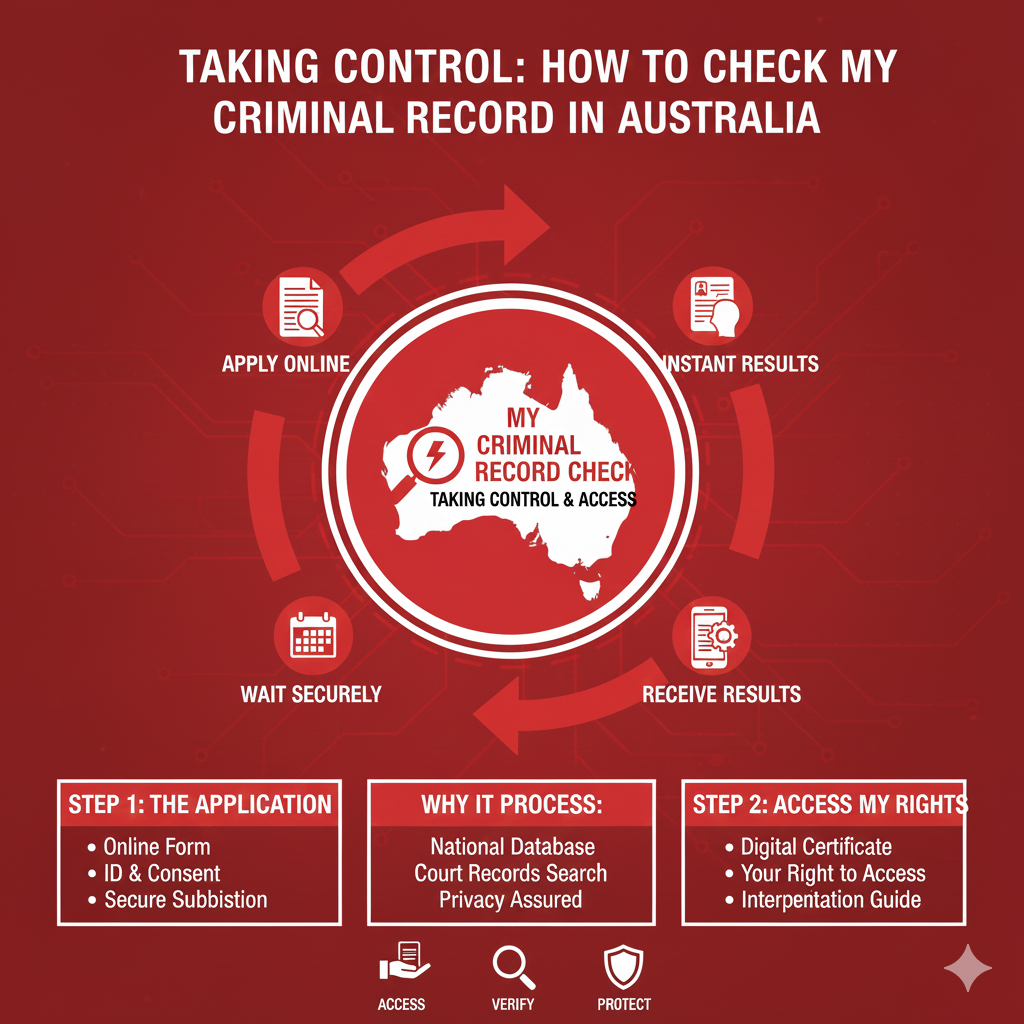
Step by Step: How to Check My Criminal Record Online
An accredited provider like Rapid Screening has designed the online process to be completed in minutes.
Step 1: Complete the Online Application
You will need to visit the accredited provider’s website and fill out a secure application form. This involves providing:
- Current and Former Legal Names: Include all names you have ever been known by.
- Date and Place of Birth: Essential for identity matching across databases.
- Address History: Typically, details of all residential addresses for the last five years.
- Purpose of the Check: Clearly state that the check is for Personal use, employment, or volunteering, as the stated purpose can affect what information is legally disclosable.
Step 2: Provide Informed Consent
Legally, a police check cannot proceed without your explicit, informed consent. You must read and digitally sign a consent form that confirms you permit the submission of your personal information to the NPCS for verification and that you understand how the system will release any disclosable court outcomes.
Step 3: Complete Digital Identity Verification (IDV)
This is the most critical stage for security and speed. Instead of visiting a post office or having documents certified, you complete the 100 point identity check digitally.
- Document Submission: You will securely upload images or scans of various identity documents.
- Verification: The online system uses secure technology to verify these documents against government databases, ensuring they are valid and belong to you. This step prevents fraud and ensures the check is legally compliant.
Step 4: Secure Submission and Tracking
Once the system verifies your ID and processes the payment, it immediately submits the application electronically to ACIC for processing. You will receive an immediate confirmation and often a tracking number, allowing you to monitor the status of your check via the provider’s online portal.
Understanding the Results: What Your Check Reveals
The certificate you receive will detail your disclosable criminal history. It will show one of two primary outcomes:
1. No Disclosable Court Outcomes (NDCO)
This means the search found no releasable criminal history. This includes applications where:
- No criminal records exist in any Australian jurisdiction.
- Criminal records exist, but they have been legally filtered from disclosure because they are classified as spent convictions.
For the vast majority of checks that result in an NDCO, the system returns the result very quickly, often within minutes to a few hours, demonstrating the speed of the digital process.
2. Disclosable Court Outcomes (DCO)
This means the certificate lists one or more records that the law permits to be disclosed for the purpose stated on the application. A DCO can include current convictions, certain findings of guilt, or pending charges.
If you receive a DCO, it’s vital to remember:
- Relevance is Key: A past offence does not automatically disqualify you from employment. The employer must consider the direct relevance of the offence to the duties of the role.
- Dispute Mechanism: If you believe the record is inaccurate, you have the right to dispute the result through the accredited provider. They will liaise with the police agencies to review the information.
The Shield of Spent Convictions
Understanding how to check my criminal record involves knowing the protection provided by the Spent Convictions Schemes. These federal and state laws prevent the disclosure of minor offences committed long ago when the individual has demonstrated a crime free period. This is critical for rehabilitation and reintegration into the workforce.
When You Might Need to Check My Criminal Record
While many checks are employer initiated, obtaining your own check is valuable for several personal and professional reasons.
Proactive Career Management
In competitive hiring environments, having a current, personal police check ready to submit with an application can significantly speed up the hiring process and give you a competitive edge. It shows preparedness and eliminates the usual waiting period.
Licensing and Accreditation
Many professional bodies and trades require a personal police check as part of their licensing or accreditation process. This is common for:
- Legal practitioners
- Financial services representatives
- Security licence holders
Peace of Mind and Verification
A personal check is the only guaranteed way to know exactly what information police agencies hold against your name. If you have any uncertainty about old records, name matches, or compliance, a personal check provides the definitive answer.
Conclusion: Confidence in Compliance
Knowing how to check my criminal record is the first step toward responsible personal and career management. By utilising an ACIC-accredited online provider, you ensure you receive a legally valid, nationally recognised, and timely document. This proactive approach gives you the necessary confidence to apply for jobs, pursue licences, and manage your professional reputation effectively.
Frequently Asked Questions (FAQs)
Q) How long does it take to get my personal criminal record check?
For the majority of applications, the result is typically returned within minutes to one business day of submission. If your check is referred for manual processing due to a potential name match, it can take longer, usually between 10 and 15 business days.
Q) Does a personal check expire?
There is no official expiry date, as the certificate is a record at the date of issue. However, most Australian organisations require the check to be current, meaning it was issued within the last three to six months to ensure the most recent history is covered.
Q) Can I get an Australian criminal record check if I live overseas?
Yes. As long as you can meet the 100-point identity check requirements using the accepted combination of Australian or foreign documents, you can apply for an Australian NCCHC through an ACIC-accredited online provider, regardless of where you currently reside.
Q) Will a record from a Children’s Court appear on my check?
Children’s Court convictions and findings of guilt can appear on an adult police check, subject to the relevant state and territory legislation governing the disclosure of juvenile records. The same spent convictions rules are also applied, but the rules for juvenile offences typically involve shorter crime-free periods.