
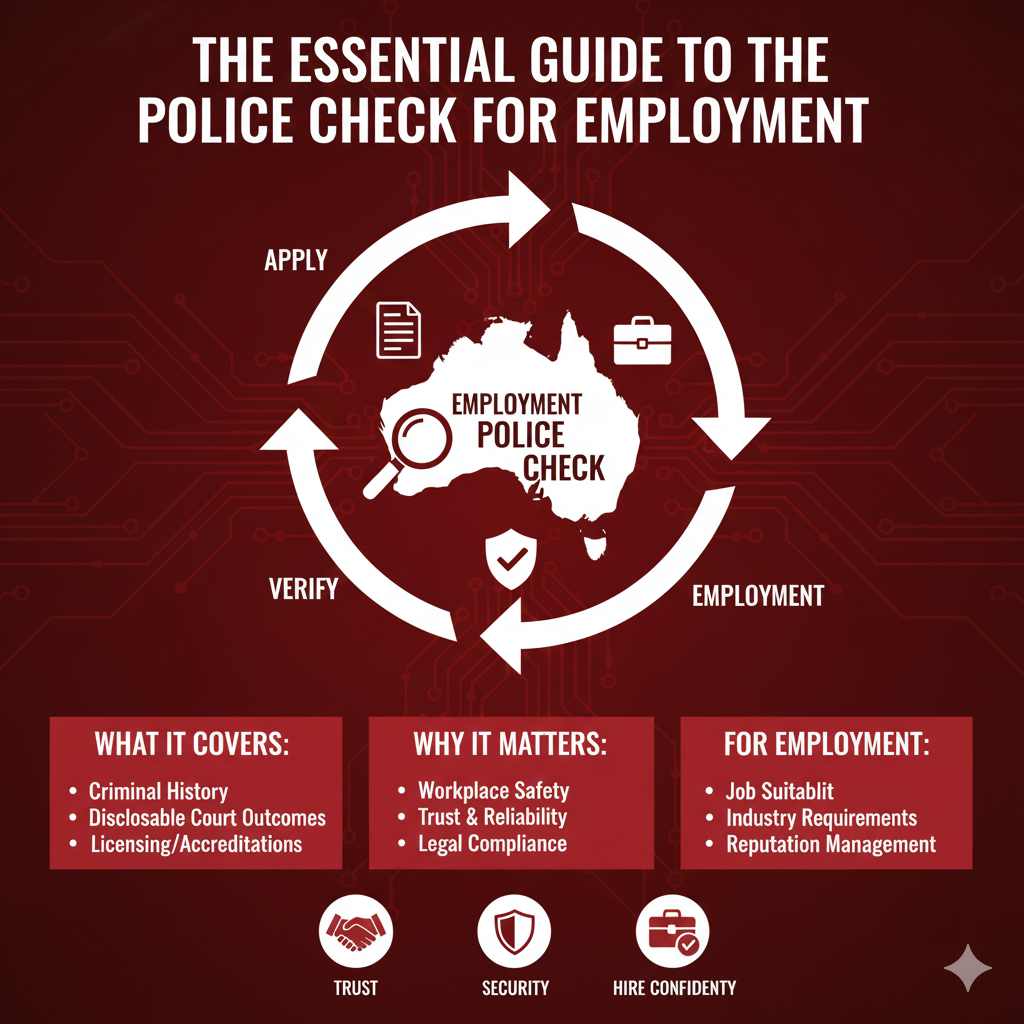
The Mandate for Trust
A police check for employment, formally known as a Nationally Coordinated Criminal History Check (NCCHC), is a standard and often mandatory part of the hiring process in Australia. It is the key document that employers use to verify a candidate’s suitability for a role, ensuring that they manage risks, maintain a safe workplace, and comply with specific industry regulations.
Job seekers must understand why employers require this check, how it works, and what it discloses to navigate the job market successfully. Today, the most efficient and reliable method to secure a police check for employment is through an ACIC-accredited online screening provider like Rapid Screening.
The Legal and Ethical Basis for the Police Check for Employment
Employers don’t request a police check arbitrarily; they do so based on a foundation of legal obligation, ethical duty, and risk management.
Legal Compliance and Due Diligence
In many high-risk sectors, the law mandates that employers request a police check for employment. This is particularly true in industries that serve vulnerable people. Examples include:
- Childcare and Education: State and Territory laws often require a check, sometimes in addition to a separate Working with Children Check (WWCC).
- Aged Care and Disability Services: Federal legislation, such as the Aged Care Act, requires police checks to protect residents.
- Financial Services: Licensing bodies may require checks to ensure the integrity of individuals handling client funds.
By conducting a police check for employment, an organisation fulfils its legal duty of care to its customers, clients, and employees.
Risk Management and Organisational Trust
Beyond legal mandates, a police check is a fundamental risk management tool. It allows employers to:
- Assess Relevance: Determine if a candidate’s history has any bearing on their ability to perform the duties of the role safely and ethically.
- Maintain Reputation: Protect the company’s integrity and public trust by ensuring high ethical standards among staff.
- Ensure Safety: Mitigate the risk of workplace theft, fraud, or harm to others.
The Modern Process: Securing Your Check Online
Gone are the days of paper forms and post office queues. The current process for obtaining a police check for employment is digital, secure, and fast.
Choosing an ACIC-Accredited Provider
The most important step is choosing an organisation accredited by the Australian Criminal Intelligence Commission (ACIC) to process the check. ACIC-accredited bodies, like Rapid Screening, have direct, secure access to the National Police Checking Service (NPCS) system, guaranteeing:
- National Validity: The certificate will be accepted by employers across every Australian state and territory.
- Compliance: The law requires the provider to uphold strict privacy and filtering rules, including applying Spent Convictions legislation.
An employer will usually direct an applicant to a preferred ACIC-accredited provider or conduct the check themselves through their legal entity account.
Digital Identity Verification (IDV)
A key innovation is the use of Digital Identity Verification. To meet the necessary 100-point check for a police check for employment, applicants simply upload scans or clear photos of identity documents.The system securely validates these documents against government sources, bypassing the need for in-person verification and speeding up the entire process.
Interpreting the Results: Understanding Disclosable Outcomes
The result of a police check for employment is not a simple ‘pass’ or ‘fail’; it is a report of Disclosable Court Outcomes (DCOs).
Disclosable Court Outcomes (DCO) vs. No Disclosable Court Outcomes (NDCO)
The certificate will show one of two results:
- No Disclosable Court Outcomes (NDCO): This means the system finds no police history, or it identifies history that state and federal laws deem not releasable.
- Disclosable Court Outcomes (DCO): This means the certificate lists convictions, findings of guilt, or pending charges that the law requires to be disclosed for the stated purpose of the check.
When assessing a DCO, employers must consider its relevance to the inherent requirements of the job. For example, a minor traffic offence from twenty years ago is unlikely to be relevant to a marketing role, but a recent fraud conviction would be highly relevant to a finance position.
The Impact of Spent Convictions Laws
The Spent Convictions Schemes across Australia govern the police check for employment process. This legislation automatically filters out certain older, minor convictions and prohibits their disclosure on the certificate.
This is a powerful protection designed to facilitate rehabilitation. Unless the job is specifically exempt, a spent conviction will result in an NDCO, and the employer will never see the record. Providing services not only in NT or SA but in entire Australia.
Tips for Job Seekers: Being Proactive
For job seekers, preparing for the police check for employment can give you a significant advantage in the hiring race.
1. Be Transparent with Employers
If you know you have a record that will be disclosable (a DCO), you should be upfront with the prospective employer before submitting the check. Being proactive and prepared with a professional, honest explanation demonstrates integrity and maturity. This can minimise the negative impact of an unexpected DCO appearing late in the hiring process.
2. Get Your Own Check First (Personal Check)
To eliminate any surprises and to expedite the hiring process, consider obtaining your own personal police check before you apply for jobs.
- Verify Your Record: See exactly what an employer will see.
- Reduce Onboarding Time: If your check is current, you can present it immediately upon request, allowing the employer to onboard you faster than candidates who must wait days for their check to process.
3. Ensure Details are Accurate
The most common cause of processing delays is inaccurate personal information or poorly uploaded identity documents. Double-check all names, dates of birth, and document expiry dates to ensure a smooth, quick submission.
Conclusion
The police check for employment is an essential and non-negotiable step in the Australian job market. By understanding its purpose, relying on an ACIC accredited online provider for speed and security, and being proactive about your own records, you can transform the process from a potential roadblock into a simple administrative step that confirms your suitability for the role. Choose the fast, compliant path to your next job by utilising an accredited online screening service.
Frequently Asked Questions (FAQs)
Q) How long does a police check for employment take?
For applications that result in a No Disclosable Court Outcome (NDCO), the system typically completes and returns the check in under one business day, often within minutes. If the application is flagged for manual review by police agencies, it can take between 10 and 15 business days, sometimes longer.
Q) Who pays for the police check for employment?
This varies. In many cases, the employer will cover the cost, particularly for checks conducted through their own accredited provider account. However, some organisations, particularly those hiring contractors or volunteers, may require the applicant to pay the fee upfront and later reimburse it.
Q) Can an employer legally ask me about my spent convictions?
Generally, no. The laws governing Spent Convictions are designed to protect you from discrimination based on irrelevant, old, minor offences. For most jobs, if the conviction is spent, it will not appear on the check, and you are legally entitled to act as if it never occurred. Only roles with specific legislative exemptions like those involving vulnerable people override this protection.
Q) How old can my police check for employment be?
Police checks do not have a formal expiry date, as they are a record at the date of issue. However, most employers and regulatory bodies require a check to be current’ which usually means it must have been issued within the last three to six months of the application date.