- Last updated:August 25, 2026
Tax season in Australia often brings a mix of confusion and opportunity. As we navigate the professional requirements of 2026, many workers find themselves juggling various compliance costs, from professional registrations to background clearances. One of the most common questions hitting our support inbox at this time of year is simple: can you claim police check on tax? Or more precisely, can you claim a police check on tax given your specific employment situation?
Background screening is a non-negotiable part of modern Australian life, especially in high-trust sectors like aged care, disability support, and education. While these checks are essential for safety, they do come with a cost. Understanding the Australian Taxation Office (ATO) guidelines on these expenses can help you maximise your refund and ensure you aren’t paying more for your professional compliance than you have to.
In this comprehensive guide, we will break down the Golden Rules of tax deductibility for police checks and help you determine if you are eligible for a deduction this financial year.
The ATO Rule of Thumb: Pre-Employment vs. Ongoing Compliance
The most important factor in determining if can you claim police check on tax is the timing of the expense. The ATO operates on a principle often referred to as the point too soon doctrine.
The Point Too Soon Doctrine (Not Deductible)
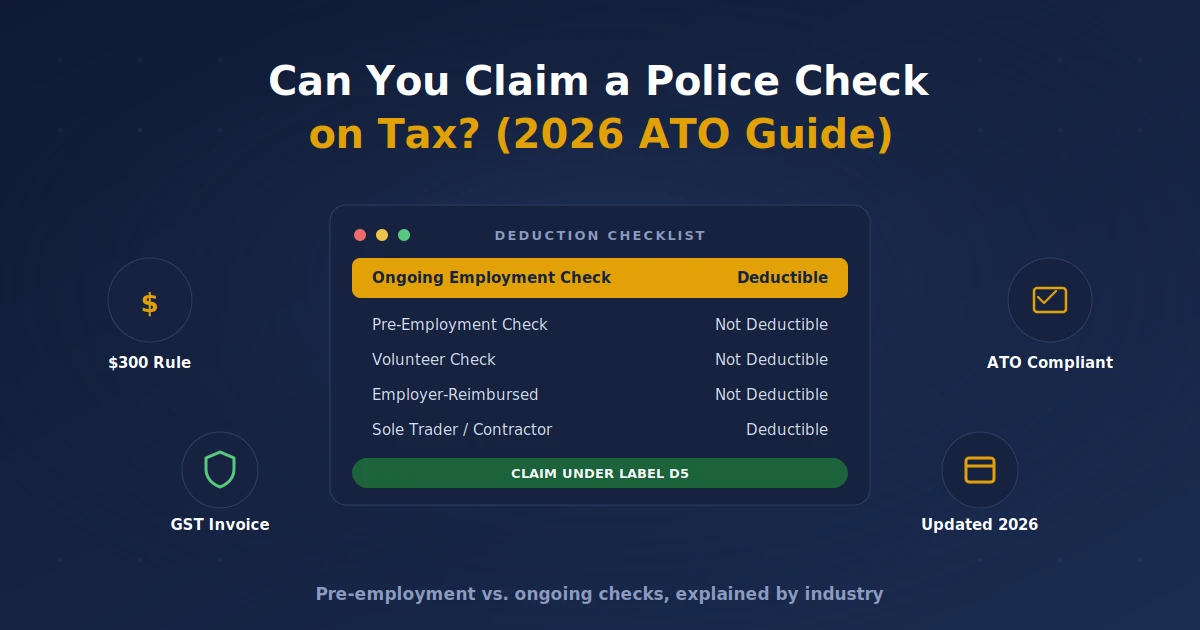
If you are currently looking for work and you pay for a National Police Check to add to your resume or as a prerequisite for a job application, the ATO generally views this as a private expense. Why? Because you incurred the cost to put yourself in a position to earn income, rather than incurring it while you were already earning that income. The tax office views pre-employment checks as occurring too early to be directly associated with your assessable income.
Ongoing Employment Requirements (Deductible)
The scenario changes significantly once you are already employed. If your current employer or industry regulator requires you to maintain a current clearance, meaning you have to pay for a renewal or a fresh check every one to three years, this cost is usually deductible. In this case, the expense is directly related to your ability to continue earning your current income.
Key Takeaway: If you’re getting a check to get a job, you likely can’t claim it. If you’re getting a check to keep your job, you likely can.
Industry Breakdown: Who Can You Claim Police Check on Tax For?
Certain industries have mandatory renewal cycles, making it much easier for workers in these fields to justify a tax deduction. Let’s look at how this applies to some of Australia’s most vital sectors.
| Industry | Typically Deductible When |
|---|---|
| Healthcare & Aged Care | Renewing an existing clearance to maintain AHPRA registration or current employment is especially relevant for aged care workers renewing annually. |
| NDIS & Disability Support | Refreshing an NDIS Worker Screening Check to continue working with participants |
| Education & Childcare | An active employee is required to obtain a fresh standard police check by their employer. See our educators and childcare compliance guide for the full picture |
| Transport & Rideshare | An already-active driver must renew a check to maintain platform status |
What You Cannot Claim: Common Pitfalls
While we all want to maximise our deductions, it’s important to stay within the ATO’s boundaries to avoid audits or penalties. Even if you are in a high-compliance industry, there are scenarios where you cannot claim the cost.
- Volunteer Checks: Many people undergo a police check to volunteer at a local sports club or charity. Because there is no assessable income associated with volunteer work, you cannot claim this expense on your tax return.
- Reimbursed Expenses: If you paid for the police check, but your employer paid you back, you cannot claim it as a deduction. You only claim what you are personally out of pocket for.
- Commuting and Private Use: If you obtained a police check for a private purpose, such as an adoption application or a personal visa (see the difference between an NCCHC and AFP check if you’re unsure which applies to you), it is strictly a private expense and not deductible.
How to Claim Your Police Check at Tax Time
If you’ve determined that you meet the criteria for a deduction, the next step is knowing where to put it on your tax return.
Label D5: Other Work Related Expenses
Most individuals will claim the cost of their police check under Other Work Related Expenses, in line with the ATO’s own guide to occupation and industry-specific deductions. This section is designed for miscellaneous costs like union fees, professional subscriptions, and, of course, background clearances.
The $300 Rule
The ATO allows you to claim up to $300 in total work-related expenses without needing formal receipts. However, since a police check usually comes with a clear digital receipt, it is always safer to keep the documentation regardless of your total claim amount.
How Much Is Your Deduction Actually Worth?
A deduction doesn’t mean you get the full cost back; it reduces your taxable income, and your actual benefit depends on your marginal tax rate. Using a real example: if you’re in the 32.5% tax bracket and claim a $51.73 employment police check renewal, your actual refund benefit is roughly $16.81, not the full amount. If you’re in the 37% bracket, it’s closer to $19.14. It’s a modest saving on its own, but it adds up when combined with your other work-related expenses, such as union fees, professional subscriptions, and renewal costs throughout the year.
How to Claim It on myTax
- Log in to myGov and open your myTax return.
- Go to Deductions → Work-related expenses → Other work-related expenses.
- Select D5 and enter a short description, e.g., “National Police Check renewal”.
- Enter the amount from your Rapid Screening tax invoice.
- If you’re a sole trader lodging through a tax agent or your own business schedule, this instead sits under your standard business operating expenses, not the individual D5 label.
Record Keeping: Why Your Rapid Screening Receipt Is Vital
The foundation of any successful tax claim is substantiation. If you are audited, the ATO will want to see proof that the expense was incurred. When you use Rapid Screening for your compliance needs, we provide a clear, GST-compliant tax invoice via email as soon as your payment is processed. For a full pricing breakdown, see our police check cost guide.
When wondering can you claim a police check on tax in Australia, having a digital paper trail is your best defence. We recommend:
- Saving the PDF Invoice: Create a “Tax 2026” folder in your email or cloud storage. Check our Fees & IDs guide if you need to confirm what documentation counts.
- Checking the Date: Ensure the date of the invoice falls within the correct financial year.
- Note the Purpose: On the receipt, it’s a good idea to jot down a quick note.
Conclusion: Simplifying Your Compliance Journey
Understanding the nuances of the tax system helps ensure that the cost of doing business in Australia doesn’t weigh you down. The answer to ‘Can you claim a police check on tax?’ essentially boils down to your current employment status. If you are a professional staying on top of your ongoing compliance, you are likely entitled to a bit of relief come July.
At Rapid Screening, we are committed to making the compliance process as fast and transparent as possible. By providing instant receipts and 2-4 hour turnaround times for 70% of our checks, we help you get back to work and back to what matters sooner.
Frequently Asked Questions (FAQs)
Q) Can you claim a police check on tax if you are a sole trader?
Yes. If you are a sole trader or contractor, the cost of a police check is a business operating expense. You would typically claim this as a business deduction rather than a work-related employee deduction.
Q) Can you claim a police check on tax if the job offer was rescinded?
Generally, no. If the job didn’t start, the expense remains pre-employment and doesn’t have a sufficient nexus to earn income. It is still considered a cost incurred in searching for work.
Q) What if my employer paid for the check directly?
If your employer paid the provider directly, you haven’t incurred an expense. Therefore, there is nothing for you to claim on your individual tax return.
Q) Does the ATO check these small deductions?
The ATO uses sophisticated data matching. While a single police check is a small amount, they look at other work-related expenses as a whole. Having your Rapid Screening receipt ready ensures you are prepared for any queries.
Q) Can I claim the GST component?
As an employee, you claim the total cost as a deduction. If you are a GST-registered business, you claim the expense as a deduction and claim the GST back as an input tax credit on your BAS.
Q) Can you claim a police check on tax if you need it for a promotion?
If you are moving to a new role within the same company and a new check is required for that promotion, this is often deductible because you are already in an established employment relationship with that employer.
Can you claim WWCC on a tax return?
Generally yes, under the same rules as a standard police check: if you’re renewing your WWCC to maintain your current employment, it’s typically deductible. If it’s your first WWCC as a condition of starting a new job, it’s treated as a pre-employment expense and isn’t deductible.
Can I claim NDIS screening check on tax?
Yes, if you’re an existing worker renewing your NDIS Worker Screening Check to continue in your current role. As with other checks, a first-time check to gain a new position isn’t deductible.
Can I claim up to $300 without receipts?
The ATO’s $300 rule applies to your total work-related expenses across the year, not $300 per item. Since a police check comes with a clear digital receipt anyway, it’s always worth keeping regardless of your total claim amount.
Can you claim police check on tax in Australia?
Yes, subject to the same rule that applies nationwide: if the check is for maintaining your current job, it’s typically deductible; if it’s for a new job, it isn’t.
Can you claim police check on tax nsw?
The rules are federal, so whether you’re asking can you claim police check on tax nsw or in any other state, the same ATO criteria apply. See our NSW police check guide for state-specific pricing.
Does it matter if I got my police check in Victoria?
No. Tax deductibility depends on federal ATO rules and your employment situation, not which state issued your check. If you’re in Victoria and want pricing and turnaround details, see our Victoria police check guide.
Stay Informed
Get updates on police check requirements and processing times, straight to your inbox.
Get Your Police Check Now