- Last updated:October 13, 2026
Quick Answer
Yes, a CV check is legit when a reputable Australian screening provider does it with your written permission. A CV check is a manual check of your resume: the provider contacts your past employers, your referees and the places you studied to confirm your details are true. Many employers also ask for a National Police Check, which is a separate check that only providers accredited by the Australian Criminal Intelligence Commission (ACIC), like Rapid Screening, can lodge. It costs $51.73 + GST, and 70% of results come back within 2 to 4 hours.
Been asked to do a CV check for a new job? It’s normal to feel a bit wary. You’re being asked to upload your passport, driver licence, and five years of addresses, often to a website you’ve never used before. This guide explains, in plain English, what a CV check is, why Aussie employers ask for one, how to spot a scam, and what it will cost you in time and money.
What Is a CV Check?
A CV check is a background check that confirms the details on your CV or resume are true. You might also hear it called a resume check, CV screening, CV checking, or a CV background check. Your new employer (or a company working for them) organises it, and it can’t happen without your permission.
A CV check is done by people, not a database. The provider’s team contacts your past employers, referees, and the places you studied to confirm what you’ve written. Depending on the job, it can include:
- Employment checks, confirming your past job titles and the dates you worked there
- A qualification check, confirming your degree, diploma, trade ticket or licence is real
- Reference checks, where your referees are contacted about your work
- A right to work check (VEVO), which confirms a visa holder is allowed to work in Australia. VEVO stands for Visa Entitlement Verification Online, the Department of Home Affairs system
Many employers also add a National Police Check, which shows any criminal history that can be released. That’s a separate check run through the national police system, not part of the CV verification itself.
Why Australian Employers Run CV Checks
Because a resume is written by the person applying, and not all of them are accurate. In a survey of more than 1,000 Australians by StandOut Resume, reported by the Australian Computer Society, 42.5% admitted they’d lied on a job application or in a job interview at least once.
| What Australians admitted lying about | Share of people surveyed |
|---|---|
| Lied on a job application or in an interview at least once | 42.5% |
| Why they left their last job | About 21% |
| Their work experience | About 20% |
| Their skills or qualifications | About 14% |
The fallout from a fake resume can be serious. In Australia, people have been sacked, struck off from their profession, and even convicted of a criminal offence for obtaining a financial advantage by deception. For employers, a CV check is a cheap way to avoid that risk. For honest job seekers, it means you’re not competing against someone who made things up. Our guide to false CVs and qualifications covers the most common warning signs.
Is a CV Check Legit and Safe?
Yes, as long as it’s done by a genuine Australian business, with your written permission, and the provider checks your details with the source: your past employers, your referees, and the institutions that issued your qualifications.
The CV check itself doesn’t go through any government database. It’s careful manual work, which is why it takes a few days rather than a few minutes. What makes it trustworthy is that the information comes straight from the people and institutions who can confirm it.
The police check is different. If your employer adds a National Police Check, only an organisation accredited by the Australian Criminal Intelligence Commission (ACIC) can lodge it. Around 147 organisations hold that accreditation, and the ACIC audits them. It’s a busy system: in the 2024-25 financial year, it handled more than 7.26 million police checks, the most since it started in 2012. Rapid Screening is one of those accredited providers, so it can do both the CV check and the police check for you.
How to tell if a CV check website is legit
- Check the business is real. The website should show a registered business name, an ABN (Australian Business Number) and an Australian address. You can confirm the ABN on the government’s ABN Lookup.
- Ask how they verify your details. A genuine provider contacts your past employers, referees and institutions directly. It shouldn’t just ask you to upload documents and call it verified.
- Read the consent form and privacy policy. You should be asked for written permission, and the provider should explain how it handles your information under the Australian Privacy Principles.
- If a police check is included, look the provider up on the ACIC list. The ACIC publishes an official list of accredited bodies. Only these organisations can legally lodge a police check.
- See the full price and give them a call. A legitimate provider shows the total cost up front and will answer your questions about turnaround times and refunds.
| Signs it’s legit | Red flags |
|---|---|
| Business name, ABN and Australian address on the website | No ABN and no Australian address |
| Contacts your employers, referees and institutions directly | Says your resume is “verified” without contacting anyone. |
| Asks for your written consent and has a privacy policy | No consent form, or vague about how your data is used |
| On the ACIC list, if it offers police checks | Offers police checks but isn’t on the ACIC list |
| Full price shown before you pay | A “free” check with a subscription hidden in the fine print |
| You start the application yourself | A text or email you weren’t expecting, with a link asking you to “complete a CV check” |
If something feels off, don’t click the link. You can report suspected scams to Scamwatch, run by the ACCC.
What Does a CV Background Check Include?
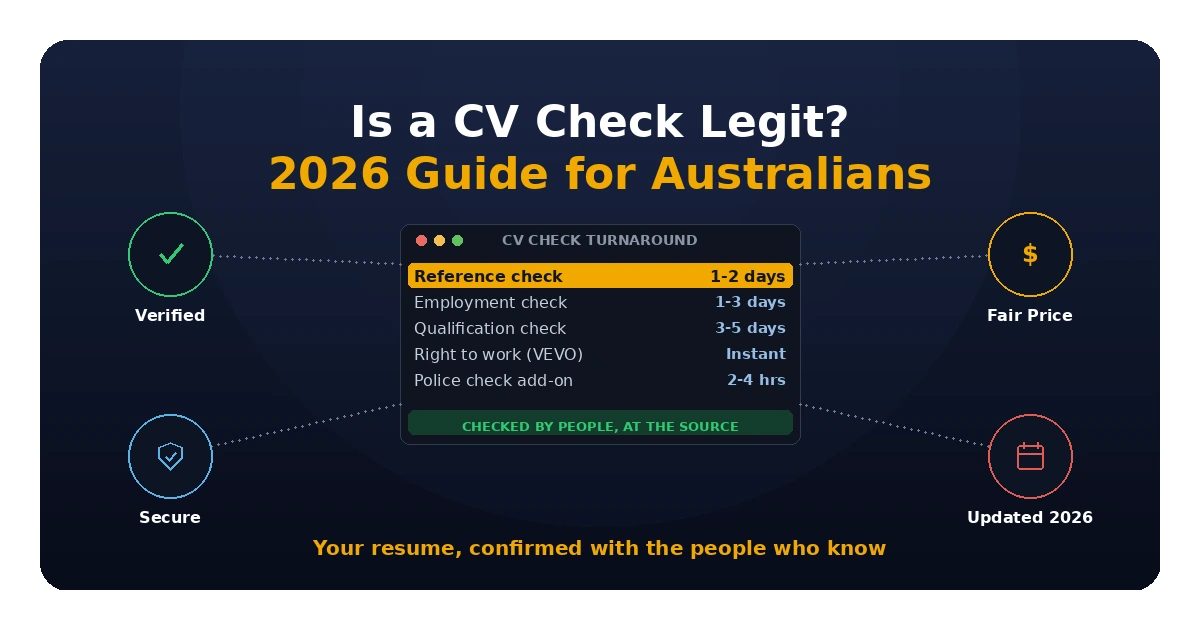
| Check | What it confirms | Usual turnaround |
|---|---|---|
| Employment check | Your past job titles and the dates you worked there | 1 to 3 business days |
| Reference check | Your work and conduct, from your referees | 1 to 2 business days |
| Qualification check | Degrees, diplomas, trade tickets and professional certificates | 3 to 5 business days |
| Right to work (VEVO) | That you’re allowed to work in Australia | Instant |
| National Police Check (optional add-on) | Criminal history that can be released, from every state and territory | 70% within 2 to 4 hours with Rapid Screening |
Employers can run all of these through one account. With Rapid Screening’s pre-employment packages, you get one link, fill everything in once, and the results all come back to the same place. For more detail, see what a pre-employment background check includes.
How Does a CV Check Work?
- Your employer asks for the check and tells you which checks they need.
- You give your permission and fill in an online form with your details, any previous names and your addresses for the last five years.
- You confirm your identity by entering your ID details.
- The checks are done by hand. The provider’s team contacts your past employers, referees and the places you studied. If a police check is included, it’s lodged separately through the national police check system.
- The results come back to you or your employer, depending on who ordered the check.
Reference checks are where things usually slow down, because they depend on how quickly your referees reply. A quick heads-up to your referees can save days. Our guide to conducting reference checks explains how employers keep this step moving.
How Long Does a CV Check Take?
Because a CV check is done by hand, it depends on how quickly your past employers, referees and institutions reply. As a guide, reference checks take 1 to 2 business days, employment checks 1 to 3, and qualification checks 3 to 5. Overseas institutions can take longer.
If a police check is added, it’s usually the quickest part. According to the ACIC, around 70% of police checks are finished within minutes.
The other 30% are sent to one or more police services to be checked by hand. That’s more than 7,000 checks a day across Australia, which is why some take longer.
Even those usually don’t take more than two weeks. In 2024-25, more than 98% of standard police checks were done within 10 business days, and more than 99% of urgent ones within 5.
With Rapid Screening, 70% of National Police Checks come back within 2 to 4 hours, and the rest take 1 to 15 business days. An AFP check (from the Australian Federal Police) takes longer, so allow 10 to 25 business days. Our guide on how long a police check takes explains what causes delays and how to avoid them.
How Much Does a CV Check Cost?
A police check has a set price. The other checks are usually quoted per person for businesses, because the cost depends on how many employers, referees and institutions need to be contacted.
| Check | Rapid Screening price |
|---|---|
| National Police Check (employment) | $56.90 inc. GST ($51.73 + GST) |
| Volunteer Police Check | $26.95 inc. GST ($24.50 + GST) |
| AFP Check | $72.90 (GST free, includes postage) |
| Reference, employment and qualification checks | Quoted for businesses, can be bundled with a police check |
| Right to work (VEVO) check | Quoted for businesses |
If you just need the police check, you can order a National Police Check online in a few minutes.
CV Check ID Requirements
For a police check, you’ll need 100 points of ID. That’s usually one main document, like an Australian passport or a full birth certificate, plus other documents like your driver licence or Medicare card. Your name needs to match across your documents, so have your marriage certificate or change of name certificate handy if your name has changed. Our guide to what documents are needed for a police check shows which combinations add up to 100 points.
Doing a CV Check Online in NSW and Other States
A National Police Check covers every state and territory, so the process is the same whether you’re in Sydney, Perth or Hobart. One check works Australia-wide. The only exception is if you need a check for a visa or Australian citizenship. In that case, you need an AFP check instead.
If your new job involves working with children, you’ll usually also need a Working with Children Check from your state or territory. That’s a separate check from a police check.
Your Rights During a CV Check
- Nothing happens without your permission. An employer can’t run a police check without your written consent.
- You can see and fix your information. Under the Australian Privacy Principles, you can ask the provider what information it holds about you and ask for mistakes to be corrected. If you’re not happy with how it’s handled, you can complain to the Office of the Australian Information Commissioner (OAIC).
- You can dispute a result. If you think your police check result is wrong, the provider has to help you lodge a dispute with the police.
- Some old offences won’t show up. Spent convictions laws mean many older, minor convictions aren’t released after a set period. See our guide to spent convictions in Australia.
Is a CV Check the Same as a Resume Checker?
No. If you searched “free resume check” or “check my CV”, you might be after a tool that reviews how your resume is written, or how well it gets through the software (ATS) many employers use to sort applications. That’s a writing tool for job seekers. A CV check for a job confirms the facts; it doesn’t mark how well your resume is written. For help with the writing side, see our guide to writing a winning resume.
Frequently Asked Questions
Is a CV check legit?
Yes, when a genuine Australian screening provider does it with your written permission and confirms your details directly with your past employers, referees and institutions. If a police check is included, the provider must also be on the ACIC’s list of accredited bodies.
Is a CV check safe?
Yes, if you use a genuine provider’s official website. The main risk is scam texts, emails and fake websites, so start the application yourself, never email photos of your ID, and check the business has an ABN and a privacy policy.
What is a CV check in Australia?
It’s a background check that confirms the details on your resume, such as your criminal history, work history, qualifications, referees and right to work in Australia.
How does a CV check work?
Your employer asks for the check, you give permission, fill in an online form and confirm your ID. The provider’s team then contacts your past employers, referees and the places you studied to confirm your details. If a police check is included, it’s lodged separately through the national system.
How long does a CV check take?
Usually a few business days, because it’s done by hand. Reference checks take 1 to 2 business days, employment checks 1 to 3, and qualification checks 3 to 5. If a police check is added, 70% come back within 2 to 4 hours with Rapid Screening.
How much does a CV check cost?
A National Police Check through Rapid Screening costs $56.90 including GST. Reference, employment and qualification checks are usually quoted per person for businesses and can be bundled with the police check.
Is a CV check a police check?
No. A CV check is a manual check of your work history, qualifications and referees. A National Police Check is a separate check of your criminal history, lodged through an ACIC-accredited provider. Many employers ask for both.
How long is a CV check valid for?
A police check doesn’t have an official expiry date, because it only shows your record on the day it was done. Most employers only accept one issued in the last 12 months. Work history and qualification checks show the facts on the day they were checked.
Can an employer do a CV check without my permission?
No. A police check needs your written consent, and good providers ask your permission before contacting your referees, past employers or the places you studied.
What is the fastest way to get a police check?
Apply online through an ACIC-accredited provider. With Rapid Screening, 70% of National Police Checks come back within 2 to 4 hours. Applying in person or by post is usually slower.
Is a police check the same as a crime check?
Yes. “Crime check”, “police check”, “police clearance” and “National Police Check” all usually mean the same thing: a Nationally Coordinated Criminal History Check.
Can I use a CV check for a visa?
Only an AFP check. The Department of Home Affairs needs an Australian Federal Police check for visas and citizenship, not a standard National Police Check.
Do employers check CVs for AI?
Some employers use software to sort and rank resumes, and some keep an eye out for generic, AI-written wording. A CV check is different. It checks the facts in your resume, like dates, qualifications and referees, no matter how the resume was written.
Conclusion
So, is a CV check legit? Yes, as long as a genuine Australian provider does it with your permission and checks your details with the people and institutions who can confirm them. With more than 40% of Australians admitting they’ve stretched the truth on a job application, CV checks are now a normal part of getting hired. Before you start, make sure the business has an ABN and a privacy policy, check the price and turnaround, and, if a police check is included, confirm the provider is on the ACIC list. Rapid Screening does both: a manual CV check, and a National Police Check that usually comes back within hours for $56.90.
Stay Informed
Get updates on police check requirements and processing times, straight to your inbox.
Get Your Police Check Now