Navigating the requirements for a background check can often feel like a complex puzzle. Whether you are applying for a new job, seeking a volunteer position, or fulfilling visa requirements, understanding what documents are needed for police check Australia is the first and most crucial step. In Australia, the process is highly regulated to ensure the highest standards of security and identity verification. This guide provides a comprehensive breakdown of the identification requirements mandated by the Australian Criminal Intelligence Commission (ACIC) and the Australian Federal Police (AFP), ensuring your application is processed swiftly and without hitches.
What is the 4 Document Rule for a Nationally Coordinated Criminal History Check?
When applying through an ACIC-accredited body like Rapid Screening, you must adhere to a specific 4 document rule. This framework is designed to establish a digital breadcrumb trail of your identity in Australia. The ACIC requires a combination of documents from four distinct categories to verify who you are. Failing to provide the correct combination is the most common reason for application delays. We also provide services in other states such as VIC and QLD.
What are the four categories of required documents?
To satisfy the identity requirements, you must provide one document from each of the first two categories and two from the third. Specifically, you need:
1. Commencement of Identity Document: To establish your birth or arrival in Australia.
2. One Primary Use in the Community Document: To show your identity is active in the Australian community.
3. Two Secondary Use in the Community Documents: To further corroborate your identity through various official records.
What Documents Qualify as Commencement of Identity?
The commencement document is the foundation of your identity profile. It proves your legal right to be in Australia. For most applicants, this is the most critical document to locate before starting the online application.
What are common examples of commencement documents?
The most widely accepted commencement documents include:
•Full Australian Birth Certificate: Must be a full certificate, not an extract or a commemorative version.
•Current Australian Passport: Even if you were born overseas, a current Australian passport serves as a commencement document.
•Australian Citizenship Certificate: For those who have naturalised.
•Valid Australian Visa: This can be a VEVO (Visa Entitlement Verification Online) printout or a visa label in a foreign passport.
•ImmiCard: Issued by the Department of Home Affairs to certain visa holders.
What Documents Are Considered Primary Use in the Community?
Once your commencement is established, you need a Primary document. This category focuses on government-issued identification that you use in your daily life within Australia. These documents almost always require a photograph of the applicant.
What are the most used primary documents?
Most Australians use one of the following as their primary document:
•Australian Driver’s Licence: This is the most common primary document. It must be current and can be a learner’s permit or provisional licence.
•Current Foreign Passport: Must be accompanied by a valid Australian Visa (which would have been your commencement document).
•Proof of Age Card: Issued by a state or territory government agency.
•Shooter or Firearm Licence: Must be a current, full licence.
•Student Identification Card: For applicants under 18, a current school ID with a photo and signature is often acceptable.
What Are Secondary Use in the Community Documents?
The final piece of the puzzle involves providing two secondary documents. These are used to verify that your identity is consistently used across different sectors of society, such as healthcare, finance, or government services.
What secondary documents can I provide?
There is a broad range of acceptable secondary documents, making this category the most flexible. Common examples include:
•Medicare Card: A staple for almost all Australian residents.
•Australian Electoral Commission (AEC) Enrolment: Proof that you are registered to vote.
•Bank Card or Credit Card: Only the front of the card is needed; ensure your name matches your other IDs.
•Working with Children Check (WWCC) Card: Or a similar vulnerable person’s check card.
•Government Agency ID Card: Such as a tertiary student ID or a public service ID.
•Utility Bill: A recent (less than 3 months old) electricity, gas, or water bill showing your current residential address.
How Do Document Requirements Differ for an AFP Check?
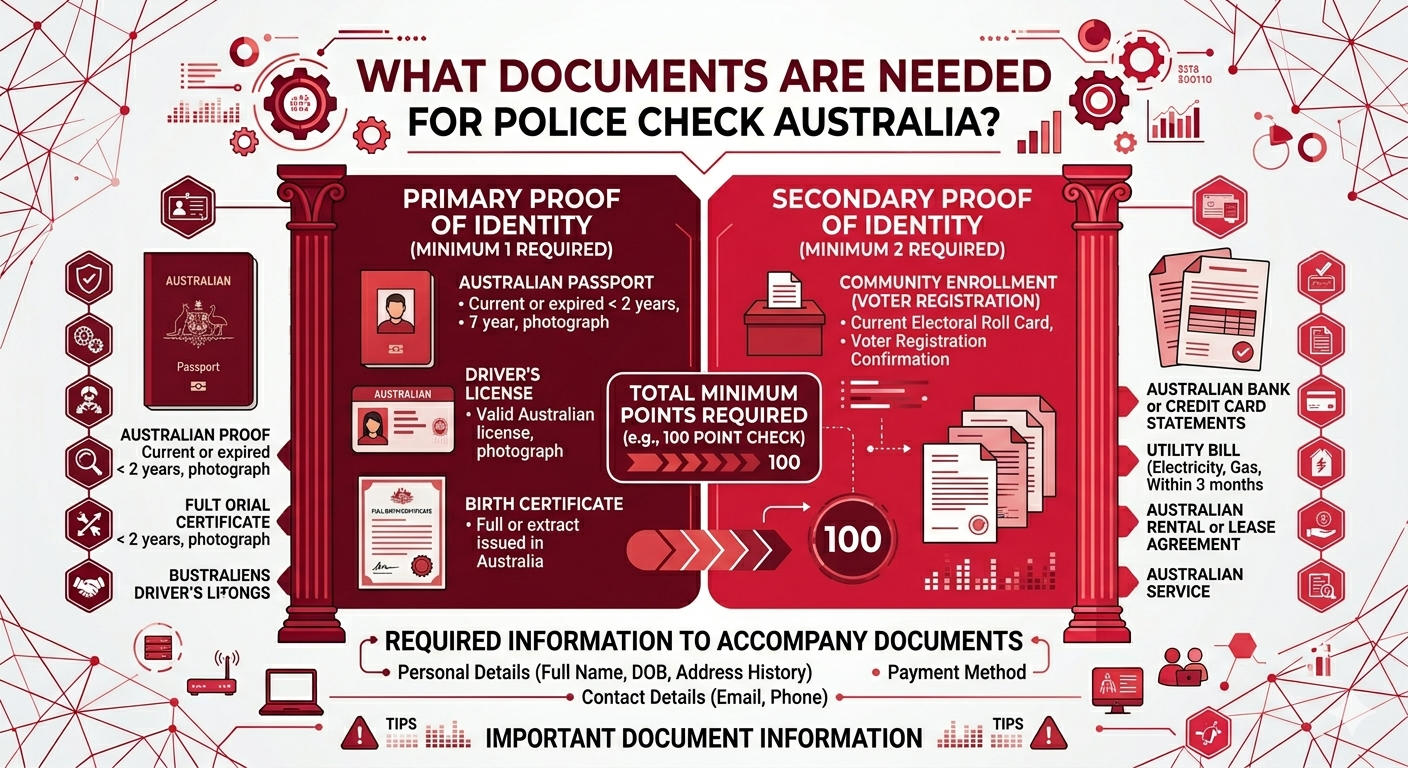
While the ACIC-coordinated check uses the 4-category system, the Australian Federal Police (AFP) often use a 100-point system for their National Police Certificates. It is vital to know which check your employer or the Department of Home Affairs requires, as what documents are needed for police check Australia question has a slightly different answer for the AFP.
What is the 100-point ID system?
The AFP system assigns points to different documents. You must reach a total of at least 100 points. For example:
•70 Points: Birth Certificate, Citizenship Certificate, or Passport (Primary documents).
•40 Points: Driver’s Licence, Public Service ID, or Tertiary Student ID (Secondary documents with photo).
•25 Points: Medicare Card, Credit Card, or Utility Bill (Supporting documents).
| Document Type | ACIC Category | AFP Points (Approx) |
| Australian Passport | Commencement | 70 Points |
| Driver’s Licence | Primary | 40 Points |
| Medicare Card | Secondary | 25 Points |
| Utility Bill | Secondary | 25 Points |
What If I Have Changed My Name?
If the names on your documents do not match, for example, if you have married or changed your name by deed poll, you must provide additional evidence. This is a critical part of what documents are needed for police check Australia process to ensure all records are correctly linked to you.
What documents prove a change of name?
You will need to provide an official linking document, such as:
•Marriage Certificate: Issued by a state or territory Registry of Births, Deaths and Marriages (church-issued certificates are generally not accepted).
•Change of Name Certificate: Issued by an Australian Registry of Births, Deaths and Marriages.
•Divorce Decree: If you have reverted to a maiden name.
Why Is a Selfie Often Required During the Process?
In the digital age, simply uploading scans of documents isn’t enough to prevent identity fraud. Most accredited providers, including Rapid Screening, now require a Selfie or a Liveness Check. This involves taking a photo of yourself, often while holding one of your primary ID documents. This ensures that the person applying is the same person pictured on the identification provided.
Conclusion
Understanding what documents are needed for police check Australia is the key to a stress-free application. By preparing your one commencement, one primary, and two secondary documents in advance, you can complete your online application in minutes. At Rapid Screening, we leverage advanced technology to verify these documents instantly, with 70% of our checks returned within just 2 to 4 business hours. Don’t let missing paperwork delay your career or volunteer goals; gather your IDs today and get started with Australia’s fastest police check service.
Frequently Asked Questions (FAQs)
1. Can I use an expired passport for my police check?
Generally, no. For a Nationally Coordinated Criminal History Check, your passport must be current. However, some providers may accept an Australian passport that has expired within the last two years for certain categories, but it is always safest to use valid, current identification.
2. What documents are needed for police check Australia if I am a New Zealand citizen?
New Zealand citizens can use their current NZ Passport as a primary document. For the commencement category, they can often use their VEVO record, which shows their Special Category Visa (subclass 444) granted upon entry to Australia.
3. Is a digital driver’s licence accepted?
Yes, most accredited bodies now accept screenshots or PDF exports of digital driver’s licences (like those from Service NSW or VicRoads), provided all details, including the photo and address, are clearly visible.
4. Do I need to get my documents certified by a JP?
If you are applying online through an accredited body like Rapid Screening, you typically do not need certified copies. Our secure platform uses Document Verification Service (DVS) technology to verify your IDs against government records in real-time.
5. What if I don’t have a birth certificate or passport?
If you cannot meet the standard 4-document requirement, you should contact your police check provider. There are special provisions for certain groups (such as recent arrivals, young people, or those in remote areas) that allow for alternative document combinations.
6. Can I use the same document for two different categories?
No. Each of the four required documents must be a separate, distinct item. For example, you cannot use your passport as both your commencement and your primary document. You would need a different photo ID, like a driver’s licence, for the primary category.
7. What documents are needed for police check Australia for a volunteer check?
The document requirements for a volunteer check are exactly the same as for an employment check. The only difference is usually the cost of the check, which is often discounted for volunteers, but the identity verification standards remain the highest possible.
Stay Informed
Get updates on police check requirements and processing times, straight to your inbox.
Get Your Police Check Now