- Last updated:September 24, 2026
Quick answer: To avoid delays in your police check, submit your full legal name (including all previous names), a complete five-year address history with no gaps, and a clear, high-resolution ID photo. Around 30% of applications are flagged for manual review, and the large majority of those flags are caused by avoidable data entry issues rather than an actual criminal history match.
In the fast-paced Australian job market, your police check is often the final gatekeeper between you and a new role. Whether you’re applying for a position in healthcare, finance, or government, the speed of your background screening can make or break your start date. While most checks are returned within hours, a meaningful minority run into frustrating hold-ups. Knowing how to avoid delays in your police check is a genuinely useful skill for any job seeker or HR professional.
The National Police Checking Service (NPCS) is a highly efficient, automated system, but it isn’t infallible. Small errors in your application or a complex personal history can push the process from hours into weeks.
Why Do Police Check Delays Happen?
The process isn’t a simple yes/no lookup. It involves matching your personal details against millions of records held by state and territory police jurisdictions across the country.
1. The Manual Review Referral
Approximately 30% of police check applications are flagged for manual review. This happens when the automated system finds a potential match between your details and a record in the database. It doesn’t necessarily mean you have a criminal record. It could be a false positive caused by:
- Having a common name.
- Sharing a date of birth with someone who has a record.
- Having a similar address history to a person of interest.
2. Data Entry Errors
The most common delay cause within your control is incorrect data entry. Even a single typo in your middle name or a wrong digit in your date of birth can cause the system to stall.
3. Incomplete Address History
The NPCS requires a full five-year address history. Gaps in your timeline, or vague addresses, can flag your application for further investigation.
Top Strategies to Avoid Police Check Delays
If you’re in a hurry, these proven strategies give your application the best chance of sailing straight through the automated system.
1. Double-Check Every Detail
Accuracy is the single biggest factor. Before you submit, review your application line by line.
Names: Use your full legal name exactly as it appears on your birth certificate or passport. Don’t use nicknames or shortened versions.
Previous names: Disclose every previous name, including maiden names, former married names, or names changed by deed poll.
Date of birth: Double-check the day, month, and year are correct.
2. Provide High-Quality ID Documents
The Document Verification Service (DVS) verifies your ID in real time. If your ID photo is blurry, cropped, or has glare, the DVS check fails, and a human has to manually verify your documents instead, adding days to your turnaround.
3. Be Precise With Your Address History
When the system asks for five years of address history, it means exactly that.
Include the unit number, street number, street name, suburb, state, and postcode for each address. If you lived overseas during the last five years, include those international addresses too.
Common Mistakes and How to Fix Them
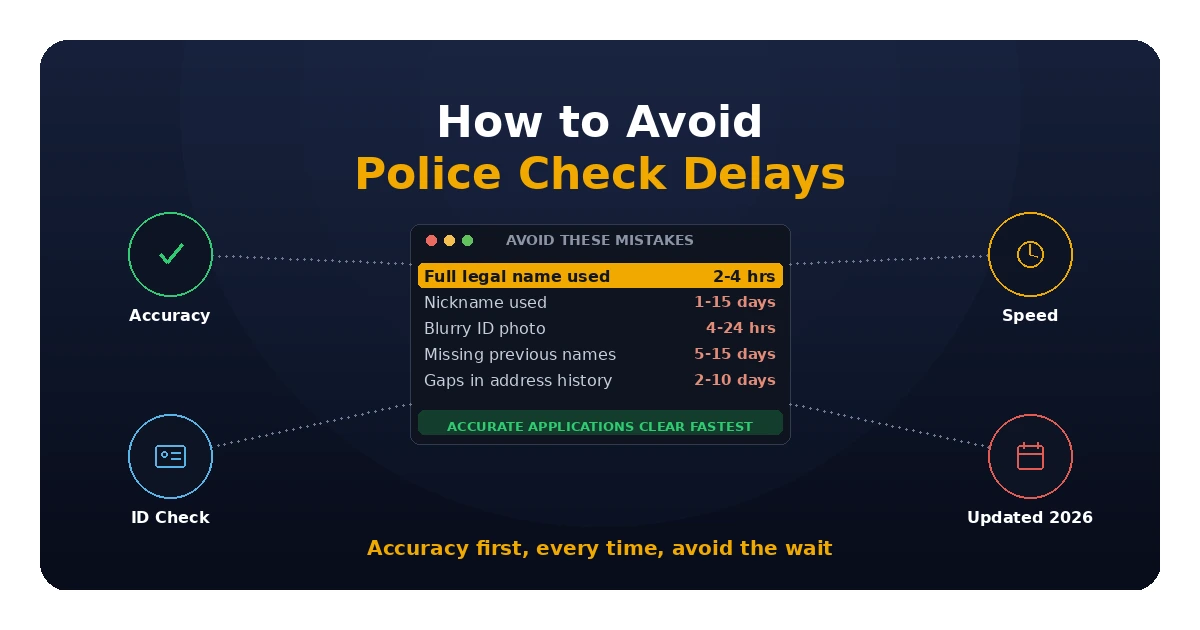
| Common Mistake | Impact on Turnaround | Fast-Track Solution |
|---|---|---|
| Using a nickname | 1-15 business days (manual review) | Use your full legal name exactly as it appears on your ID |
| Blurry ID photo | 4-24 hours (manual ID check) | Use a high-resolution photo with no glare |
| Missing previous names | 5-15 business days (police referral) | Disclose every name you’ve ever been known by |
| Gaps in address history | 2-10 business days (investigation) | Provide a continuous 5-year history with no gaps |
| Applying via post office | 10-20 business days (postal delay) | Use an ACIC-accredited online provider |
Why Online Accredited Providers Are Faster
A major factor in avoiding delays is the platform you apply through. Traditional methods, like applying via the post office, are consistently the slowest option. ACIC-accredited bodies like Rapid Screening have direct, secure API links to the National Police Checking Service, which means:
Instant submission: Your application reaches the police database the moment you finish it.
Real-time ID verification: The DVS verifies your identity in seconds, not days.
Automated notifications: You’re alerted immediately if there’s an issue, so you can fix it before it causes a major delay.
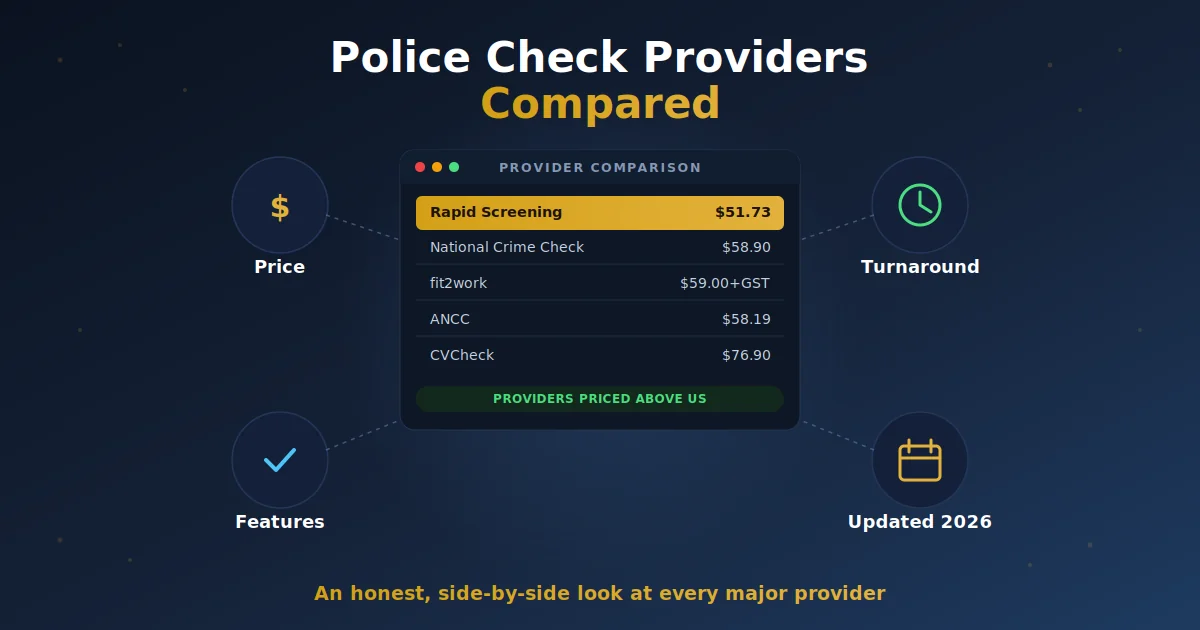
For a full breakdown of how different accredited providers compare on speed and price, see our police check providers comparison.
High-Demand States: Western Australia and Queensland
In states like Western Australia and Queensland, there’s constant high demand for site-ready clearances. Rapid Screening is built to handle this volume, helping workers get to the site without unnecessary waiting.
The Role of False Positives in Delays
One of the most frustrating parts of background screening is dealing with things outside your control, like having a common name. If your name is “David Jones”, there’s a real chance someone else with that name has a criminal record.
When this happens, the system can’t automatically clear you. It sends your file to a police officer, who compares your other details against the person with the record. You can’t change your name, but providing as much supporting detail as possible, such as your place of birth, helps the officer clear the false positive faster.
Advice for HR Managers
If you’re an employer or HR manager, your goal is getting new hires started as quickly as possible. A structured screening process is the best way to ensure consistency and speed.
1. Standardise the Onboarding Checklist
Give candidates a clear list of what they need before starting their application, including acceptable ID documents and a reminder to have their five-year address history ready.
2. Use a Centralised Dashboard
A provider like Rapid Screening lets you manage every employee check from one dashboard, so you can track status in real time, spot which candidates are lagging, and receive results instantly as they clear.
3. Educate Candidates on the Process
Many candidates don’t realise they’re the ones most likely to cause a delay. A short email explaining how to avoid police check delays, emphasising accuracy and ID quality, can meaningfully reduce your time-to-hire.
Typical Timeframes by Scenario
| Scenario | Estimated Timeframe | Action Required |
|---|---|---|
| Standard online application | 2-4 hours (70% of cases) | None – results delivered via email |
| Manual review (false positive) | 1-10 business days | Wait for police verification – no action needed |
| Manual review (complex history) | 5-15 business days | Police may request further information |
| ID verification issue | 1-2 business days | Re-upload a clear ID photo |
| Incomplete application | Indefinite | Complete the missing sections |
The Real Cost of a Delay
A delay costs more than just time. For a job seeker, a two-week delay can mean two weeks of lost wages. For an employer, it can mean a stalled project or an understaffed healthcare facility.
A few extra minutes spent getting your application right the first time is the cheapest insurance against exactly that outcome.
Frequently Asked Questions
Why is my police check taking so long?
The most common reasons are a manual review referral (about 30% of applications), a data entry error, or an incomplete address history. Most delays are caused by something fixable in the application itself, not an actual criminal record match.
Can you speed up a police check?
You can’t pay to skip a manual review once it’s underway, since it’s a government-controlled queue. The real way to speed things up is preventing the referral in the first place by double-checking your details and using a high-quality ID photo before you submit.
What is the quickest way to get a police check?
Apply through an ACIC-accredited online provider with a fast, automated processing system, rather than by post or in person. Rapid Screening returns 70% of standard applications within 2-4 hours.
How long does it take to process an Australian police check?
Most standard applications are processed within 2-4 hours. The roughly 30% referred for manual review can take anywhere from 1 to 15 business days, depending on the complexity of the match.
What should I do if my police check is delayed?
Wait for the manual review to complete. If you’re concerned something specific is wrong, such as a data entry error you’ve noticed after submitting, contact your provider directly. If your application hasn’t yet reached the police database, they may still be able to correct it.
Can I pay extra to fast-track a manual review?
No. Once an application is referred to the police for manual review, it enters a government-controlled queue that no provider can pay to skip. The best way to “fast-track” is to make sure your application is accurate enough not to be referred in the first place.
Why is my friend’s check faster than mine?
Turnaround depends on individual history. A unique name and a simple address history are more likely to clear automatically. A common name or a history across multiple states is more likely to trigger manual review.
Do I need to provide my middle name?
Yes. Provide your full legal name exactly as it appears on your identity documents. Omitting a middle name is a common cause of a manual review referral, since it makes it harder for the system to distinguish you from others with the same first and last name.
Does living overseas cause a delay?
Not necessarily. You must provide your international addresses for the last five years, but the Australian police check only searches Australian criminal records. Identity verification may take slightly longer if you’re using an international passport.
Is a police check from the post office the same as an online one?
The final certificate is identical. The application process itself is significantly slower at the post office, due to manual data entry and physical document handling. If avoiding delays matters to you, applying online is almost always the better option.
Conclusion
Avoiding delays in your police check comes down to one thing: accuracy. Double-check your names, be precise with your address history, and provide the highest-quality ID photo you can. Combine that with an ACIC-accredited online provider, and what could be a weeks-long wait becomes a matter of hours.
Stay Informed
Get updates on police check requirements and processing times, straight to your inbox.
Get Your Police Check Now