
Industries New
Industry Screening Solutions | Rapid Screening Industry Solutions Pre-employment screening built foryour industry Police checks, right to work, qualification verification, credit checks and more — all in one platform. Select your sector below to see how Rapid Screening works for you specifically. ACIC Accredited · VEVO Integrated · 100% Australian operations · 98% of checks returned within 12 hours Our Industries Screening solutions tailored to your sector Every industry has different compliance obligations, check types and workforce needs. Click your sector to see exactly how we help. Recruitment & HR Agencies High volume Speed up candidate onboarding with fast turnarounds and a platform that handles all check types in one place — including a partnership programme with agency pricing and referral rebates. Police checks Right to work & VEVO Employment references Qualification verification Explore solutions Healthcare & Aged Care Mandatory compliance Meet mandatory compliance obligations across the Aged Care Act, NDIS standards and AHPRA requirements — with fast turnarounds that don’t leave shifts uncovered. Police checks AHPRA registration verification NDIS Worker Screening Qualification verification Explore solutions Education & Childcare WWCC & compliance WWCC, police checks and qualification verification — bundled in a single candidate invitation. One of the only providers to offer all three together, covering every state and territory. Working with Children Check Police checks Qualification verification Volunteer screening Explore solutions Finance & Professional Services Regulatory compliance Credit checks, police checks and qualification verification — bundled for ASIC-regulated roles, legal practices and accounting firms. Full audit trail for regulatory reviews. Credit & financial history checks Police checks Qualification verification Employment references Explore solutions Construction & Infrastructure Growing requirements Screen your full workforce — employees and subcontractors alike. Bulk invitations, VEVO right to work and audit-ready records for head contractor and government project compliance. Police checks VEVO right to work Subcontractor bulk screening Employment references Explore solutions Don’t see your industry?We cover a lot more. Our platform handles pre-employment screening across virtually every Australian industry. Whatever your sector, we can configure the right package of checks for your compliance obligations and workforce type. NDIS & disability services Transport & logistics Hospitality & retail Government & public sector Not-for-profit & community Security & facilities management Need a custom screening package? Our General Manager is happy to walk through the specific checks your industry requires and configure a package that fits — including pricing that scales to your volume. Set Up a Business Account Speak to Our General Manager ACIC Accredited Fully accredited by the Australian Criminal Intelligence Commission for nationally coordinated criminal history checks. 100% Onshore All operations, team and data are in Australia. No offshore processing of candidate data — ever. 12-Hour Turnaround 98% of checks returned within 12 hours. Results when you need them — not days later. Dedicated Account Manager One Australian-based contact for your account. Direct line — not a call centre or ticket queue. Ready to get started? Set up a business account today or speak with our General Manager — we’ll configure the right screening package for your industry, volume and compliance requirements. Set Up a Business Account Speak to Our General Manager Rapid Screening is fully accredited by the Australian Criminal Intelligence Commission (ACIC) and integrated with the Department of Home Affairs VEVO system. All operations onshore in Australia. ABN: 63 612 155 987 ACIC Accredited VEVO Integrated Privacy Act Compliant 256-bit Encryption
Legally Hire Foreign Workers with Full Compliance Checks

Foreign workers are increasingly being hired in Australia. For instance, the health sector and construction sector import a lot of foreign workers for these industries. Hospitality is also another sector that sources foreign workers for hotels, restaurants, and tourism sectors. However, businesses must conform to federal and state legal requirements in the hiring of overseas workers; otherwise, the business will attract heavy penalties. Lastly, legal compliance in hiring foreign workers in Australia involves not only checking the statuses of their visas but also checking a right-to-work authority, such as a police check NSW or police check WA. It also involves checking your employees’ status against visa conditions through services like Rapid Screening. In this step-by-step guide, we’ll be taking you through the necessary steps required to ensure your business is compliant with the laws of Australian immigration and how services like Rapid Screening can make this process as smooth as possible. Why Is Legal Compliance Crucial for Hiring Foreign Workers? Legal compliance on hiring foreign workers in Australia is necessary for very important reasons. These reasons include protecting business from heavy penalties, either in the form of fines or criminal charges. It also ensures that businesses gain the respect of their people and in some fields such as healthcare and education, ensure well-needed compliance. Last but not least, it is an ethical responsibility to treat the foreigners working for one fairly and legally. Key Legal Hiring Requirements of Overseas Employees There are many legal requirements a business follows in hiring foreign workers in Australia, that is, from checking for visas to police checks, especially in states such as NSW and WA. Right to Work Checks (VEVO) The Visa Entitlement Verification Online (VEVO) system is the principal tool that businesses have to rely on to confirm the work rights of foreign nationals. VEVO is an online check that employers can undertake to verify the visa status of any prospective employee to ensure that they are legally permitted to work in Australia. Rapid Screening provides businesses with efficient, fast VEVO checks to ensure that employers hire employees with the proper visa entitlement. This avoids unwitting hiring by incompetent employers who do not familiarize themselves with the relevant visa entitlements. Employer Requirements Besides the above, the businesspersons have to obey the Migration Act 1958 about the rights and liabilities of employers about the employment of foreign nationals. Not being able to demonstrate whether or not the working conditions of a particular worker conform with visa issues can lead to a very high fine or even imprisonment. The employers must: Be able to demonstrate that the foreign worker holds a proper visa; be able to demonstrate that conditions with his visa, such as the times he is working or where he is allowed to work, are respected. Keep records of work status and visa checks. It is where Rapid Screening provides real worth in ensuring that businesses are updated with no administrative hassle. NSW Police Check and Police Check WA Depending on the industry, hiring foreign workers in Australia may be subjected to producing police checks. Industries such as healthcare, education, and a host of others would mandatorily require police checks to be produced by both local and foreign workers to validate their backgrounds. NSW Police Check: Certain categories or sectors, such as aged care, child protection, and health, in New South Wales require the Australian or foreign worker to hold a valid NSW police check. Police Check WA: Similarly, in Western Australia, for hiring foreign workers in Australia, education, health, and public services sectors need Police checks in WA. Rapid Screening makes it easy with their verification services, which include also these checks. Steps to Compliance with the Legal Hiring of Foreign Employees Verify Work Rights The most important thing that can be done for compliance is the doing of work rights verification through VEVO. It will enable you to cross-check with regard to the type of visa, working restrictions, and the expiry date of the visa. You must ensure to check all these things before actually offering the person a job as it would save you from the legal risks. It is easy to access VEVO. Either direct access or services such as Rapid Screening can be undertaken by ensuring accuracy and efficiency in the process. Industry-Specific Requirements Compliance processes while hiring foreign workers in Australia are industry-specific. For example, the health sector in NSW would require a more strict process of police checks and issuing work permits than the construction industry in WA. Rapid Screening shall help obtain the right compliance process by an industry. Conduct Police Checks (NSW, WA) The worker presents a current NSW police check if he or she is employed in New South Wales. The worker presents a current police check WA if he or she is working in Western Australia. Failure to perform these checks may result in penalties for non-compliance. QuickScreen offers streamlined support for police check verifications, so your business remains compliant with both state and federal needs. Stay Informed on Immigration Law Updates Immigration laws and work rights regulations can change overnight, so it is the responsibility of employers to keep up to date. In using a service such as Rapid Screening, businesses can ensure their hiring practice is up-to-date on any legal changes. Penalties for Non-Compliance Employers may be liable to experience penalties if they are hiring foreign workers in Australia without the appropriate visa or work rights. A failure to verify work rights using Australian law has penalties such as: A penalty of as high as AUD $315,000 per employee for failing to comply Possible imprisonment for criminal charges Destruction of a business reputation, particularly of a company involved in controlled industries like health and building Through the use of Rapid Screening, a company can be certain that it meets all the legal provisions to prevent such penalties. How Rapid Screening Can Help Your Business Rapid Screening is a firm that does work rights verification, police checks, and immigration compliance
Instant Online Police Checks with Rapid Screening

Speed and convenience are generally two of the top considerations for most people when it comes to obtaining an instant police check online. Whether you’re in New South Wales, Victoria, or South Australia, having your police check done as quickly as possible will make all the difference in landing that job, getting on that volunteer work, or even that tenancy agreement. In this tutorial, we’ll cover the fastest way to obtain a police check online via a streamlined and trustworthy service such as Rapid Screening. Online services mean that you don’t have to go to a police station or wait weeks to have it. We return 70% of checks in a couple of hours. Why Do You Need an Online Police Check? An instant police check online saves time and hassle. With a digital solution, you save time, avoiding queues and paperwork for the entire process, which is a speeded-up process. Rapid screening delivers an easy-to-navigate online service whereby you submit your application in minutes to make it available to Aussies. How to Apply for a Police Check Online in Minutes Step 1: Visit the Rapid Screening Website First, apply through the Rapid Screening website, which serves people of numerous states across Australia. If you are searching for police check NSW,police check Victoria, or police check SA, there is undoubtedly an option that best suits your needs from this list of customized options. Step 2: Choose Your State While it doesn’t matter from which state you are, the good news is that Rapid Screening makes it all easy for you. When applying, you can select your location from New South Wales, Victoria, or Police South Australia. This way, the system will tailor the application to ensure that state regulations are met. Step 3: Complete Mandatory Fields You need to complete the information required to finalize the instant police check online application. These usually include: Step 4: Finally, Complete Your Identity Verification Rapid Screening provides a safe online process to verify your identity. Normally, you will be required to present any form of identification, including, but not limited to, your driver’s license, passport, or Medicare card. It is only through the verification of applicants’ identities that your police check will be conducted both accurately and according to law standards. Step 5: Submit Your Police Check Application and Obtain Your Result Once confirmed, submit all the information that you hold. You are ready to go! Rapid Screening gives results on Police Check NSW, Police Check Victoria, or Police Check SA in most cases 70% within 24 hours. It is, therefore, one of the fastest services around. Benefits of Selecting Rapid Screening for Police Check Quick turn-around time Fast Screening gives one of the fastest turnaround times possible; we do almost 70% of checks in a couple of hours. This is a big thing when working with a timeline. 100% Online Process The Rapid Screening system can be done from anywhere online and from any device, therefore you will not be tethered to a location. You can say goodbye to the hassle of site visits. Secure and Confidential All collected information is strictly kept to be safe. Rapid Screening ensures that personal information is safe through the latest and most advanced security measures available in the market. Each State Has Its Options Rapid Screening has dedicated services for Police Check NSW, Police Check Victoria, and Police Check SA. Every state in Australia has different specific requirements. Police Checks by State Police Check NSW If you are located in New South Wales you are bound to need a Police Check NSW at least some of the time when applying for a position in healthcare, education or a government position. Rapid Screening has striven to make this process as painless as possible because they are inherently very much aware of the unique features that the checks for NSW-based people are expected to have in place. All you need to do is choose the Police Check NSW through their platform and then go through the subsequent steps. Police Check Victoria For persons living in Victoria, a police check of Victoria often is required by employers and volunteer groups. Applying online allows you to be able to receive your police check Victoria results quickly, with no need to go to a police station. Police Check SA For any South Australian residents, placements in childcare, health settings, and other regulated environments require a Police Check SA. Rapid Screening offers a quick solution to complete your police check for SA, ensuring compliance and accuracy in a fraction of the time. Why Employers Prefer Rapid Screening for Police Checks New South Wales, Victoria and Police Check South Australia employers depend on Rapid Screening for instant police check online no more time and are compliant. Services such as online services offered by Rapid Screening facilitate employers to handle requests for police checks efficiently and on time so that they can hasten their hiring decisions. Bulk Application Options Through Rapid Screening, businesses are capable of posting multiple applications at one time which helps easily get big teams onboarded. Digital Records for Easy Access Employers can view and securely store instant online police check results to manage records efficiently and renew checks conveniently when they expire. State by State Compliance Every instant police check online by Rapid Screening is assured to meet the state’s regulations. So, employers can source people confidently. Tips for a Hassle-Free Police Check Application Process Get Ready for Your ID Documents You should have all your identification documents ready and scanned appropriately. This can be a combination of primary and secondary IDs, for example; a driver’s license, passport, or Medicare card, and many more. Personal information correctness Human errors in personal information may delay the time taken to receive the instant police check online outcomes. You must ensure your personal information is correct before submitting the application. Application Follow-Up If your result isn’t ready within the expected time, you can contact Rapid Screening’s 24/7 customer service to query
Police vs Background Checks: Know the Difference
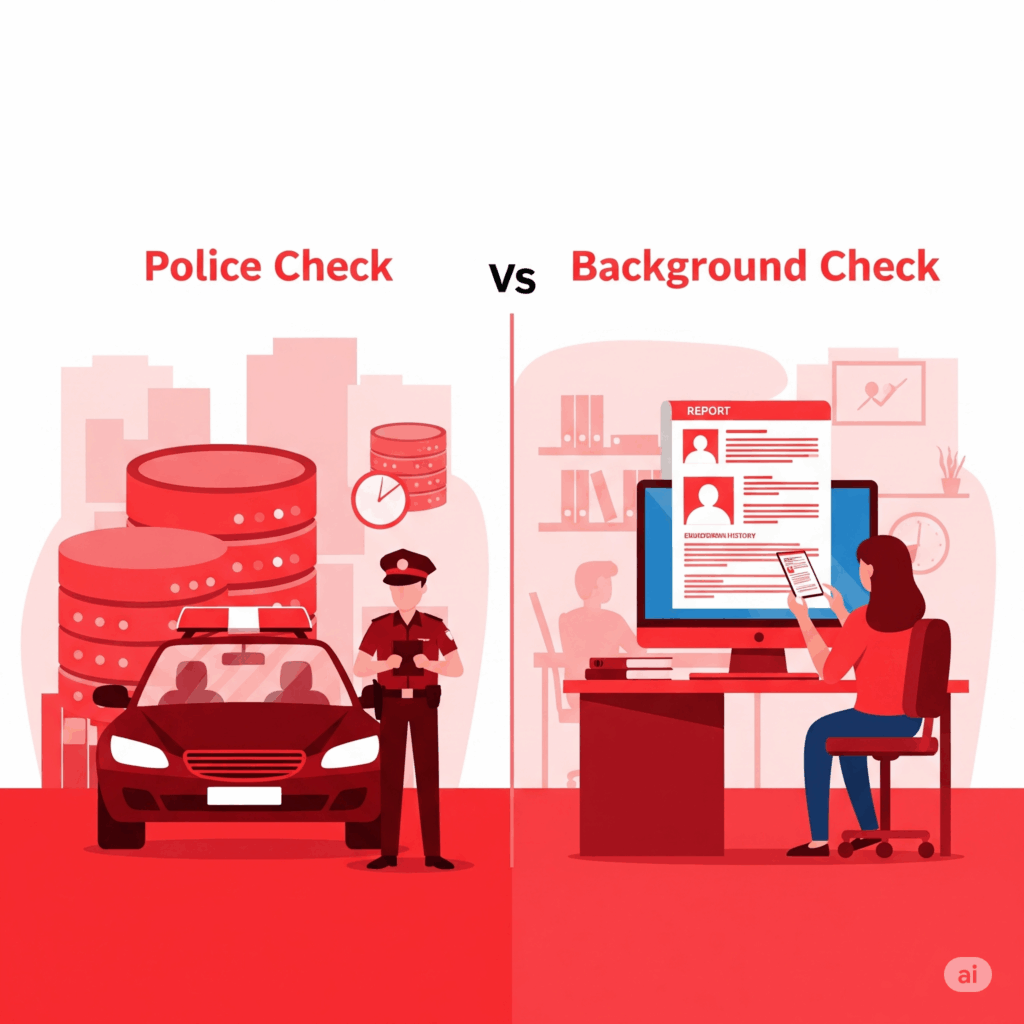
While screening candidates is important for employers to build a reliable and safe workforce, such processes before hiring are never too much. When referring to someone’s history, two of the most common terms that are usually called upon are a police check and a background check. While often treated as the same thing, they have different applications, and their information content varies. It then assists employers and applicants to know what check may be necessary in any given situation. Rapid Screening provides Police Checks as well as full background checks, customised based on individual industry and regional requirements, for example, Background Check WA. Key Differences of Police Check and a Background Check? Understanding the basics of the difference between a police check and a background check can easily clarify which is better for a particular role or purpose. A summary of some of the primary difference between a police check and a background check is explained below: Police Checks These checks occur in organisations whose safety and trust are a key focus. From the health sector to teaching, childcare, and even aged care sectors, most of them demand a detailed knowledge of the difference between a police check and a background check from employees. An employer in South Australia may ask a person for a Police Check SA, for instance, just to ensure that they have minimal safety standards This check basically revolves around a criminal review of the individual. It might include past convictions, current charges, as well as cases of offenses in particular jurisdictions. Background Checks People generally prefer these background checks at higher or sensitive levels, like finance or corporate organizations, or jobs related to governments, because long histories are believed to be useful. While a background check is more holistic. It may cover employment verification, education history, and financial checks, as well as criminal history. Companies requiring in-depth information regarding diverse aspects of a candidate’s background often opt for a full background check. Most individuals appointed for the exercise of high-ranking government powers, such as some at Background Check WA. Rapid Screening can offer concentrated solutions, and the details of background information of various industries’ employers would be attained. Turnaround Times Police Checks Generally, the difference between a police check and a background check is that a police check is faster than all other forms of background checks, which take hours or just a few days. They are very apt for jobs that require speedy verification, such as casual and part-time work. With increased scrutiny in the verification process, such as employment and education checking, background checks might take a few days or even up to a week, depending on the level of detail. Legal Compliance and Requirements The difference between a police check and a background check can also be that some jobs require police checks, especially in areas that are legally and normatively mandated in trust positions. Many government and healthcare organizations enforce police checks to ensure a safe environment for clients and the public at large. Organizations whose management or executive roles demand thorough history checks legally demand background checks. So it’s important to understand the difference between a police check and background check. A background check safeguards the reputation and integrity of an organisation. An openness characterises the working environment; for instance, finance or government institutions engage in open and transparent operations; therefore, conducting background checks presents a chance for this. Privacy and Candidate Consent Other than that, the difference between a police check and a background check can be that police checks are less intrusive as they address criminal records rather than personal sectors. They are easier to obtain, and there are fewer requirements of documents from applicants. Why the Employer Would Prefer One over the Other The type of check really depends on the nature of information considered valuable enough for that job. A police check would be effective for jobs that only require basic verification, in the event that a criminal history raises a concern, much like some healthcare roles manage to get through with a Police Check SA. More Exposed Profiles Recruiters associated with organizations holding significant authorities on funds, powerful legal mandates, or government powers like to employ the background check procedure. Like in the case of Background Check WA, they have a more 360-degree view of the applicant. It’s vital to know the difference between a police check and background check. Benefits of Partnering with Rapid Screening for Police and Background Checks Rapid Screening provides the most tailor-made solutions based on the screening needs of businesses within sectors. Here is how Rapid Screening stands apart: Compliance Rapid Screening ensures that all checks are compliant with national and state regulations that include Police Check SA or Background Check WA. Fast Turnaround Rapid Screening will undertake a streamlined process to deliver results within a quick turnaround even on the most detailed checks, often involving multiple verification tiers. Comprehensive Options Companies can opt for checks customized for the specific job’s requirements, ensuring that the information gathered is relevant and valuable. Ease of Use The Rapid Screening process is simple and easy to understand and operates based on easy accessibility to employers and applicants for quicker, simpler, and even more effective service. Choose the appropriate check to match your needs, and it’s not always necessary to do a police check. The police background checks are merely to provide information related to criminal history. It takes a relatively short period of time, and it best suits businesses dealing with urgent issues of safety, such as health, childcare, and aged care. More suitable for jobs that demand scrutiny of one’s personal history, professional credentials, and integrity in financial matters, which are highly in demand in the finance, corporate, and government industries. Conclusion While the difference between a police check and a background check provides a necessary tool in the recruitment process, they are different both in their goal and the information collected. Police checks target the individual’s record of crimes committed,
Personal Privacy: How Rapid Screening Protects Your Data
The protection of personal data is severe in the digital world we live in today. You could just be asking to get a police check NSW, police check Victoria, police check WA or even a police check SA and don’t want your data going out of the window. Australia’s most trusted police check provider, Rapid Screening, understands these concerns and has integrated rigorous measures to protect applicant data from data breaches at each step of the screening process. In the following blog post, we’re going to show how Rapid Screening keeps your data safe, take a closer look at privacy protections, and why a trusted online police check provider will be the best option for Australians. Why Personal Privacy Matters in Police Checks A police check often asks for sensitive personal identification details, contact information, and sometimes even biometric data. All such information needs to be handled with much care as it can land in the wrong hands, where it could be exploited for identity theft or other types of fraud. You are getting not only fast and accurate but also committing your data to a service provider who maintains an obligation to protect it when you receive an application for Police Check NSW, Police Check Victoria, Police Check SA, or any state check through Rapid Screening. How Does Rapid Screening Protect Your Data? Rapid Screening has been well recognised for its swift and effective police checks and, above all, for its intensifying security measures taken to ensure all applicant information is safe. Some of the key ways Rapid Screening maintains data privacy and security include the following: 1. Advanced Encryption Protocols Encryption is key to having your private data kept confidential. Fast Screening engages industry-standard encryption technologies in the safe transmission and storage of your information. This way, data you are inputting into your Police Check NSW, Police Check Victoria, or Police Check SA application, for instance, your name to the numbers on identification cards-are made undecipherable. Why encryption? The encryption feature works like a digital lock such that no hacker can access the sensitive data unless he has the correct decryption keys. Rapid Screening, on the encryption protocols, protects both how your data moves across the internet while being transmitted (whenever you enter your information online), and also how it is stored on secure servers at their end. Compliance with Australian Privacy Laws Rapid Screening follows every valid privacy legislation of Australia, such as the police check western Australian Privacy Act 1988, which delineates rigid specifications in handling, storing, and guarding personal information. When using a compliant vendor like Rapid Screening, you will feel comfortable with the understanding that your data is being handled according to the legal standards of privacy. Key Compliance Actions: Access is strictly limited to only authorised personnel. Conduct regular audits to ensure data protection standards procedures for storage, access, and disposal of information Authentication with security Secure identity verification is one of the processes that guarantee the securing of a police check. Rapid Screening carries out verification of applicant identities utilizing a secure procedure that does not undermine the applicant’s privacy. This verification comprises several layers of security as indicated by multi-factor authentication and document validation checks, thus ensuring the applicant’s identity without exposing any unnecessary information. Advantages of Secure Identity Verification This ensures that the identity of the applicant is authentic as it checks the person who claims to be who he is. The rigid verification processes by Rapid Screening speed up the application process and add safety through the screening of applicants. Data Minimization Principles Rapid Screening follows the tenets of data minimization that suggest they collect and store only the information needed for the police check. This is an important privacy strategy because it limits the personal information that is stored while reducing the risk associated with a data breach. Why Data Minimization Is Important Data minimization helps minimise exposure in case of a security breach by only saving necessary information. Rapid Screening limits data collection to what is legally required. Therefore, it does not put unnecessary information at risk. Regular Security Audits and Updates Rapid Screening constantly holds periodic security audits to maintain the optimum level of preparedness to prevent any possible attacks and modifies its security systems in accordance with such audits. Cyber security is a dynamic sector, and Rapid Screening continues to make improvements in order to counter emerging threats and vulnerabilities. Continuous Improvement Means Better Protection: Rapid Screening ensures that its security practice is top-notch with continuous auditing and updating, and your information remains protected as new cyber threats emerge. States Privacy Measures of Rapid Screening Regarding Police Checks General privacy measures apply uniformly, Rapid Screening has some police check services in many states, these include police check NSW, police check Victoria, police check WA, police Check SA, etc. Here’s how Rapid Screening varies its privacy protection depending on where you are Police Check NSW For applicants in Police Check NSW, your privacy is especially taken into consideration because many NSW-specific jobs require the screening of applicants’ backgrounds for sensitive positions like health or education and government. Rapid Screening ensures that applications made in NSW or any other region follow strict data practices that comply with the regulations of the state. Hence, your application remains safe and compliant. Police Check Victoria Police Check Victoria has customised steps to fulfill Victorian citizens’ privacy demands. Rapid Screening has a platform that considers the state protocols regarding data collection and verification. This, in turn, helps provide for the safe management of all the information considered sensitive enough to be needed to get a Victorian police check. Police Check SA The privacy policy for Police Check SA of Rapid Screening ensures protocols based inpolice check South Australia are integrated to ensure local standards are maintained. Data for a police check in SA is treated with the same exhaustive protection requirements as other states but places greater emphasis on assurance that the local standards for data handling are upheld. Understanding
Choose the Right Screening Services for Your Business

How to Choose the Right Screening Services for Your Business Effective trust-building within the competitive business environment can begin with prudent hiring decisions. Pre-employment screening and workforce screening help maintain a safe work environment, improve compliance with a range of regulations, and lead to long-term success. It can save time and help you better manage risks as you associate with the question of how to choose the right screening services provider and enhance your organization’s reputation. Rapid Screening is a name that has long been synonymous with screened solutions across the business communities across Australia. They emphasize reliability and efficiency with high-standard services such as police checks in NSW, Victoria, Tasmania, Queensland, WA, SA, etc to help organizations remain compliant and make smart decisions. In this detailed piece, we have ventured on how to choose the right screening services for your company, with attention focused on what Rapid Screening offers the table. Why Workforce Screening Is Important Workforce screening is not just about verifying credentials but also something much more proactive in protecting your business from potential risks. Be it ensuring that employees meet legal and regulatory requirements or ensuring that the employee fits the role, screening is prime in several ways: Enhancing Workplace Safety Screening decreases the possibility of getting involved with people who might be a hazard to others’ safety. Preserving Company Reputation A vigorous screening process prevents reputational loss due to criminals or the wrong employees. Reduction of Legal and Financial Losses Compliance with laws and regulations eliminates substantial losses in terms of fines and cases. Streamlining Recruitment How to choose the right screening services: Rapid Screening shortens the screening time as its impact eliminates unqualified applicants, meaning you only need to look at the right talent. Key Factors When Selecting Screening Services Needs of your Business Every business has specialised screening needs. For instance, for a healthcare professional, comprehensive criminal history screening would be necessary, whereas for a logistics company, a drug and alcohol screening may be required. Understanding how to choose the right screening services, with Rapid Screening offers several services that meet the requirements of various industries and regions. The company gets police checks depending on the region. For instance, hiring for any Sydney-based position would require a police check NSW, while hiring in Adelaide would require a police check SA. Range of Checks Provided All intensive screening checks should be available, including the following: National Police Checks, Drug and Alcohol Testing, Identification Verification, Right-to-Work Checks, Employment and Education Verification. Rapid Screening does all of these under one roof, whether you require a police check Victoria, or a more comprehensive package. Speed and Convenience The fast-paced hiring environment calls for a turnaround at the quickest time. A slow screening process might delay hiring, disrupt operations, and forfeit the top talent. Rapid Screening is in a proud position of delivering results at the quickest possible time. 70% police checks, return within a couple of hours. A service provider you choose should align with national and state laws as well as regulations. For example, in Australia, national police checks must conform to the standards of the Australian Criminal Intelligence Commission, or ACIC. Rapid Screening meets these demands by ensuring accuracy as well as compliance for any police check undertaken in any region. Data Security and Confidentiality Screening deals with sensitive personal information, so information security comes first. Your provider should have robust measures in place to safeguard applicant data from breaches or misuse. Rapid Screening employs state-of-the-art encryption and secure storage protocols to maintain complete confidentiality. Customer Support and Counseling The screening procedure can sometimes be cumbersome and complicated, especially if the checks cross multiple states. It’s always nice to have top-class customer support that would answer all the questions at hand and make the process easy. Rapid Screening has an experienced support team to guide you at all times. This ensures that the experience is indeed smooth and seamless. Why Rapid Screening? Rapid Screening has become the mainstream premier choice for businesses seeking a trustworthy, efficient, and compliant screening solution. And here’s why: Coverage All Over Australia Rapid Screening covers all of Australia. They make sure services are functioning in all the regions. For businesses and organizations in New South Wales, Police Check NSW is available. Police Check Victoria for compliance with requirements in Melbourne and other Victorian cities. Police check SA for businesses all over Adelaide and beyond. Customised Solutions Jobs require different kinds of checks. With Rapid Screening, businesses can create customised screening packages so that the correct checks are conducted for the right job. Fast Results In recruitment, time is everything. Rapid Screening ensures that results are received fast, so your business can make timely decisions regarding hiring. User-Friendly Online Portal The Rapid Screening online system makes it easy to apply for police checks and enables business owners to submit their police checks, track them, and receive them easily. Expert Trust Rapid Screening has been one of the leading firms in Australia for years, with excellence in services that have made Rapid Screening highly reliable for businesses. How to Begin on Rapid Screening Step 1: Access the Rapid Screening Website. Head to rapidscreening.com.au for a wide scope of how to choose the right screening services. Step 2: You can choose the kind of police check that suits your needs. For example, you can get a police check in NSW, a police check Victoria, or police check SA and more. Step 3: Upload your documents and finish your process in a few minutes. Step 4: Get Results. 70% of results are given within a couple of hours in most cases, and you will be carrying the information you need without delay. Conclusion To build a safe, compliant, and efficient workplace, knowing how to choose the right screening services provider most appropriately chosen for the workplace will play a very important role. Trusted partners in Rapid Screening help make fast, reliable, and comprehensive screening solutions available to your business. QLD, West Australia, NSW,
2025 Best Step-by-Step Guide to Getting a Police Check

How to get a police check is one of the primary steps to be taken or carried out for most legal, employment, and volunteer purposes in Australia. This guide is important, providing more details on how to get a police check with detailed steps, costs, and timelines across different states like NSW, South Australia, and Tasmania. When you need it at work, through volunteering, or for whatever reason, you are supposed to understand the process involved. Understanding the Police Check Process The police check is also a document reflecting court outcomes that are disclosable and pending charges of an individual officially. It is very significant in many employers, licensing bodies, and other institutions to use this document to ensure safety and reputation within the premises it operates. How to Get a Police Check Getting a police check slightly varies from state to state but generally follows the same lines throughout Australia. Step 1: Identify the Type of Police Check Needed Beforehand, it is important to decide which type of police check you will need. There are different checks to be made for employment or volunteer work, as well as checking for some licenses. Make sure you apply for the proper one so that it does not delay the processing. Step 2: Choose an Accredited Provider You will need a police check application through an accredited provider. One that is accredited means that they are authorized to submit applications to the database at a national level. In one consideration for a police check, one must consider getting a recognized and accredited provider who adheres to the necessary guidelines. Step 3: Submit Your Application Online or In-Person A lot of these applications can even be done online, making it quite handy. You will be asked to provide them with your identification documents, personal details, and consent for the check to be performed. In some instances, this might involve you applying in person at a local police station or agencies granted the authority. Step 4: Pay the Required Fee Costs for a police check will differ in terms of provider and the type of background check required. You need to know how much it costs to secure a background check, as issues on this can be a determinant of the provider you want to use. Step 5: Wait for Processing How long it takes will vary; the provider and the complexity of the check come into play in this regard. Understanding the time it takes to get a police check will help you plan appropriately. How Long Does It Take to Get a Police Check? The time it takes to get a background check primarily depends on the method of application and the provider used. Standard Processing Times Generally, the preparation of a police check can take anywhere from 1 to 10 business days. For people with urgent needs for the same, this service is available, albeit at an added cost that can shorten this time to as little as one day. Influencing Factors on Processing Time Unfinished applications, discrepancies, and other factors that require additional checking are likely to cause delays. This applies to those applying for a Police Check in NSW, South Australia, or Tasmania. What to Do If Your Check Is Delayed If it is longer than you expected, contact the provider for the status. They can give you an update or may need to request further information if required. How Much Does a Police Check Cost? The cost to put in for a background check can vary depending on the provider, type, and the state that you will be applying to. Cost Range Generally, the cost can range on average from $30 to $50 for an average standard check. Sometimes some states or providers charge more than the flat cost, particularly when some other checks are mandatory. Price Variations by State In NSW, the cost of a police check may be slightly higher than that of South Australia or Tasmania. Refer to the provider always for the best and most updated difference. Additional Cost There may be extra costs for priority processing, hard copy certificates, or certain check types. These are important factors to keep in mind while thinking in terms of how much it costs. State-Specific Processes Now, the general process on how to get a background check may be more or less the same, but there are some specific differences that one may be required to bear in mind during the application. Police Check in NSW The state of New South Wales has its specific guidelines and providers for police checks. NSW Police Force Police checks can be done directly from the NSW Police Force or through accredited third-party providers. The procedure usually comprises an online application and provision of the required identification documentation. Processing Times: NSW In general, the processing time of a police check in the area of New South Wales takes place within 10 business days. However, delays might be caused if some more checks are required. Cost of Getting a Police Check in NSW In NSW, the police check costs anywhere between $30 and $50 depending on the provider and type of check. Police Check in South Australia In general, South Australia is subject to the same process as NSW, but it comes with some distinct features. SA Police (SAPOL) For those who want a police check in South Australian Police Checks, it can be applied for either through the website of SA Police (SAPOL) or by the assignment of privately qualified agencies. The process for applying is an easy one and ends with an online application. Processing Times Processing the check in South Australia takes 7 to 10 business days standard time, though it will depend on its degree of complexity. Cost In South Australia goes for an amount that is almost equivalent to the cost charged in NSW. Just like the latter, the amount in South Australia varies from $30 to $50. Police Check in Victoria Want a Police Check
Working for Yourself vs Someone Else: Pros & Cons

The opportunity to work for oneself is often one of the most rewarding and empowering career choices a person can make. It affords the individual with an ability to design his own schedule and work on his very own passions while creating a balance with his lifestyle, fitting to his particular life needs. Still, careful planning and much forethought must go into the inception of this process. This manual shall discuss a guide to the steps on how to work for yourself, ideas to get you going, and a comparison between the pros and cons of working for others versus working for self. Understanding the Concept of Working for Self Working for yourself can mean many things: business ownership, freelancing, or independent contracting. You are the boss, and heck, you are pretty much responsible for everything, from marketing your business to keeping the quality up, managing the money, and working with customers or clients. Navigating the Hiring Process If you’re considering self-employment, understanding the hiring process can also be critical, especially if you plan to expand and hire others. A streamlined hiring process not only helps in building a skilled team but also ensures compliance with legal requirements, including background checks. For instance, in Australia, various police checks such as the rapid screening option can be employed to ensure potential hires meet necessary criteria. How to Start Working for Yourself Starting to work for oneself is quite a big decision. It calls for one to plan, do research, and sometimes even take up calculated risks. The following are some of the steps that one has to undertake: Step 1: Assess Your Skills and Interests First, analyze what kind of skills and interests you may possess. This would be a starting point for your self-employed career. Be it as a graphic designer, a writer, a consultant, or a craftsperson, it’s the skill and the passion you have that are going to determine the choice of work. Step 2: Research the Market It is obvious that you will have to know your target market. You should know if apart from the service there is any demand. This research will also, therefore, help you carve out a niche and bring companies or customers to your business. Step 3: Create a Business Plan You will be producing a business plan that will have your goals, strategies, financial projections for a business. You will have its target market, how to market the product or service, where you will price your products, and resources you will need to start your business. Your business plan will be your roadmap as you travel the path to self-employment. Step 4: Set Up Your Business Structure Form your business as a legal entity. Your decision in this matter—whether to form as a sole proprietor, partnership, limited liability company, corporation, not-for-profit, Limited Liability Company, or the like—will impact your tax situation and business liability. Consider talking to a lawyer or accountant about which legal entities are best for you. Step 5: Raise Money depending on your business, you will need to raise money for everything else. This can be through personal savings; loans, and investors — weigh the options and pick the best choice for your needs and risk tolerance. Step 6: Create a Brand and Online Presence Today no business can afford to remain out of sight. Get a professional website built, create your social media presence, and design a brand identity that sketches the professional ‘you’ best and appeals most to your target audience. This online presence will be one of the major tools to market your services or products. It is usually best to start on a smaller scale, perhaps part-time, to help you develop your customer base and refine your product or service. As you stabilize the business and build some personal confidence, then you expand functions and move yourself to full-time self-sufficiency at a pace that is best for you. 2. Working for Yourself Jobs: Popular Options You can be self-employed in many ways, most of which involve skills you’re applying or plan to apply in the future. Some of the most popular ways to work for yourself are listed here. Freelancing Freelancing is selling work in bits and portions with a client. Other examples of freelancing services include writing, graphic design, web development, and digital marketing. Freelancing can be a flexible way to provide services, while interacting with a wide array of clients. Consulting Consultants Share expert advice in what they do. Whether consulting is done in businesses, technology processes, or personal development activities, most of them commonly assist clients in problem solving, performance improvement, and achievement of desired results. What Consulting boils down to is giving expert advice in what they do, Weather if its businesses, technology processes, or personal development activities, most of them help their clients solve their problems and improve performance Online Retailing One of the most popular routes to being an independent contractor involves the sale of products or services via a website. The product can be home made products, drop ship products, or other types of resale products. Financial control, remarking, customer/partner control, and many other managerial functions are key to efficiently running a profitable small retail shop. Coaching and Training If you master a certain field, you may be a coach or a trainer in this sphere: life coaching, business coaching, fitness training, or teaching languages. It requires very strong soft skills and the ability to lead people to a motivated state. Content Creation The content creators create online content like blogs, videos, and podcasts, or even on social media. Once the content is up and running, one can then monetize such through ads, sponsorships, or merchandise. As a matter of fact, content creation befits individuals who are into creative self-expression and who enjoy communicating with an audience. 3. Working for Yourself and NDIS The Australian National Disability Insurance Scheme opens opportunities for self-employment through disability support. Imaginable facilities that a person under NDIS can self-employed include
Police Checks for Aged Care Jobs: Best 2025 Practices

Protecting residents or clients in aged care from any form of harm is very significant. One of the most sensitive aspects of their protection has to do with the police check for aged care employment. This guide explains all the essential details that make the police check vital, how authorities process them, and how valid they are in the context of aged care What is a Police Check for Aged Care in Reality? A police check in the context of aged care means background screening, which refers to ascertaining an individual’s criminal assertion to the particular aged care roles that he or she is applying for or already working for. This check is quite important to ascertain that workers in aged care meet every standard of safety and integrity set for taking care of elderly people. Need for Police Checks in Aged Care In fact, these police checks pull out people who have past records of criminal history, which can be very harmful to these two vulnerable groups Instruments are in establishing rapport and safety in aged care facilities with the surety of employing only those whose records are clean. For instance, if a potential employee has an offender’s record, they will not be eligible to work for any aged care organization because the staff has to deal with fragile populations like the old and the young. How Long is a Police Check Valid for in Aged Care? The period a police check remains valid is subject to variation depending on the organization and the jurisdiction but is generally accepted for up to three years. However, some organizations may update this more often due to the internal policy of some organizations and because the role bears a high risk factor. Regular Updates and Renewals Aged care facilities should demand constant new police checks on aged care facilities’ workers for their safety. This is because changes may be added to the individual’s crime record and, at some time, renewals of checks that had been returned clear of any wrongdoing. Rapid screening procedures may help keep checks updated. NSW Police Check for Aged Care Workers The police check for aged care workers is an inherent condition of employment in the New South Wales aged care sector. There are two ways to check: through the NSW Police check itself or an accredited supplier, targeting its goal of ensuring individuals employed in that sector do not possess any disqualifying elements in their criminal record. These inspections are essential to guarantee that aged care providers fulfill the strictest requirements for dependability and trust, particularly when tending to old populations who are at risk. Before starting any work, employers must make sure that all employees whether permanent, part time, or volunteers have successfully undergone a police check. In many cases, this step is a legal requirement under aged care regulations and national standards. Failure to comply can lead to penalties for facilities and potentially place residents at risk. Having a police check on record not only safeguards the well being of residents but also enhances transparency and builds public trust in the quality of care provided in NSW aged care services. NSW Police Check Process Application Submission A person makes an application for a police check with the NSW Police Force or one of the accredited agencies. Background Screening An organization performs a comprehensive check of the background on behalf of the police force. Issuing the Report The result is issued in the form of a report containing any criminal history or, if not, simply a response stating “Nope, nothing to see here. National Police Check for Aged Care A national police check is a history check on the criminal records of a person in all states and territories of Australia. Such checks, in particular, would be valuable for employers with operations that transcend the borders between state and territory borders, such as in Victoria or South Australia. This includes a police check South Australia and other regions. Benefits of National Police Check This holds all the data of criminal records from all the states and territories. Standardization This brings about a standard way of going through the background check process throughout Australia. Safety This ensures that all forms of possible crimes are detected irrespective of where the crime is committed. Police Check for Aged Care Victoria A police check Victoria for aged care is an essential requirement when working in the Victorian aged care sector. The Victorian government to guarantee the safety of the elderly provokes these checks and that all concerned staff working with them strictly adhere to safety standards set out in operation. If you’re in Victoria, you may want to contact us for assistance with your police check. Victoria Police Check Procedure Application The application for a police check happens from an applicant to the Victoria Police or an accredited agency. Results There will be a report returned on the record of an individual, indicating any conviction or cleanliness. Police Check for Work in Aged Care: Key Factors First, working in the aged care setting requires that one be aware of the requirements, their implementation, and setting into process. The following are some considerations on approaches to application: How to Apply Ensure that you are using an accredited provider to do a check that is acceptable and recognized. Fill the required application forms correctly. Submit some documents in identification just for substantiating your identity. Costs and Processing Times Costs On some occasions, these police checks would come at a designated price depending on jurisdiction and provider. Processing Times The average processing times are many times from some days up to a few weeks, depending on the type of check one has applied for and the provider. Compliance and Updates Don’t let your police check be a one-off. Periodically check and update in line with aged care requirements. Track Changes Be abreast of policy regulation changes or other normative changes on police checks about aged care. Conclusion Therefore, aged care providers must
What is an NDIS Support Worker?

Any person charged with supporting persons living with a disability to achieve their goals, apart from being able to live freely on their own, is an NDIS support worker. Since the National Disability Insurance Scheme is the national insurance program for Australia, the services offered by support workers in this scheme are very wide-ranging. Roles and Responsibilities Some of the roles that an ndis support for children worker would take up include: -Personal care and management of daily living: cooking, cleaning -Assisting clients in social and recreational activities -Assisting clients in achieving their employment, education, or social participation related objectives -Companionship and emotional support -Collaboration with other professionals for a holistic approach towards care planning, such as NDIS support coordinators Why is an NDIS Support Worker Important? An NDIS support worker is important for the following reasons; Empowerment: They help a disabled person live and act independently with self-confidence in a more independent way. Customized Care: Design of the services by an NDIS support worker views the needs of each client to provide better, personalized care. Community Inclusion: The support workers arrange community activities that make their clients feel they are part of the community. How to Become an NDIS Support Worker Step 1: Acquire the Required Qualifications This normally needs a person to possess a Certificate in Disability Support or other qualifications such as Certificate III in Individual Support, Certificate IV in Disability, or a Diploma of Community Services. Step 2: Get Some Experience This experience could be useful, more so if acquired through a similar role. All this experience is acquired through volunteering or working on related fields such as in aged care or mental health support. There are some NDIS Police Check Requirements that you must go through. Step 3: Understand the NDIS Framework NDIS philosophy, and funding, scope of practice, and the parameters of working as a ndis support for children coordinator should be known. The information will enable you to provide quality service to your clients. Step 4: List all Checks and Clearances Required On the other hand, considering the safety of the weak clients involved, there needs to be some sort of checks and clearances with a minimum requirement of: Step 5: How to Apply to Become an NDIS Support Worker If you want to be an NDIS support worker professionally, then you would need to get registered with the NDIS Commission. The requirements may include agreeing that you viewed a few standards and uphold the NDIS Code of Conduct. NDIS Support NSW In New South Wales, the NDIS support services are tailored to meet the diverse needs of individuals with disabilities. The state offers a range of specialized services, from personal care and daily living assistance to community engagement and capacity building. NSW Check is designed to ensure that participants receive the help they need to achieve their goals and enhance their quality of life. Local service providers and support coordinators work closely with clients to navigate the NDIS framework and access appropriate resources and funding. NDIS Support Worker Hourly Rate It does depend upon many factors: location, level of experience, and services delivered. This would be anywhere from $25-45 per hour. This also creates rates that are dissimilar for independent support workers in comparison to agencies. Specialized Skills: Specialized skills, such as NDIS behavior support workers, command a higher rate. Location: The prices differ from location to location. A bit higher in the metropolitan areas. NDIS Support Services Services with regards to ndis support for children range from daily living supports to specialist behavior support. Let us discuss some of the major services. Daily Living Supports This consists of hand-on services for activities like dressing, bathing, cooking, and other activities. It might bring in easier, comfortable, and independent living conditions for the client. Community Participation The community workers make the clients they work with take part in social and recreational activities, hence maximizing community integration and minimizing isolation. NDIS Behavior Support Behavior support refers to the support of persons who exhibit challenging behaviors. Support workers, in collaboration with behavior professionals develop and apply positive behavioral strategies in supporting their clients. Assistance with Transport It is common for many NDIS participants to require support in accessing various appointments or getting to and from work or other social activities. Obviously, some will only need transport; others may require a support worker traveling with them on public transport. What Does an NDIS Support Coordinator Do? While an ndis support for children coordinator represents a similar but broad and complementary role in contrast to the latter, the former is responsible for managing the NDIS plan of the client and linking him to appropriate services. Key Responsibilities of an NDIS Support Coordinator Plan Management: Assist clients to understand and manage respective NDIS plans. Service Coordination: Link clients with service providers who could meet their needs. Setting goals and achieving them. Helping clients set and achieve their personal goals in a collaborative way. Independent NDIS Support Worker Many people work as independent support workers. They don’t work for an agency. While this offers flexibility, it also creates some extra responsibilities. Pros and Cons of Being Independent Pros: You are in control; you set your hours, charge at the rate at which you want to charge. Cons: This means you have to sort out your own tax, insurance, and that kind of thing. How to Work for Yourself/Self-Registration with the NDIS Whereupon one decides to work as an independent NDIS support worker, he has to complete the required studies, establish a bookkeeping system, obtain an ABN, and market his services. In any case, be reminded that networking and contacting people looking for services is paramount. reminded that networking and contacting people looking for services is paramount. Police Check Queensland Queensland Police Check is a critical requirement for anyone looking to work as an ndis support for children. This check ensures that individuals have a clear criminal history and are suitable to provide support services to vulnerable populations. The