In this comprehensive guide, we will explore everything you need to know about obtaining a Government Accredited Police Check, why it matters, and how you can secure yours in record time through Rapid Screening.
Navigating the world of criminal history clearances can often feel like a bureaucratic maze. With various terms like National Police Check, AFP Clearance, and Nationally Coordinated Criminal History Check being used interchangeably, it is easy to get confused. However, the core requirement remains the same: a reliable, secure, and official verification of an individual’s disclosable criminal history.
What is a Government Accredited Police Check?
A Government Accredited Police Check is an official process that involves searching the records of all Australian police jurisdictions to identify any disclosable court outcomes or pending charges associated with an individual. In Australia, these checks are primarily coordinated through the Australian Criminal Intelligence Commission (ACIC) or the Australian Federal Police (AFP).
When you apply for a check through an accredited body like Rapid Screening, you are accessing a secure system that communicates directly with the National Police Checking Service (NPCS). This ensures that the information provided is accurate, up-to-date, and legally recognised by employers and regulatory bodies across the country.
The Role of the ACIC and AFP
It is important to distinguish between the two main types of government-authorised checks:
1.Nationally Coordinated Criminal History Check (NCCHC): Managed by the ACIC, this is the most common check used for employment, licensing, and volunteer purposes. It is facilitated by accredited bodies that have undergone rigorous vetting to ensure they meet strict security and privacy standards.
2.Australian Federal Police (AFP) Check: These are typically required for specific purposes such as immigration, overseas employment, or working for Commonwealth government agencies.
For the vast majority of Australian workers, a nationally coordinated criminal history check obtained through an ACIC-accredited provider is the standard requirement.
Why You Need a Government Accredited Police Check
The requirement for a police clearance is no longer limited to high security roles. Today, it is a standard part of the onboarding process in almost every sector. Here are the primary reasons why you might be asked to provide one:
•Employment Screening: Employers use these checks to mitigate risk and ensure the safety of their workplace, clients, and assets.
•Regulatory Compliance: Industries such as aged care, childcare, and healthcare have mandatory requirements for staff to hold valid clearances.
•Volunteer Work: To protect vulnerable members of the community, non-profit organisations require volunteers to undergo screening.
•Licensing and Accreditation: Many professional bodies require a Government Accredited Police Check before granting licenses to practice in fields like real estate, security, or finance.
Comparison of ACIC vs. AFP Police Checks
| Feature | Nationally Coordinated Criminal History Check (ACIC) | Australian Federal Police (AFP) Check |
| Primary Purpose | General employment, volunteering, and licensing. | Immigration, Commonwealth employment, overseas visas. |
| Facilitator | ACIC-accredited bodies (like Rapid Screening). | Australian Federal Police. |
| Data Source | All Australian police jurisdictions. | All Australian police jurisdictions. |
| Turnaround Time | Often within hours (via Rapid Screening). | Typically 5–15 business days. |
| ID Requirements | 4 documents (including one photo ID). | 100-point ID check. |
The Importance of Using an Accredited Provider
When it comes to sensitive personal data, where you get your check matters just as much as the check itself. Using a Government Accredited Police Check provider like Rapid Screening offers several critical advantages:
1. Enhanced Security and Privacy
Accredited bodies must adhere to the Privacy Act 1988 and strict ACIC security protocols. This means your personal information, including your birth certificate, passport, and criminal history, is encrypted and handled with the highest level of confidentiality.
2. Speed and Efficiency
Traditional methods of obtaining a police check, such as visiting a local police station, can take weeks. In contrast, an online police clearance through Rapid Screening leverages advanced technology to deliver results in a fraction of the time. In fact, 70% of our checks are returned within just 2 to 4 business hours.
3. Compliance and Validity
A check from an unaccredited or third party source that doesn’t have direct ACIC access may not be accepted by your employer. By choosing an accredited provider, you ensure that your certificate is valid and meets all Australian legal standards.
How the Process Works
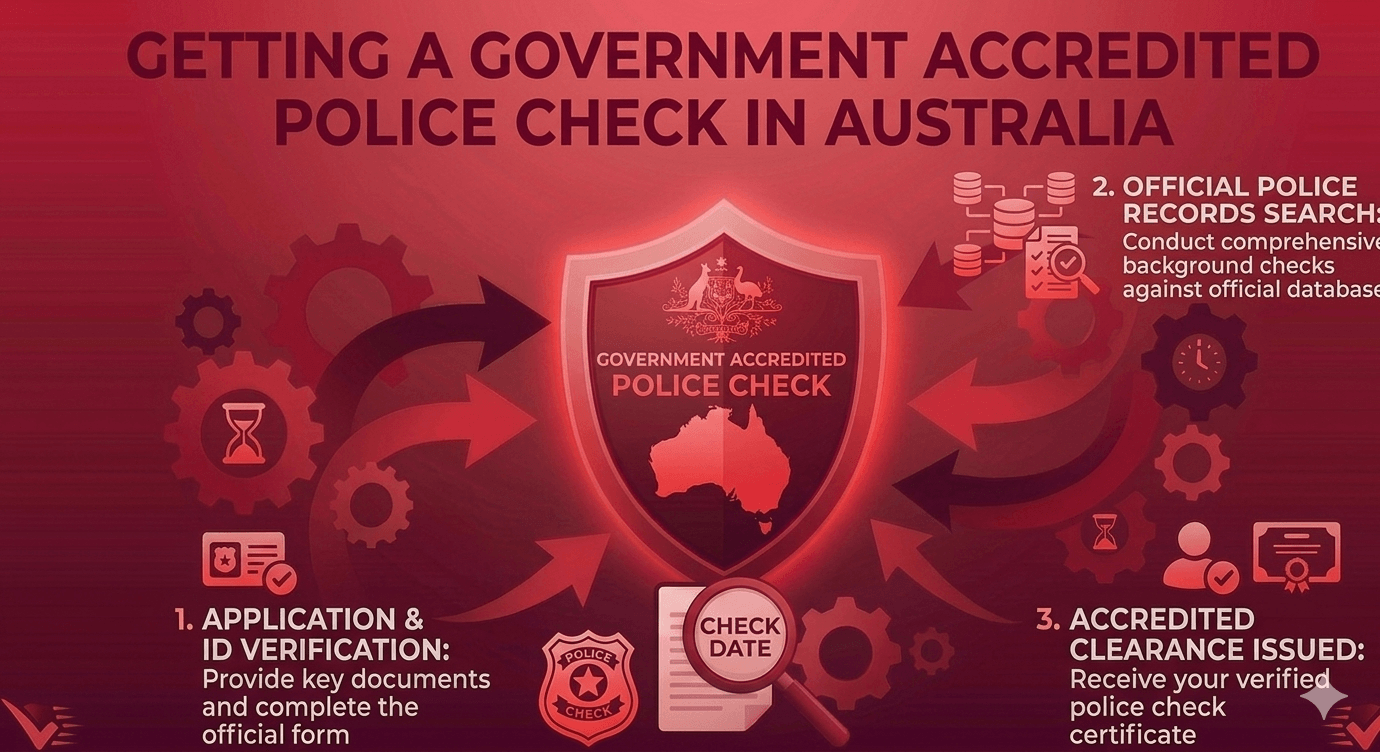
Obtaining your official police clearance has never been easier. Gone are the days of printing forms and waiting in queues. Here is how the modern, 100% online process works with Rapid Screening:
Step 1: Online Application
You will be asked to provide basic personal details, including your full name, date of birth, and five years of address history.
Step 2: Identity Verification
To maintain the integrity of the system, you must prove your identity. We use the Document Verification Service (DVS), a national online system that allows real time verification of government issued documents. You will typically need to provide:
•One commencement document.
•One primary use in the community document.
•Two secondary uses in the community documents.
Step 3: Payment
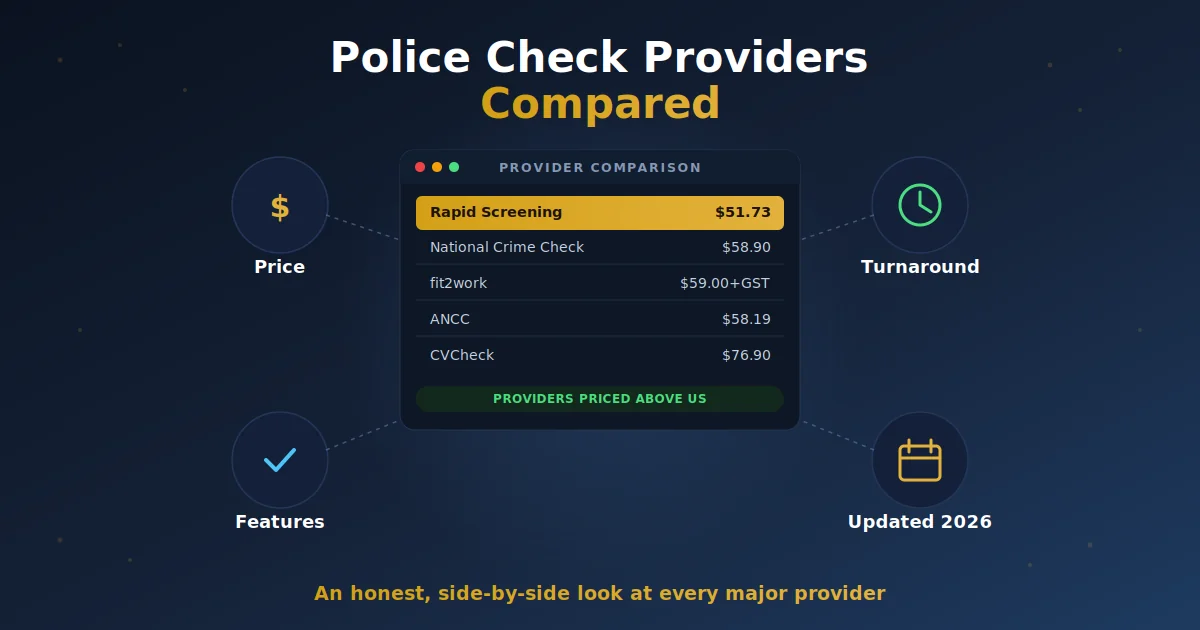
Our pricing is transparent and competitive. A standard Nationally Coordinated Criminal History Check is available for just $51.73 + GST. We accept all major credit cards and secure online payment methods.
Step 4: Processing and Results
Once submitted, your application is sent to the National Police Checking Service. If there are no potential matches, your result is often returned within hours. You will receive a secure link to download your digital certificate immediately.
State-Specific Requirements for Police Checks
While the nationally coordinated criminal history check is a national document valid across all states and territories, some industries or local regulations may have specific nuances.
New South Wales (NSW)
In NSW, police checks are frequently required for those working in the vibrant hospitality and security sectors. Whether you are in Sydney or regional NSW, our online service ensures you meet state requirements without delay.
Victoria (VIC)
Victoria has stringent requirements for those working in the Working with Children and Aged Care sectors. A national criminal history check is often the first step in these multi-layered screening processes.
Queensland (QLD)
From the mining hubs to the tourism centres of the Gold Coast, Queensland employers rely on fast clearances to keep their operations running smoothly. Rapid Screening provides the speed necessary for QLD’s fast moving industries.
Western Australia (WA)
The WA mining and resources sector often requires site ready clearances. Having a valid police clearance ready to go can be the difference between landing a role and missing out.
Understanding Disclosable Court Outcomes (DCO)
A common question people ask when applying for a police clearance is: What exactly will show up on my certificate?
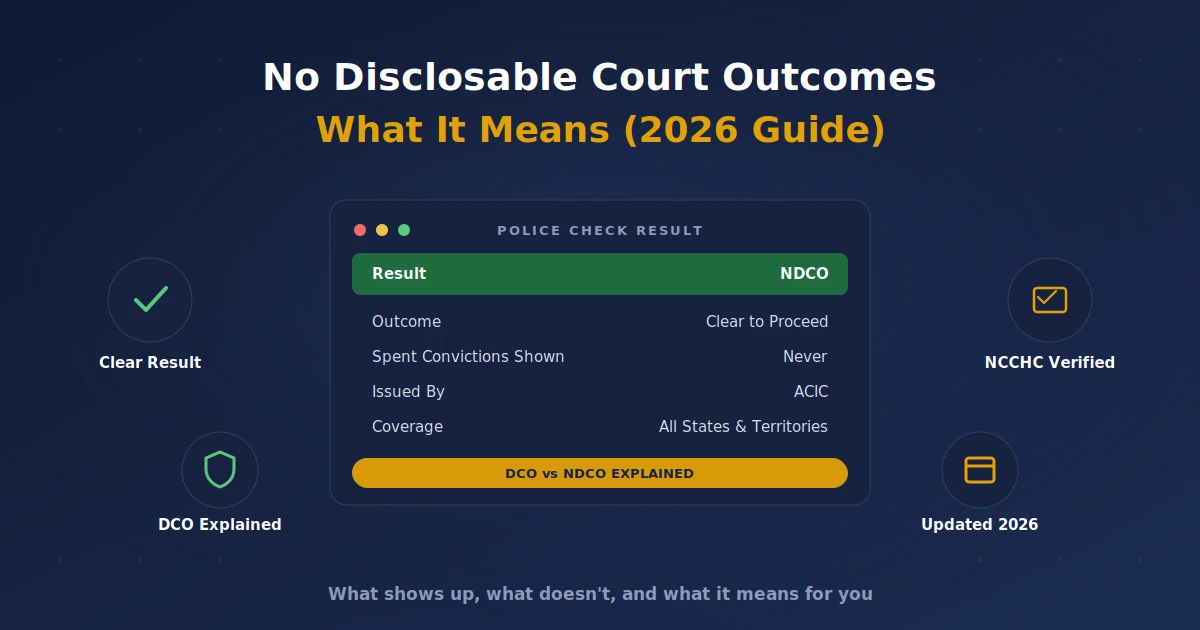
The result of your check will either be No Disclosable Court Outcomes (NDCO) or Disclosable Court Outcomes (DCO). If a DCO is found, it may include:
•Charges and court convictions.
•Findings of guilt with no conviction.
•Sentences and penalties.
•Pending charges (matters currently before the court).
It is important to note that Spent Convictions legislation exists in Australia. This means that older, minor offences may be removed from your record after a certain period, provided you have not re-offended. However, certain roles such as those involving children or the elderly, may have exclusions that allow even spent convictions to be disclosed.
Common Industries Requiring Police Checks
| Industry | Typical Requirement | Why it’s Needed |
| Healthcare & Aged Care | Mandatory NCCHC | Protecting vulnerable patients and residents. |
| Education & Childcare | NCCHC + Working with Children Check | Ensuring the safety of minors. |
| Finance & Banking | Credit Check + NCCHC | Verifying integrity for handling sensitive financial data. |
| Government & Defence | AFP Check / Security Clearance | National security and public trust. |
| Transport & Logistics | NCCHC + Driving Record | Safety of goods and public road users. |
Why Local Relevance Matters
An official police clearance is not just a piece of paper; it is a local requirement that affects real people in real Australian communities. By focusing on the specific needs of Australian workers, from the nurse in Melbourne to the construction worker in Perth, we ensure that our content resonates with both search engines and human readers.
Tips for a Smooth Application
To ensure your official police clearance is processed as quickly as possible, keep these tips in mind:
•Check Your Spelling: Ensure your name matches your ID documents exactly. Even a small typo can lead to a manual review and delays.
•High-Quality Scans: When uploading your ID, ensure the images are clear, uncropped, and in colour.
•Disclose Everything: If you are unsure about a past matter, it is always better to be honest. The check is an objective search of police records.
Conclusion
Securing a nationally coordinated criminal history check is a vital step in the Australian professional journey. It provides the peace of mind that employers need and the professional credibility that individuals strive for. By choosing an accredited, online provider like Rapid Screening, you are choosing a path that is fast, secure, and fully compliant with Australian standards.
Don’t let bureaucracy hold you back from your next big opportunity. Whether you are starting a new job, volunteering your time, or applying for a professional license, get your official police clearance today and move forward with confidence.
Frequently Asked Questions (FAQs)
1. How long does a nationally coordinated criminal history check last?
Technically, a police check has no expiry date. It is a point in time check, meaning it is accurate up to the date it was issued. However, most employers and organisations require a check that is no older than 6 or 12 months.
2. Can I get a police check if I am currently overseas?
Yes! Because Rapid Screening offers a 100% online service, you can apply for a police clearance from anywhere in the world, provided you have the required Australian ID documents and an internet connection.
3. What is the difference between a volunteer and an employment check?
A volunteer check is specifically for unpaid work. It is often offered at a reduced rate but cannot be used for paid employment. An employment check is the standard for any paid role.
4. Why is my police check taking longer than 4 hours?
While 70% of checks are returned quickly, about 30% are flagged for manual review. This happens if your details match or are similar to someone in the police database. A manual review can take anywhere from 1 to 10 business days and is a standard part of the government’s vetting process.
5. Is a digital certificate as valid as a hard copy?
Absolutely. Most employers now prefer digital certificates as they are easier to store and verify. Rapid Screening provides a secure digital certificate that you can print or email directly to your employer.
6. Can I use one police check for multiple jobs?
This depends on the employer. Some companies will accept a recent check you already have, while others may require you to undergo a new check specifically for their organisation to ensure the most current information.
Stay Informed
Get updates on police check requirements and processing times, straight to your inbox.
Get Your Police Check Now