Australia’s gig economy now employs over 4.6 million people — rideshare drivers, freelance tradies, healthcare locums, delivery couriers, remote IT contractors, and more. Yet most platforms and businesses still lack a structured gig economy worker background check process. This gap creates serious liability, safety, and compliance risk — and in regulated sectors, it can result in heavy penalties.
Key Statistics at a Glance
| 4.6M+gig workers in Australia as of 2025 | 68%of platforms have no mandatory screening policy | 2–4 hrsRapid Screening result turnaround (70% of checks) | $51.73+GST per NCCHC — ACIC accredited |
1. What Is a Gig Economy Worker Background Check?
A gig economy worker background check is a pre-engagement screening process applied to independent contractors, freelancers, and platform-based workers before they are permitted to deliver services — especially in roles involving access to homes, vulnerable people, sensitive data, or financial assets. Unlike traditional employment screening, gig worker checks must be fast, flexible, and fully digital to match the on-demand nature of platform work.
The foundation of any compliant gig worker screening in Australia is the Nationally Coordinated Criminal History Check (NCCHC), issued through the Australian Criminal Intelligence Commission (ACIC). Depending on the platform and sector, checks may also include:
• Nationally Coordinated Criminal History Check (NCCHC) — searches disclosable court outcomes across all Australian jurisdictions
• Right to Work / VEVO Check — confirms the worker is legally permitted to work in Australia
• Identity Verification via DVS — real-time government ID cross-check to prevent fraud
• Working with Children Check (WWCC) — mandatory for gig workers engaging with minors
• Credit Check — relevant for finance, fintech, and accounting contractors
• Reference Check — structured employment history verification for high-trust roles
2. Why the Gig Economy Creates Unique Screening Challenges?
Traditional employment screening is designed for a linear process: one employer, one candidate, one background check, one outcome. The gig economy breaks this model entirely. Here is why:
High Volume, Rapid Turnover
Platforms like Uber, DoorDash, Airtasker, and hipages onboard hundreds of new contractors weekly across NSW, VIC, QLD, SA, WA, and beyond. Manual or paper based processes simply cannot keep pace, creating dangerous gaps between onboarding and verification.
Workers Serve Multiple Platforms
A single gig worker may simultaneously work for three or four platforms. Without a portable, verifiable background check result, each platform must screen independently, creating duplication of cost and effort or worse, assuming another platform has screened adequately.
Access to Vulnerable People and Private Property
Many gig roles, aged care support workers, childcare casuals, home cleaning, in-home tutoring, involve direct access to vulnerable individuals or private residences. A thorough gig economy worker background check is not just best practice in these contexts: it is a legal obligation in several Australian states.
Regulatory Exposure for Platform Operators
The NDIS Quality and Safeguards Commission, the Aged Care Quality and Safety Commission, and various state-based child safety regulators all require platforms to verify that workers engaging in relevant roles hold valid criminal history clearances. Non-compliance can result in deregistration, fines, and civil liability.
3. Which Gig Sectors in Australia Require Background Checks?
The requirement for a strong business case, for a gig economy worker background check varies by sector. Here is a breakdown of the six most common gig industries in Australia and their screening obligations:
| Gig Sector | Screening Requirement |
| 🚗 Rideshare & Delivery | Uber, DoorDash, Menulog drivers require police checks for platform access in most Australian states. |
| 🔧 Trades & On-Demand | Airtasker, hipages, and ServiceSeeking workers often need checks before undertaking home-entry tasks. |
| 👩⚕️ Healthcare Locums | Agency nurses, allied health, and NDIS support workers need mandatory NCCHCs under national standards. |
| 💻 Remote Freelancers | IT contractors and consultants accessing sensitive client systems often need cleared background checks. |
| 🏗️ Construction Casuals | Casual labourers on regulated sites (especially government projects) require verified criminal clearances. |
| 🧒 Childcare Casuals | Relief educators and casual childcare assistants require a police check alongside their Working with Children Check. |
4. State-by-State Obligations for Gig Worker Screening in Australia
A Rapid Screening NCCHC is valid across all eight Australian states and territories, making it the most efficient single check for gig platforms operating nationally. However, state-specific obligations can layer on top. Here is what gig platforms and contractors need to know in each jurisdiction when arranging a gig economy worker background check:
• New South Wales (NSW): Gig workers in childcare, aged care, and NDIS must hold a current NCCHC. Rideshare and taxi drivers require a police check under Transport for NSW regulations. WWCC required for any role with children.
• Victoria (VIC): Working with Children Checks managed by DFFH. NDIS and healthcare gig workers must hold a current NCCHC. Rideshare workers in Melbourne must pass a national police check for accreditation.
• Queensland (QLD): Blue Card (WWCC) required for education and childcare gig roles. Police checks required for rideshare drivers. NDIS workers need a current NCCHC under Queensland screening guidelines.
• South Australia (SA): DHS Screenings are mandatory for NDIS and child-related gig roles. Police checks required for taxi and rideshare drivers under SACAT licensing regulations.
• Western Australia (WA): WA Working with Children Checks managed by the Department of Communities. Mining and resources FIFO casuals frequently required to hold current police clearances for site access.
• Tasmania (TAS): Registration to Work with Vulnerable People required for gig workers in healthcare and education. A current NCCHC from an accredited provider satisfies most employment requirements.
• Northern Territory (NT): Ochre Cards required for gig workers engaging with children. Mandatory NCCHC for healthcare and NDIS support roles.
• Australian Capital Territory (ACT): Working with Vulnerable People registration applies to education, disability, and healthcare gig contractors. Government-contracted gig workers often require NCCHC under Commonwealth procurement rules.
5. How to Conduct a Gig Economy Worker Background Check: Step-by-Step
Whether you are a gig platform onboarding contractors at scale, or an individual worker needing clearance to start a new engagement, here is the exact process for completing a gig economy worker background check with Rapid Screening:
1. Determine required check types — Is this an employment NCCHC, a volunteer check, a credit check, or a combination? Regulated sectors like NDIS and childcare may require additional state-specific checks.
2. Select an ACIC-accredited provider — Only ACIC-accredited providers can issue legally valid NCCHCs. Rapid Screening holds both ACIC and AFP accreditation, ensuring full compliance.
3. Obtain written consent — Consent must be documented before any check begins. Rapid Screening’s Business portal includes a built-in, Privacy Act-compliant consent flow.
4. Worker completes secure online application — Workers submit personal details and four identity documents (including photo ID) via Rapid Screening’s encrypted portal, no Post Office visit required.
5. Real-time DVS identity verification — Rapid Screening’s system cross-checks submitted documents against the Australian Government’s Document Verification Service in real time, dramatically reducing fraud risk.
6. Receive digitally delivered results — 70% of results are returned within 2 to 4 hours and are valid nationally. Results are tamper-evident and securely stored in the platform’s compliance dashboard.
6. Comparison: Gig Worker Background Check Methods in Australia
Not all gig economy worker background check methods deliver the same speed, legal validity, or platform-readiness. Here is how the main approaches compare:
| Feature | Rapid Screening ★ | Platform Self-Check | Manual / Paper | Generic Provider |
| ACIC/AFP Accredited | ✔ Yes | ✘ No | ✘ No | Varies |
| Result Turnaround | 2–4 hours (70%) | Days–weeks | 2–4 weeks | 1–5 days |
| 100% Online Process | ✔ Yes | Partial | ✘ No | Partial |
| Real-time DVS ID Verify | ✔ Yes | ✘ No | ✘ No | Varies |
| Gig / Contractor Ready | ✔ Dedicated flow | ✘ No | ✘ No | Partial |
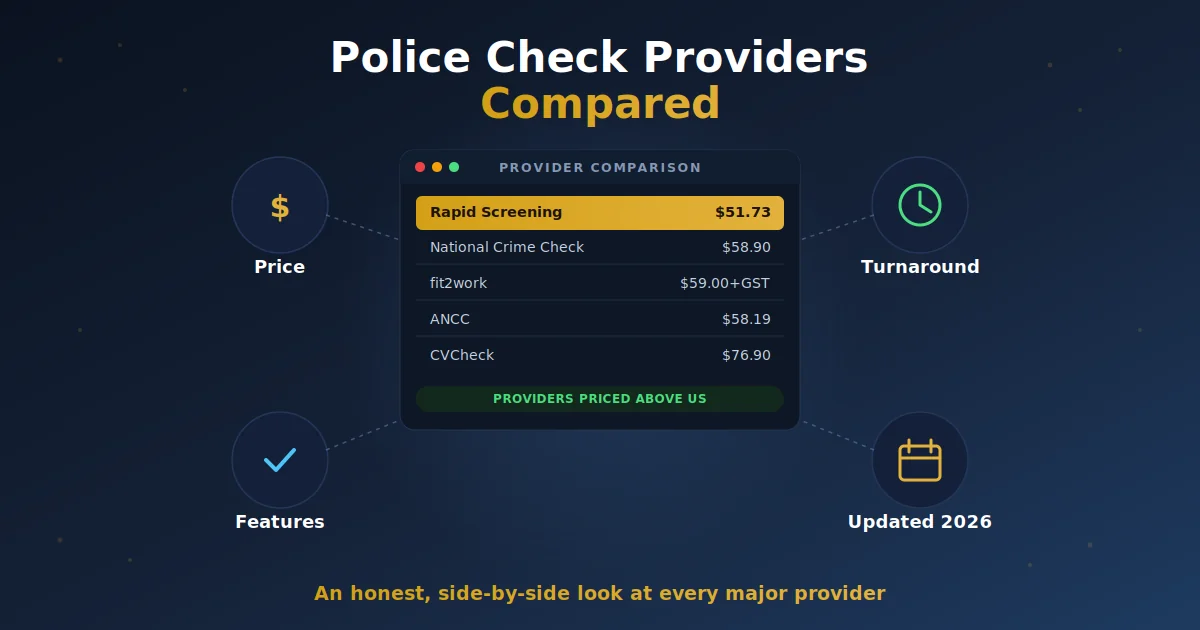
| Cost (NCCHC) | $51.73 + GST | N/A | $42–60 + delays | $50–80 |
| Bulk / Platform API Portal | ✔ Yes | ✘ No | ✘ No | Some |
| Nationwide Validity (all 8) | ✔ Yes | ✘ Varies | ✔ Yes | ✔ Yes |
| Candidate Self-Service Link | ✔ Yes | ✘ No | ✘ No | Partial |
| 24/7 Access | ✔ Yes | ✔ App only | ✘ No | Varies |
7. Best Practices for Platforms Running Gig Worker Screening at Scale
Build Checks Into Your Contractor Onboarding Flow
Integrate the background check invitation into your contractor registration portal. Rapid Screening’s Business API allows platforms to trigger check invitations automatically at the point of sign-up, eliminating manual follow-up and ensuring no worker goes live without clearance.
Use a Centralised Compliance Dashboard
For platforms managing hundreds or thousands of contractors across NSW, VIC, QLD, and WA, a centralised dashboard is essential. Rapid Screening’s Business Essentials account provides real-time status visibility, expiry reminders, and audit-ready reporting.
Establish a Rechecking Policy
A gig economy worker background check is a point-in-time snapshot. In high-risk sectors like healthcare, NDIS, and childcare, platforms should establish an annual or biennial recheck policy to ensure continued suitability. Rapid Screening’s recurring check feature makes this easy to automate.
Educate Your Contractor Community
Many gig workers, especially those new to the Australian workforce or recently arrived in Sydney, Melbourne, Brisbane, or Perth are unfamiliar with the NCCHC process. Rapid Screening’s self-service portal is designed to be intuitive for first-time applicants, with clear step-by-step guidance in plain English.
Never Skip Consent
Australian Privacy Principles are unambiguous: documented consent is mandatory before screening any individual, regardless of their employment status. Platforms that skip this step expose themselves to Privacy Act enforcement action and civil liability from aggrieved contractors.
Conclusion: Screen Smart, Scale Safely
Australia’s gig economy is not slowing down — and neither is regulatory scrutiny. Platforms that fail to implement a consistent, compliant gig economy worker background check process are not just taking a legal risk; they are putting the people their workers serve at genuine risk of harm.
The good news is that fast, affordable, compliant screening is no longer the exclusive domain of large enterprises. With Rapid Screening’s ACIC-accredited platform, any gig economy business from a two-person startup in Sydney to a national rideshare platform operating across all eight states and territories can run professional background checks in hours, not weeks.
Whether you are a contractor in Brisbane preparing for a new platform engagement, an HR manager in Melbourne onboarding casual healthcare workers, or a tech platform in Perth scaling your contractor base, Rapid Screening delivers the fastest, most compliant gig economy worker background check solution in Australia.
Frequently Asked Questions
Q: Do gig economy workers in Australia legally need a background check?
A: It depends on the sector. In regulated industries such as NDIS, aged care, childcare, rideshare, and healthcare, a gig economy worker background check is legally required under sector-specific legislation. For other gig roles, it is not always mandated but is strongly recommended as a risk management measure for platform operators. Failing to screen workers in regulated sectors can result in deregistration and significant financial penalties.
Q: Can a gig worker use one background check result across multiple platforms?
A: Yes — to a point. A Nationally Coordinated Criminal History Check issued by an ACIC-accredited provider like Rapid Screening is nationally valid. However, each platform must individually determine whether an existing check satisfies their compliance requirements, and some platforms may require checks to be no older than 12 months. Rapid Screening’s portable, digitally delivered result makes it easy for workers to share verified results securely.
Q: How quickly can a gig platform onboard a new contractor with Rapid Screening?
A: For 70% of applicants, Rapid Screening returns results within 2–4 hours of submission. This means a contractor who applies in the morning can often be cleared and active by the same afternoon — a critical capability for platforms with tight supply-demand cycles. Complex cases may take up to 10 business days if manual review by the ACIC is required.
Q: What identification documents does a gig worker need to complete the check?
A: Applicants need to provide four identity documents, including at least one photo ID (such as a passport or driver’s licence). Rapid Screening’s platform guides applicants through the document requirements step-by-step and uses the Australian Government’s Document Verification Service (DVS) for real-time identity validation.
Q: How much does a gig economy worker background check cost in Australia?
A: A Nationally Coordinated Criminal History Check for employment through Rapid Screening costs $51.73 + GST per person — one of the most competitive rates from an ACIC-accredited provider in Australia. Volunteer checks are $24.50 + GST. Business and platform accounts with bulk screening needs can contact Rapid Screening for customised pricing and API integration options.
Q: Is a Working with Children Check the same as a police check for gig workers?
A: No. They are separate checks. A Working with Children Check (WWCC) is a state-specific clearance issued by state authorities (e.g. the NSW Office of the Children’s Guardian, Victoria’s DFFH) and is mandatory for gig workers who have direct unsupervised contact with children. A Nationally Coordinated Criminal History Check is a broader criminal history check valid across all sectors and industries. In many regulated roles, gig workers need both.
Stay Informed
Get updates on police check requirements and processing times, straight to your inbox.
Get Your Police Check Now