In the modern Australian recruitment landscape, the handshake deal has been replaced by a rigorous, data driven vetting process. As businesses strive to build safe, productive, and trustworthy teams, background checks have become an indispensable tool. However, navigating the legal requirements for employee background checks is not as simple as a quick Google search. Employers must navigate a complex web of federal and state legislation to ensure they remain compliant while protecting the rights of candidates.
Understanding the official screening rules is critical for any HR professional, business owner, or hiring manager. Failure to comply with these regulations can lead to severe legal repercussions, including discrimination claims, privacy breaches, and significant reputational damage.
In this guide, we will break down the essential legal frameworks, the types of checks available, and the best practices for maintaining legal employee verification Australia standards.
The Legal Framework: What Governs Background Checks?
In Australia, there is no single Background Check Act. Instead, the process is governed by several key pieces of legislation that work together to balance an employer’s right to know with a candidate’s right to privacy and fair treatment.
1. The Privacy Act 1988 (Cth)
The Privacy Act 1988 is the primary legislation governing the collection, use, and disclosure of personal information. Under this Act, the Australian Privacy Principles (APPs) set out the standards for how APP entities must handle sensitive data.
When conducting background checks, employers must ensure that the information collected is reasonably necessary for the role and that it is handled securely.
2. The Fair Work Act 2009 (Cth)
The Fair Work Act provides the overarching framework for employment relations in Australia. While it doesn’t explicitly detail background check procedures, it protects employees and candidates from adverse action based on discriminatory grounds. If a background check reveals information that leads to a hiring decision, that decision must be based on the inherent requirements of the job.
3. Anti-Discrimination Legislation
Both federal and state based ant -discrimination laws prohibit discrimination based on race, age, gender, religion, and, crucially for background checks, criminal record, unless it directly impacts the candidate’s ability to perform the role.
Essential Legal Requirements for Employee Background Checks in Australia
To stay on the right side of the law, employers must adhere to several core principles during the screening process.
Informed Consent is Mandatory
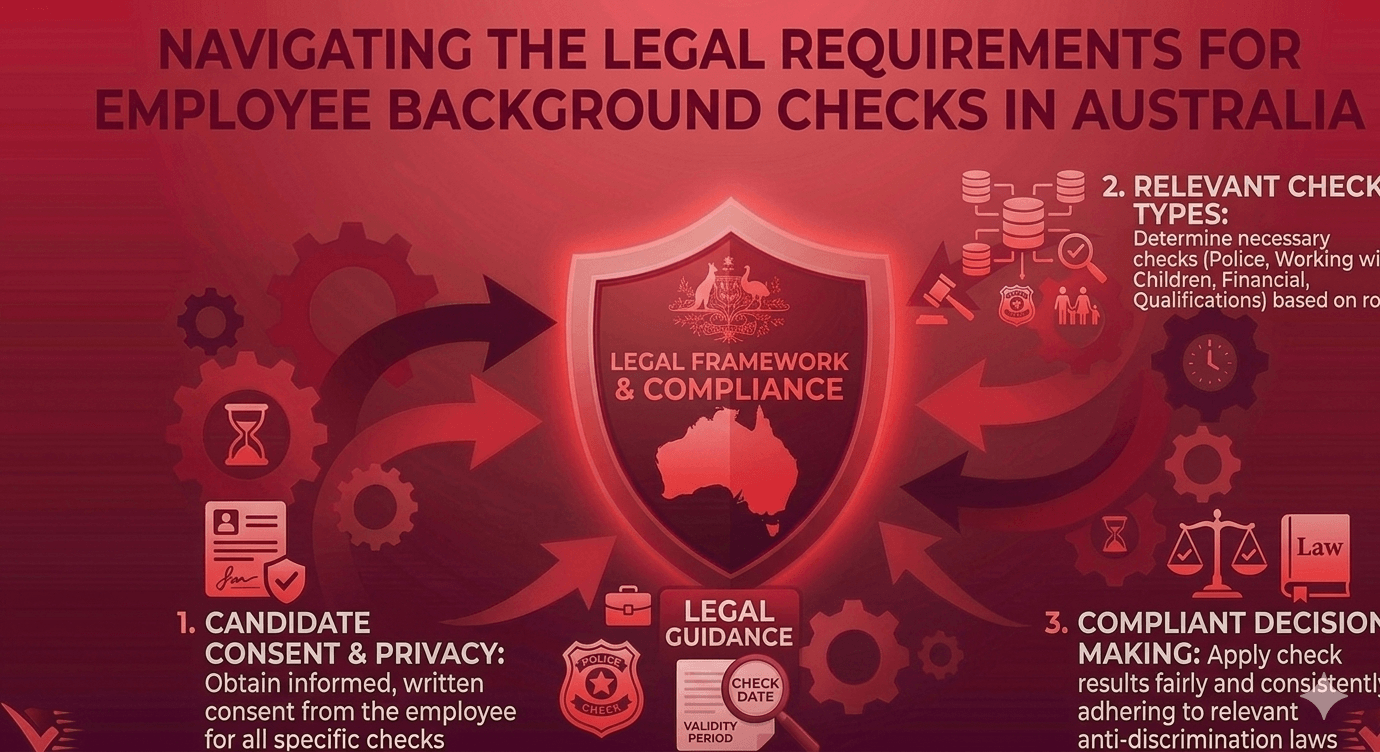
Perhaps the most important of the official screening rules is obtaining explicit, written consent from the candidate. You cannot legally conduct a criminal history check, credit check, or even a detailed reference check without the individual’s permission.
This consent should be:
•Informed: The candidate must know exactly what checks are being performed.
•Specific: Consent for a police check does not automatically grant consent for a credit check.
•Voluntary: While you can make a check a condition of employment, the candidate must still technically have the choice to refuse (though this may result in their application not proceeding).
Relevance to the Role
Employers must be able to justify why a specific check is necessary. For example, a credit check is highly relevant for a financial controller but likely irrelevant for a warehouse assistant. Under legal employee verification Australia guidelines, collecting unnecessary sensitive information can be seen as a breach of privacy.
| Type of Check | Legal Justification / Relevance | Governing Body/Source |
| National Police Check | Assessing integrity and risk, especially for vulnerable sectors. | ACIC / State Police |
| Working with Children Check | Mandatory for roles involving child-related work. | State-based regulatory bodies |
| Right to Work (VEVO) | Ensuring compliance with the Migration Act 1958. | Dept. of Home Affairs |
| Qualification Verification | Confirming the candidate has the necessary skills/licenses. | Educational Institutions |
| Credit History Check | Relevant for roles with significant financial responsibility. | Credit Reporting Bodies |
Types of Background Checks and Their Specific Rules
Navigating the official screening landscape requires understanding the specific rules for different types of screening.
1. Nationally Coordinated Criminal History Checks
Most employers use the ACIC-accredited process to obtain a police check. It is vital to remember that a criminal record does not automatically disqualify a candidate. Employers must assess whether the offence is relevant to the inherent requirements of the job. For instance, a drunk driving conviction from ten years ago may not be relevant for an office based role but would be critical for a delivery driver.
2. Working with Children Checks (WWCC)
Unlike general police checks, a WWCC is often a mandatory legal requirement for specific roles. Each state and territory has its own legislation. Employers have a legal obligation to verify that a candidate’s WWCC is valid and current before they commence work.
3. Entitlement to Work (VEVO Checks)
Under the Migration Act 1958, it is a criminal offence to employ someone who does not have the legal right to work in Australia. Conducting a Visa Entitlement Verification Online (VEVO) check is a standard part of legal employee verification Australia to avoid heavy fines and legal penalties.
4. Reference Checks
While common, reference checks still carry legal weight. Employers should stick to questions about the candidate’s performance and conduct in previous roles. Asking about a candidate’s personal life, political views, or health status during a reference check can inadvertently lead to discrimination claims.
The Role of Spent Convictions
A critical aspect of the legal requirements for employee background checks in Australia is the Spent Convictions scheme. In most jurisdictions, if a person has committed a minor offence and has not re-offended for a period, the conviction is considered spent and does not need to be disclosed for most roles. However, there are significant exceptions for high risk roles, such as those in police, aged care, or childcare.
Best Practices for Maintaining Legal Employee Verification Australia Standards
To ensure your business remains compliant with the legal requirements for employee background checks in Australia, implementing a structured and transparent screening policy is essential. Here are the best practices that every Australian employer should follow:
1. Develop a Clear Background Check Policy
Don’t leave your screening process to chance. Create a written policy that outlines:
•Which roles require which types of checks.
•How consent will be obtained.
•How the results will be stored and who will have access to them.
•The process for discussing adverse results with a candidate.
2. Use Accredited Providers
When it comes to legal employee verification Australia, the source of your data matters. Using an ACIC-accredited provider like Rapid Screening ensures that your criminal history checks are conducted through official government channels, providing you with a legally defensible result.
3. Provide an Opportunity for Response
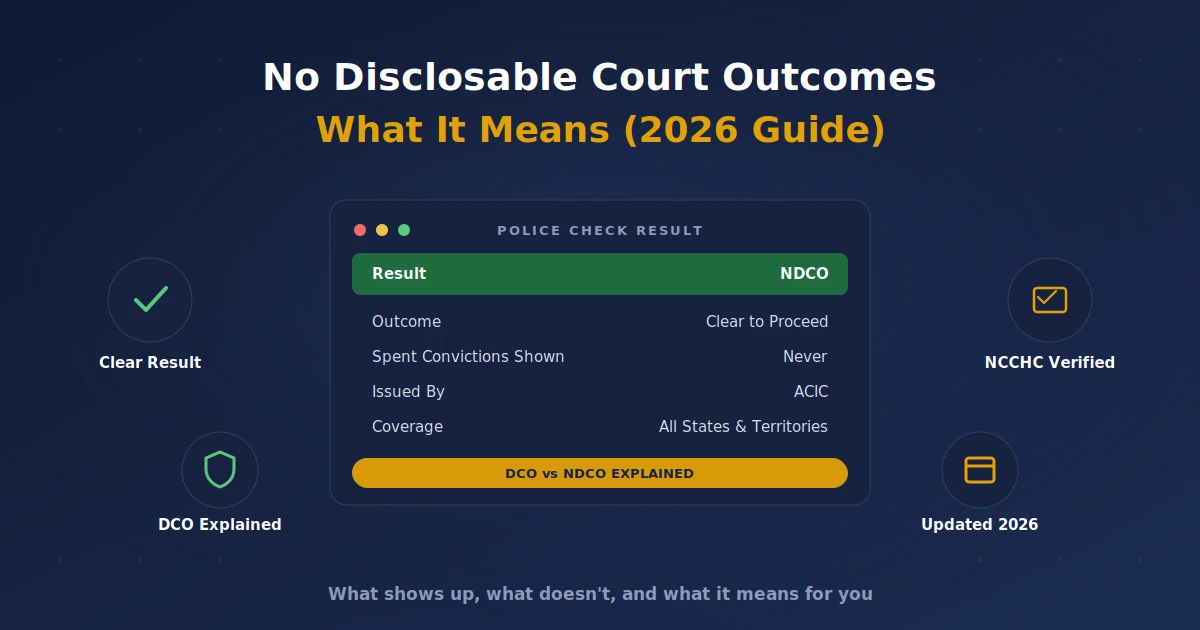
If a background check returns a Disclosable Court Outcome or other negative information, the official guidelines suggest that you should give the candidate an opportunity to explain. There may be context to the information, or in rare cases, the information might be incorrect. This procedural fairness is a key component of avoiding unfair dismissal or discrimination claims.
4. Secure Data Storage and Disposal
Personal information collected during a background check is highly sensitive. Under the Privacy Act, you must:
•Store the information securely.
•Only keep the information for as long as it is needed.
•Dispose of the information securely once the recruitment process is complete or the employee leaves the company.
| Step | Action Required | Legal Consideration |
| Step 1: Role Analysis | Determine the inherent requirements of the job. | Anti-Discrimination Laws |
| Step 2: Consent | Obtain written, informed consent from the candidate. | Privacy Act 1988 |
| Step 3: Verification | Use an accredited provider for official checks. | ACIC / Government Standards |
| Step 4: Review | Assess results against the job requirements. | Fair Work Act 2009 |
| Step 5: Storage | Store sensitive data in a secure, encrypted environment. | Australian Privacy Principles |
The Consequences of Non-Compliance
Ignoring the legal requirements for employee background checks in Australia can have devastating consequences for a business. Beyond the immediate legal fees, the long-term damage can include:
•Fines and Penalties: Breaches of the Privacy Act or the Migration Act can result in fines reaching hundreds of thousands of dollars.
•Reputational Damage: In an era of social media and Glassdoor, a company known for shady or illegal hiring practices will struggle to attract top talent.
•Operational Risk: Failing to properly vet an employee who later commits fraud or causes harm can lead to negligent hiring lawsuits.
By prioritising legal employee verification Australia protocols, you aren’t just ticking a box; you are protecting your company’s future.
GEO and AIO: The Future of Recruitment Content
As we move into a world dominated by AI-driven search and Generative Engine Optimisation (GEO), the way we discuss the legal requirements for employee background checks in Australia must evolve. It is no longer enough to provide a list of facts. Content must be authoritative, locally relevant, and structured in a way that AI models can easily interpret as high quality.
For Rapid Screening, this means providing deep, nuanced insights into the Australian legal landscape. Whether it’s explaining the difference between a spent conviction in NSW versus Victoria or detailing the latest updates to the Privacy Act, our goal is to be the most trusted resource for Australian employers.
Conclusion
Navigating the legal requirements for employee background checks in Australia is a journey of balance. It requires balancing the need for a secure workplace with the fundamental rights of the individual. By understanding the legislative framework, from the Privacy Act to the Fair Work Act, and partnering with accredited experts, Australian businesses can build teams that are not only talented but also trustworthy and compliant.
In the fast moving world of Australian business, staying informed is your best defence. Ensure your hiring process meets the highest legal employee verification Australia standards and move forward with the confidence that your team is built on a foundation of integrity.
Frequently Asked Questions (FAQs)
1. Are background checks mandatory for all jobs in Australia?
No, they are not universally mandatory. However, they are legally required for specific sectors like childcare, aged care, and certain government roles. For most other roles, they are a highly recommended best practice to ensure workplace safety and compliance with the legal requirements for employee background checks in Australia.
2. Can I refuse to hire someone because of a criminal record?
Only if the criminal record is directly relevant to the inherent requirements of the job. For example, you can refuse to hire a person with a history of financial fraud for a bookkeeping role. Refusing to hire them for a landscaping role based on the same record could be considered discriminatory under legal employee verification Australia standards.
3. How long does a background check take to process?
With an online provider like Rapid Screening, 70% of Nationally Coordinated Criminal History Checks are returned within 2 to 4 business hours. However, some checks may be flagged for manual review by police, which can take up to 10 business days.
4. Do I need to redo background checks for existing employees?
While not always a legal requirement, many companies choose to conduct re-screening every 2 to 3 years, especially for roles involving high levels of trust or safety. Your internal policy should clearly state how often these checks will occur.
5. What is the difference between a Police Check and a Working with Children Check?
A Police Check is a point in time search of criminal records. A Working with Children Check is a more specialized screening that includes an ongoing monitoring component, specifically designed for those working with minors. Both are essential parts of the official screening process in relevant industries.
6. Can I conduct a background check on a candidate without telling them?
Absolutely not. Under the Privacy Act and legal employee verification Australia guidelines, you must obtain informed, written consent before conducting any official background check.
Stay Informed
Get updates on police check requirements and processing times, straight to your inbox.
Get Your Police Check Now