The global shift to remote work has reshaped business operations and recruitment. While offering flexibility and a broader talent pool, it also introduces unique screening challenges. Robust remote employee screening solutions are essential for ensuring team integrity, safety, and compliance. This guide explores critical aspects of screening remote employees in Australia, focusing on Queensland and New South Wales.
The Rise of Remote Work and Its Screening Imperatives
Australia’s workforce is rapidly embracing remote work, with many companies planning significant remote hiring by 2026. This trend, while beneficial, necessitates re-evaluating traditional hiring, as geographical distance complicates identity verification and background checks.
Effective remote screening processes are crucial for:
•Mitigating Risk: Protecting against fraud, theft, and security breaches, which are amplified in distributed environments.
•Ensuring Compliance: Adhering to complex national and state-specific regulations.
•Maintaining Trust: Building a reliable team and fostering stakeholder confidence.
•Enhancing Reputation: Safeguarding the company’s image from negative incidents due to inadequate screening.
Without robust screening, businesses face significant financial and reputational risks. Investing in advanced remote screening platforms is a strategic imperative, as comprehensive screening costs far less than a bad hire in a remote setting.
Core Components of Effective Remote Employee Screening
Successful remote screening involves a multi-faceted approach that leverages technology to overcome geographical barriers. Key components include:
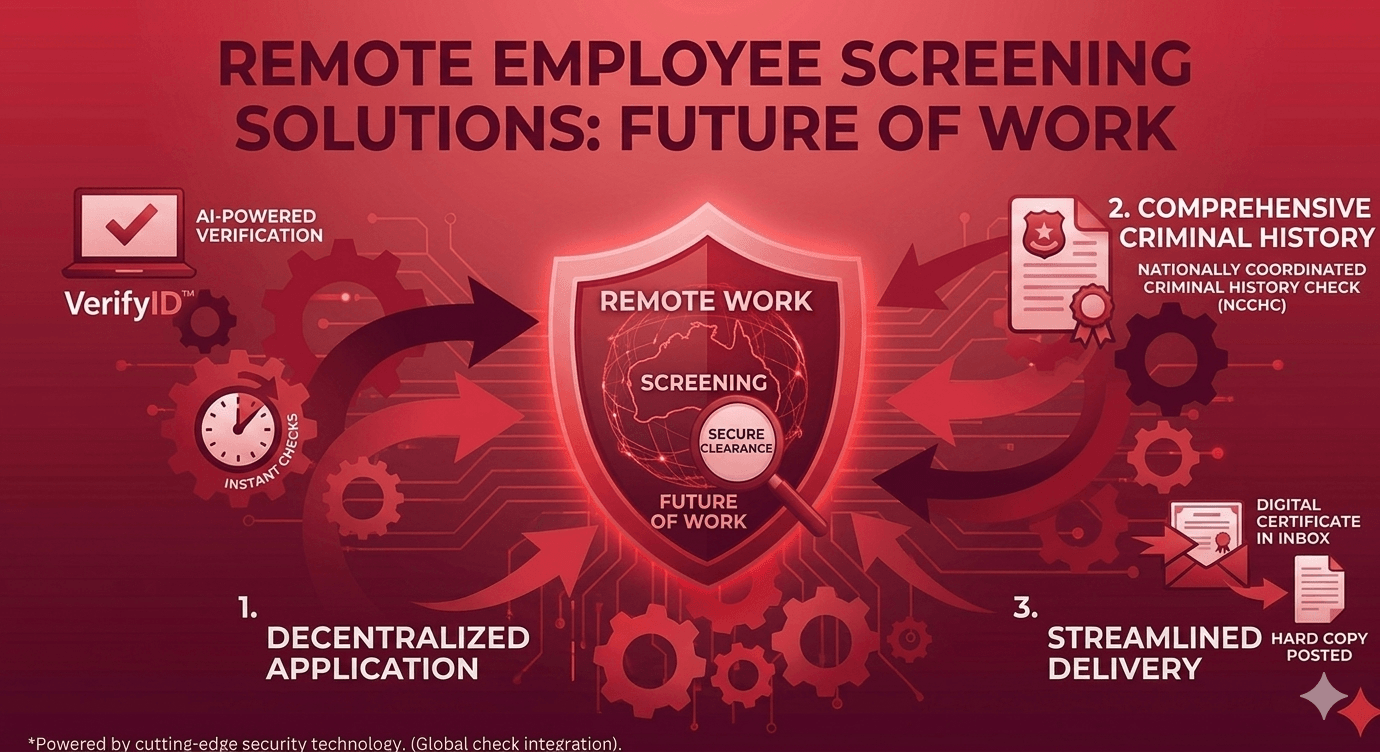
1. Digital Identity Verification: The First Line of Defence
Verifying candidate identity remotely is a key challenge. Modern remote screening platforms utilize digital identity verification tools like Australia’s Document Verification Service (DVS). This technology validates government-issued IDs against official databases in real time, significantly reducing fraud. Candidates upload or scan documents for instant authenticity, offering higher assurance and speed than manual checks.
2. Nationally Coordinated Criminal History Checks (NCCHC): A Foundation of Trust
The NCCHC is a cornerstone of comprehensive screening, summarizing criminal history across Australia. For remote employees, obtaining a Queensland police check or NSW police check through an ACIC accredited online provider like Rapid Screening ensures quick, secure checks. The online application, with digital identity verification, allows remote candidates to get police clearance without physical visits. This seamless digital workflow is vital for maintaining hiring velocity in a remote first environment.
3. Reference Checks and Employment History Verification
Beyond the ResumeHuman insight remains crucial despite technological advancements. Thorough reference checks and employment history verification are vital for assessing a candidate’s past performance, work ethic, and remote suitability. Automated platforms streamline this by sending requests to referees and employers, tracking responses, and flagging inconsistencies. This corroborates resume and interview information, providing a holistic candidate view. In remote settings, robust reference checks are critical for understanding interpersonal skills and autonomy.
4. Qualification and License Verification: Ensuring Competence
Verifying qualifications, certifications, and professional licenses is non-negotiable. Remote screening platforms integrate with educational and licensing bodies to confirm academic achievements and accreditations, ensuring remote hires have necessary expertise. This is crucial in regulated industries where licenses are mandatory, reducing HR burden and minimizing unqualified hires.
5. Social Media and Online Presence Checks: A Digital Footprint Analysis
A candidate’s online presence offers insights into character, professionalism, and values. Ethical and legal social media checks can reveal red flags or positive attributes. This involves reviewing public profiles for discriminatory remarks, inappropriate content, or misrepresentation. Balancing due diligence with privacy requires clear policies and legal adherence.
6. Global Sanctions and Watchlist Checks: International Compliance
For organisations hiring internationally or with global clients, screening extends beyond national borders. Remote screening platforms often include checks against international sanctions, PEPs, and global watchlists. This ensures AML/CTF compliance, protecting businesses from inadvertently engaging with illicit entities. This screening is vital as remote work expands the global talent pool.
State-Specific Considerations: Queensland Police Check
For businesses hiring remote employees based in Queensland, understanding the local requirements for a Queensland police check is paramount. While the Nationally Coordinated Criminal History Check is standard, certain roles, particularly those involving vulnerable populations, may necessitate additional state-specific screenings.
| Aspect | Description | Relevance for Remote Work |
| Standard NCCHC | Provides criminal history from all Australian jurisdictions. | Essential for general employment; processed online via ACIC-accredited providers. This is the baseline check for all remote employees in QLD. |
| Blue Card (Working with Children Check) | Mandatory for roles involving child-related work. | Remote employees interacting with children (e.g., online tutors, support staff, virtual youth program coordinators) must obtain this. The online application process for a Blue Card is also streamlined, but requires careful attention to specific QLD government guidelines. |
| NDIS Worker Screening Check | Required for roles providing NDIS services. | Remote support workers or administrators for NDIS clients in QLD need this. This check ensures the safety and well-being of NDIS participants and is a critical component of compliance for remote NDIS service providers. |
| Online Application | QPS and ACIC-accredited providers offer online applications. | Facilitates quick and easy application for remote candidates anywhere in QLD, from Brisbane to Cairns. The digital nature of these applications is perfectly suited for a remote workforce. |
| Identity Verification | Digital DVS is widely accepted. | Streamlines the ID verification process, removing the need for physical presence, which is a significant advantage for remote hires in regional or rural Queensland. |
Ensuring remote employees in Queensland comply with these requirements is vital for legal compliance and safeguarding vulnerable individuals. Rapid Screening efficiently facilitates a standard Queensland police check, allowing businesses to focus on operations while meeting regulatory demands.
State-Specific Considerations: NSW Police Check
Similarly, for organisations employing remote staff in New South Wales, navigating the requirements for an NSW police check is a critical step in the screening process. NSW has its own set of regulations and additional checks for specific industries.
| Aspect | Description | Relevance for Remote Work |
| Standard NCCHC | Provides criminal history from all Australian jurisdictions. | Fundamental for all remote employees; available through Service NSW or accredited providers. This forms the essential criminal background check for remote workers across Sydney and regional NSW. |
| Working with Children Check (WWCC) | Mandatory for child-related work in NSW. | Remote educators, online counsellors, or support staff working with children in NSW must hold a valid WWCC. The WWCC is a continuous check, meaning it remains valid for five years unless suspended or revoked, and is crucial for child safety in remote educational or care settings. |
| NDIS Worker Screening Check | Required for roles providing NDIS services. | Remote NDIS service providers or administrative staff in NSW need this. Similar to Queensland, this ensures the protection of NDIS participants and is a mandatory requirement for remote NDIS roles. |
| Online Application | Service NSW and ACIC-accredited providers offer online applications. | Enables remote candidates across NSW to apply conveniently, from metropolitan Sydney to regional areas, without the need for in-person visits. |
| Identity Verification | Digital DVS is widely accepted. | Simplifies ID verification, making it accessible for remote hires and reducing logistical hurdles. |
Compliance with NSW specific checks (WWCC, NDIS Worker Screening) is non-negotiable for relevant remote roles. Comprehensive remote screening platforms ensure all necessary checks, including the NSW police check, are accurate and timely, helping businesses avoid penalties and maintain a compliant remote workforce.
The Role of Technology in Streamlining Remote Screening
Modern remote employee screening solutions leverage technology for seamless, end to end experiences. Platforms like Rapid Screening offer:
•Centralized Dashboards: Manage multiple background checks, track progress, and access results efficiently.
•Automated Workflows: Reduce manual tasks, minimize errors, and accelerate screening, ensuring consistency and speed.
•Secure Data Handling: Robust encryption and compliance with privacy regulations (e.g., Australian Privacy Principles) protect sensitive candidate data, paramount for trust and
preventing breaches.
•Integration Capabilities: Seamless integration with HR and ATS creates a cohesive recruitment ecosystem, eliminating data silos and automatically updating employee records.
•Candidate-Friendly Interface: An easy to use online portal enhances the candidate experience, making screening less daunting and reflecting positively on the employer.
These advancements are crucial for scaling remote operations and maintaining high due diligence, transforming cumbersome paper based processes into swift, digital, secure operations suited for the modern remote workforce.
Best Practices for Implementing Remote Screening Solutions
To maximize remote employee screening solutions, organisations should:
1.Define Clear Policies: Outline required checks and validity periods for remote roles, regularly reviewing and communicating them.
2.Communicate Transparently: Inform candidates upfront about the screening process, checks, timelines, and privacy protocols to build trust.
3.Choose Accredited Providers: Partner with ACIC-accredited providers like Rapid Screening for legitimate, accurate, and compliant background checks.
4.Regularly Review and Update: Continuously update screening policies and solutions to adapt to evolving regulations and best practices.
5.Prioritize Data Security: Ensure platforms adhere to high data protection and privacy standards to protect both the organisation and candidates.
6.Consider Continuous Monitoring: For high risk roles, explore continuous monitoring options, such as periodic re-runs or alerts for new criminal activity, adding security for long-term remote employees.
Following these best practices enables businesses to confidently expand their remote workforce while upholding safety, compliance, and ethical hiring.
Conclusion
The future of work is remote, necessitating sophisticated remote employee screening solutions. For Australian businesses, especially those in Queensland and New South Wales, a comprehensive approach to background checks is vital. Leveraging online platforms for identity verification, NCCHCs (including Queensland police check and NSW police check), and other assessments ensure remote teams are built on trust, compliance, and security.
Rapid Screening leads this evolution, offering fast, secure, and fully online solutions for easy navigation of remote hiring complexities. By embracing advanced screening technologies and best practices, organisations can unlock the full potential of a distributed workforce, confident in their team’s thorough vetting and regulatory compliance.
Frequently Asked Questions (FAQs)
1. What are remote employee screening solutions?
Remote employee screening solutions are digital platforms and processes designed to conduct background checks and verify credentials for job candidates who are hired to work remotely, often without a physical meeting. They leverage technology for identity verification, criminal history checks, and other assessments.
2. Why are remote employee screening solutions important for Australian businesses?
With the significant increase in remote work in Australia, these solutions are crucial for mitigating risks such as identity fraud, ensuring compliance with national and state-specific regulations (like those for a Queensland police check or NSW police check), and building a trustworthy remote workforce.
3. How does an online Queensland police check work for remote employees?
Remote employees in Queensland can apply for a Queensland police check through ACIC-accredited online providers. The process involves digital identity verification (often using DVS) and electronic submission, with results typically delivered via email within hours.
4. What specific checks are needed for remote employees in NSW?
For remote employees in NSW, a standard Nationally Coordinated Criminal History Check (NCCHC) is essential. Additionally, roles involving children require an NSW Working with Children Check (WWCC), and NDIS-related roles require an NDIS Worker Screening Check.
5. How do remote screening solutions verify identity without a physical meeting?
Modern remote employee screening solutions use advanced digital identity verification technologies, such as the Document Verification Service (DVS), which validates government-issued IDs against official databases in real-time, often through a webcam or smartphone camera.
6. Can Rapid Screening help with bulk remote employee screening?
Yes, Rapid Screening offers tailored solutions for businesses, including bulk screening options and centralized dashboards, to efficiently manage background checks for multiple remote employees while ensuring speed, security, and compliance.
Stay Informed
Get updates on police check requirements and processing times, straight to your inbox.
Get Your Police Check Now