- Last updated:September 3, 2026
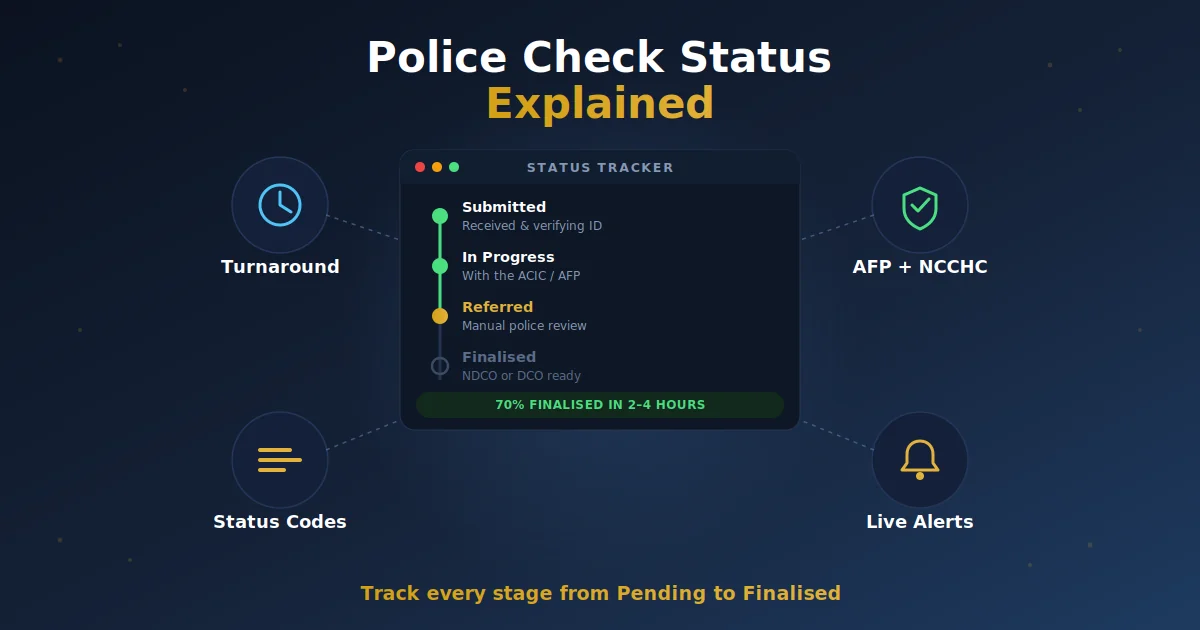
Quick answer: Your police check status moves through four stages: Submitted (received and verified ID), In Progress (with the ACIC/AFP), Referred (flagged for manual police review, up to 15 business days), and Finalised (NDCO or DCO result ready). About 70% of checks go from Submitted to Finalised within 2–4 hours.
You’ve uploaded your ID, smiled for the biometric camera, and hit submit. Now, the waiting game begins. In the fast-paced Australian job market of 2026, where “onboarding” often happens in a matter of days, waiting for a background clearance can feel like an eternity. Whether you are applying for a role in healthcare, finance, or a local volunteer position, knowing your police check status is the key to managing your professional timeline.
At Rapid Screening, we believe that transparency is the best cure for application anxiety. While the national police checking system is more efficient than ever, it isn’t always instant. This guide will walk you through the various stages of the checking process, explain why some applications take longer than others, and help you interpret exactly what your current police check status means for your employment.
The 70/30 Standard: Setting Real Expectations
Before we dive into the specific codes, it is important to understand how the Australian Criminal Intelligence Commission (ACIC) processes millions of checks every year. As of 2026, the industry operates on what we call the 70/30 rule.
The Instant Majority
Approximately 70% of all national police checks are finalised almost immediately. These are the applications where the automated name-matching algorithm finds no potential matches in the national database. If you fall into this category, your check will likely move from ‘Submitted’ to ‘Finalised’ within a matter of minutes to two hours.
The Manual Minority
The remaining 30% of applications are flagged for manual processing. This does not mean you have a criminal record. It simply means that the computer found a potential match, perhaps someone with a similar name or date of birth, and a human police officer must now manually verify the data. When this happens, your police check status will shift to Referred, and the timeframe can extend from a few hours to up to 15 business days.
Deciphering Your police check status: What Do the Codes Mean?
When you log into the Rapid Screening portal to track your application, you will encounter specific terms. Understanding these will help you provide accurate updates to your prospective employer.
| Status | What it means | Typical timeframe |
|---|---|---|
| Application Received / Pending ID Verification | Your details have reached our servers; biometric ID matching is running. | Seconds to a few hours |
| In Progress / Submitted to ACIC | Passed internal checks and sent to the National Police Checking Service. | Minutes to 2 hours |
| Referred | Flagged for manual review by one or more police jurisdictions. | Up to 15 business days |
| RFI (Request for Information) | Police need extra detail, e.g. a clearer ID photo or a previous address. | Depends on your response time |
| Dispatched | Certificate generated and emailed to you. | Immediate |
| Finalised (NDCO) | Clear result: no disclosable court outcomes. | — |
| Finalised (DCO) | Disclosable court outcome(s) included on the certificate. | — |
AFP Police Check Status: How It’s Different
If you’ve applied directly through the Australian Federal Police (AFP) rather than an ACIC-accredited provider, your AFP police check status is tracked through a separate portal with its own terminology. The stages are similar in substance to the ones above, but the labels differ slightly:
- Application Received: equivalent to our “Submitted” stage.
- In Progress: your details are being checked against police records nationally.
- Referred to State/Territory Police: the AFP equivalent of “referred”, used when a potential match needs manual verification.
- Result Ready / Certificate Issued: equivalent to “Finalised”.
The underlying process is the same Nationally Coordinated Criminal History Check or not, since the AFP and ACIC-accredited bodies like Rapid Screening both submit to the same National Police Checking Service. If you’re not sure whether you need an AFP national police check status lookup or a standard NCCHC, our NPC vs AFP Check comparison breaks down which one your employer actually needs. When you apply through Rapid Screening, you check everything from the one dashboard; no separate AFP login is required. See our AFP check page for details.
Checking Your Police Check Status by State
The status stages above are identical no matter which state or territory you applied from, since every check runs through the same national system. If you’re after state-specific pricing, turnaround, or requirements rather than status tracking, see your state’s page:
- NSW police check
- Victoria police check
- Queensland police check
- South Australia police check
- Western Australia police check
- Tasmania police check
- Northern Territory police check
Why is my cheque still referred? (The Manual Vetting Deep Dive)
It is the question every applicant asks: Why is my friend’s check finished while mine is still pending? If your police check status hasn’t moved for several days, it is usually due to one of the following complexities in the system.
Common Names and Data Overlap
If your name is Sarah Smith or David Jones, the name-matching algorithm will likely find hundreds of potential matches. The police must verify each one to ensure they don’t accidentally attribute someone else’s criminal history to you. This is a vital safeguard for your own privacy and reputation.
Multi-State Residency
If you have lived in three different Australian states over the last five years, your application may need to be vetted by the police force in each of those jurisdictions. Each state has its own workload and resource levels, which can impact how quickly they move your check from referred to finalised.
Old or Incomplete Records
Sometimes, the system encounters old records that haven’t been fully digitised. If a potential match involves a record from several decades ago, a police officer may need to manually retrieve and verify that information before the police check status can be updated.
How to Check Your Police Check Status on Rapid Screening
We’ve designed our 2026 platform to be as transparent as possible. You don’t need to call a government hotline or wait for a return email to see where you stand. For the full step-by-step walkthrough of logging in, finding your reference number, and setting up alerts, see our guide on how to track your police check.
Using Your Reference Number
When you submitted your application, you were assigned a unique reference number. By entering this number into our secure Track My Check portal, you can see real-time updates directly from the ACIC interface.
SMS and Email Alerts
You don’t need to refresh the page every ten minutes. Rapid Screening sends automated alerts the moment your police check status changes. Whether your ID is approved or your final certificate is ready for download, you’ll be the first to know.
Pro Tip: If your check is referred, check your email daily. Occasionally, the police may issue a Request for Further Information (RFI) to clarify a middle name or a previous address. Responding to these quickly is the best way to move your application along.
Communicating with Employers While Pending
In 2026, most HR managers understand the 70/30 rule. They know that a delay doesn’t equate to a failure. However, being proactive can help you maintain a professional image.
If your check has been in a “Referred” police check status for more than 48 hours, we recommend sending a brief note to your recruiter:
“Hi [Name], just a quick update on my background screening. My check is currently in ‘Manual Processing’ with the ACIC. As this can take up to 15 business days due to the current police vetting workload, I wanted to keep you in the loop. I will notify you the moment the result is finalised.”
This level of transparency shows that you are organised and understand the compliance landscape.
Conclusion: Patience and Transparency
Waiting for a background check is never fun, especially when a new job is on the line. However, the rigor of the Australian police checking system is what ensures our workplaces and communities remain safe. By understanding the different stages of your police check status, you can navigate the pending period with much less stress.
At Rapid Screening, we are committed to providing you with the fastest possible turnaround and the most transparent tracking in the industry. While we can’t make the police work faster, we can ensure that you are never left in the dark.
Frequently Asked Questions (FAQs)
My status says Dispatched. What does that mean?
In 2026, ‘Dispatched’ typically means your digital certificate has been generated and sent to your nominated email address. If you can’t see it, check your Junk or Spam folder first.
Why did my friend get their result in 2 hours and mine is taking days?
This is almost always due to the name-matching algorithm. Your friend likely had a unique name and no address history overlaps, allowing for an instant result, whereas yours may have triggered a manual review.
How long can a check stay in a referred police check status?
While most are resolved within a few days, the ACIC allows police agencies up to 15 business days to finalise a manual review. In very rare, complex cases, it can take longer.
What is an RFI status?
RFI stands for Request for Information. It means the police need more details, usually a photo of a specific ID document or clarification on a previous name, before they can finalise your check.
Can I cancel my check if the status is In Progress?
Once a check has been submitted to the ACIC, the government fees are processed, and the search is initiated. At this stage, the application cannot be cancelled or refunded.
What does “national police check status” mean?
It’s another way of describing the same thing as your police check status: where your Nationally Coordinated Criminal History Check sits in the process, from submitted through to finalised.
How do I check my AFP police check status?
If you applied directly through the AFP, you’ll track it via their own status portal using the reference number from your confirmation email. If you applied through Rapid Screening, you can check everything, including AFP-equivalent checks, from your Rapid Screening dashboard.
Does my police check status differ between NSW, Victoria, or other states?
No. The status stages (Submitted, In Progress, Referred, Finalised) are the same nationally, since all applications go through the same National Police Checking Service, regardless of which state you applied from.
Can I check my police check status online without logging in?
You’ll need your reference number and portal login to see live status updates. This is a security measure, since your check contains sensitive personal information.
Stay Informed
Get updates on police check requirements and processing times, straight to your inbox.
Get Your Police Check Now