- Last updated:September 29, 2026
Quick answer: What most people call an NDIS police check is officially the NDIS Worker Screening Check. It is mandatory for anyone in a risk-assessed role with a registered NDIS provider, including key personnel. It is issued by your state or territory worker screening unit, lasts five years, and is recorded on the national NDIS Worker Screening Database. A standard National Police Check cannot replace it.
If you run an NDIS provider, worker screening is one of the first things an auditor looks at. “NDIS police check” is the phrase most people search for, but the check you actually need is the NDIS Worker Screening Check: a national assessment run by state and territory screening units, and a separate process from a standard police check. Getting it right protects participants and protects your registration.
This guide explains who needs an NDIS police check, how it differs from a National Police Check, what it costs, how long it takes, and what providers must do to stay compliant. If you are new to the sector, our guide on how to become a disability support worker is a useful companion.
What Is an NDIS Police Check?
An NDIS police check is the everyday name for the NDIS Worker Screening Check. It is a national assessment that decides whether a person is suitable to work in a risk-assessed role with people with disabilities. It looks at criminal history and also at misconduct findings and other information held by courts, police, government agencies, and the NDIS Commission. After a clearance is issued, it is monitored on an ongoing basis rather than checked once and forgotten.
The outcome is either a clearance or an exclusion, and the decision is recorded on the national NDIS Worker Screening Database. There is no physical card. Employers confirm a worker’s status online.
The name changes slightly by state. It appears as the NDIS Worker Check in NSW and the NDIS Check in Victoria, but it is the same national check with the same five-year clearance.
Why NDIS Police Check Requirements Matter
- Participant safety. People with disabilities can be more vulnerable to harm and exploitation, and screening is a core safeguard.
- Registration. Registered providers must ensure workers in risk-assessed roles hold a clearance under the NDIS Practice Standards (Worker Screening) Rules 2018.
- Audit readiness. Worker screening records are one of the first things reviewed during an audit.
- Trust. Participants, families and referrers expect providers to only engage workers who have been properly screened.
Who Needs an NDIS Police Check?
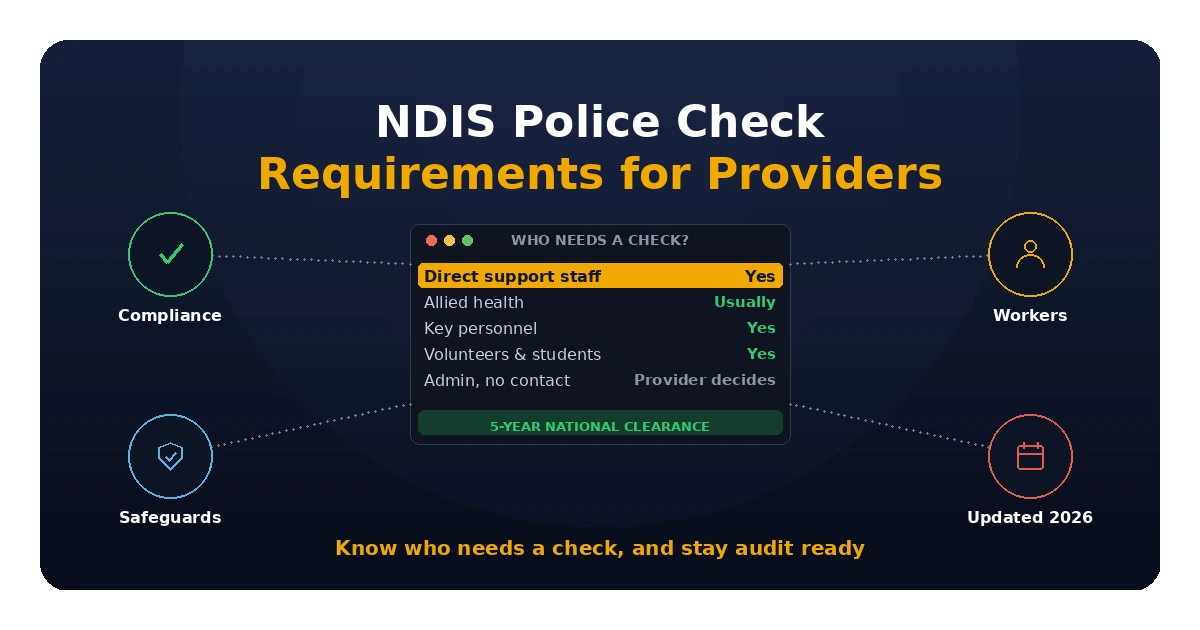
According to the NDIS Quality and Safeguards Commission, an employee, volunteer, contractor or student needs a check if they work for a registered provider in a risk-assessed role or a key personnel role. A registered provider can also decide that all of its workers need one. Unregistered providers and self-managed participants can choose to require a check from the workers they engage, though it is not mandatory for them.
A risk-assessed role is one that involves delivering specific supports or services to people with disabilities or that is likely to involve more than incidental contact with them, whether in person, by phone or online. Key personnel are people such as CEOs, board members and senior managers.
Employers are responsible for identifying which of their roles are risk-assessed. Here is how that typically plays out:
| Role | Check required? | Why |
|---|---|---|
| Direct support worker (personal care, community access) | Yes | Delivers supports directly to people with disability |
| Allied health professional delivering NDIS services | Usually | Delivers services to people with disability |
| Key personnel (CEO, board member, senior manager) | Yes | Key personnel of a registered provider must hold a clearance |
| Cleaner or customer service staff who build rapport with participants | Possibly | Roles with more than incidental contact can be risk-assessed |
| Administrative staff with no participant contact | Not necessarily | The provider decides, and some require checks for every worker |
| Volunteers and students on placement in a risk-assessed role | Yes | Free or discounted for volunteers in most states, and supervised arrangements can apply to some placements |
| Workers engaged by a self-managed participant | If the participant requires it | Self-managed participants can choose to require checks |
If you are unsure whether a role is risk-assessed, get independent advice for your specific circumstances. Our overview of what an NDIS support worker does shows the kinds of duties that typically involve participant contact.
NDIS Worker Screening Check vs National Police Check
The two are often confused, and the difference matters for compliance.
| Feature | NDIS Worker Screening Check | National Police Check |
|---|---|---|
| Purpose | Assess whether a worker poses a risk to people with disability | Report disclosable court outcomes for employment, licensing or volunteering |
| Issued by | State or territory worker screening unit | ACIC-accredited body such as Rapid Screening |
| What it assesses | Criminal history, misconduct findings and other information, with ongoing monitoring | Disclosable court outcomes at a point in time |
| Outcome | Clearance or exclusion, recorded on the NDIS Worker Screening Database | A result listing disclosable court outcomes, or none |
| Validity | 5 years, recognised nationally | No formal expiry; the employer decides how recent it must be |
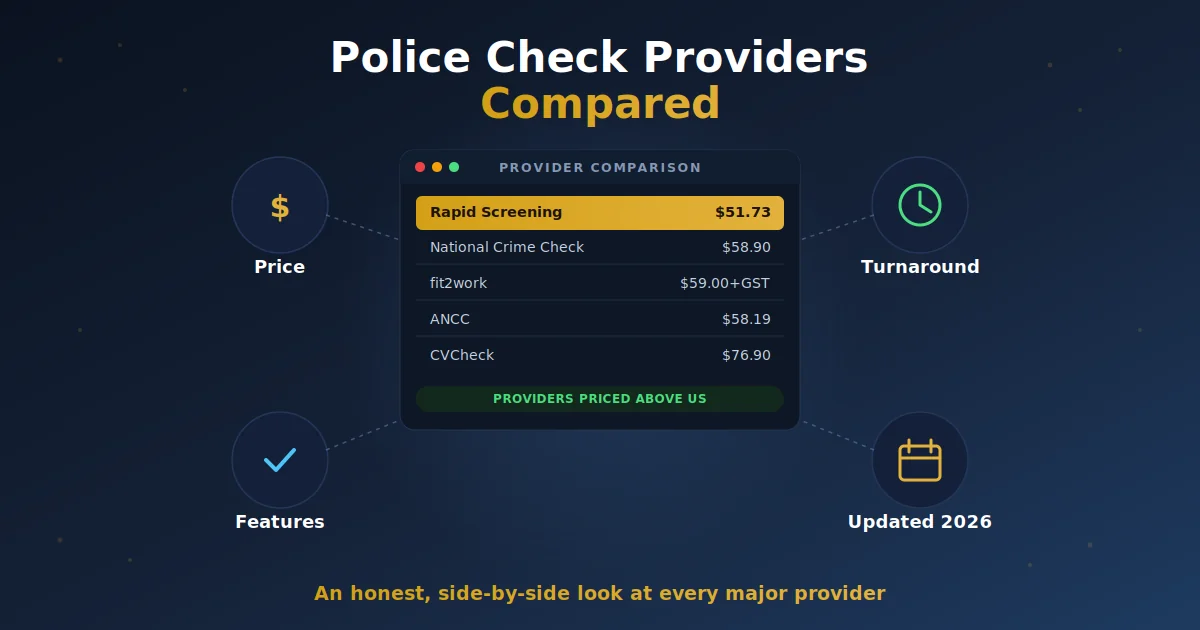
| Cost | Set by each state and territory. Paid workers generally pay over $100 (Queensland: $161.30 from 1 July 2026). Free or discounted for volunteers in most states | $51.73 + GST ($56.90 inc. GST) with Rapid Screening |
| Turnaround | Several weeks, with no guaranteed time | 70% within 2-4 hours with Rapid Screening |
| Required for risk-assessed NDIS roles? | Yes | No, it is an optional additional check |
How Providers Manage NDIS Police Check Requirements
Here is a practical process for meeting your obligations, whether you are a registered provider or a sole trader.
- Identify and record your risk-assessed roles. Registered providers must keep a written record of the risk-assessed roles in the organisation and an up-to-date record of the people in them.
- Get access to the NDIS Worker Screening Database. Registered providers access it through the NDIS Commission portal. Unregistered providers and self-managed participants can request access.
- Give workers your NDIS employer ID. Workers need it to link their application to your organisation.
- Workers apply through their state or territory screening unit. They provide identity documents, consent to the checks, and pay the fee. The NDIS Commission lists each unit and its portal.
- Verify each application promptly. An application will not progress until the employer verifies it. If it is not verified within the deadline (around 28 to 30 days), it is cancelled, and the worker loses their fee.
- Confirm clearance before rostering. Check the database before assigning any risk-assessed work, then track expiry dates and delink workers who leave.
For practical ways to move an individual application along faster, see our guide to the NDIS worker screening approval process.
How Much Does an NDIS Police Check Cost?
There is no single national fee. Each state and territory sets its own application fee, usually indexed on 1 July each year. Paid workers generally pay over $100, and Queensland’s fee from 1 July 2026 is $161.30. Volunteers are free or discounted in most states. Workers can pay themselves or arrange for an employer to pay, depending on the state.
Application fees are non-refundable, so confirm the worker’s role, their eligibility, and your NDIS employer ID before they apply. In Queensland, workers who also need a Blue Card can apply for both at once for a single fee. Always check the current amount on your state portal, because fees change.
How Long Does an NDIS Worker Screening Check Take?
There is no guaranteed turnaround. Processing depends on the state and how complex the applicant’s history is, and applications with correct details and clear ID move fastest. Plan for several weeks and apply well before a worker’s start date.
Some states and territories allow a worker in a risk-assessed role to work while their application is pending, under conditions such as supervision. Rules differ by state, so check yours before rostering, and never assume it is allowed.
Validity and Renewals
An NDIS Worker Screening Check clearance is valid for five years and is recognised in every state and territory, so a worker does not need to reapply if they move interstate or change employers. During that time, it is subject to ongoing monitoring.
The first clearances, issued from February 2021, began reaching their five-year expiry in February 2026, so many providers are managing a wave of renewals right now. Track every expiry date and start renewals early, ideally around three months ahead, so no one is rostered on risk-assessed work with a lapsed clearance.
Ongoing Compliance Checklist for Providers
- Keep a written record of your risk-assessed roles and the workers in them.
- Verify new workers on the NDIS Worker Screening Database before they start.
- Turn on email alerts for status changes to your workers’ clearances.
- Delink workers who no longer work for you.
- Track expiry dates in a central HR system and start renewals early.
- Train HR and rostering staff on current screening rules.
Consequences of Non-Compliance
Engaging a worker in a risk-assessed role without a valid clearance can put your registration at risk and lead to compliance action by the NDIS Commission. It also puts participants at risk and can seriously damage your reputation with participants, families and referrers.
Where a National Police Check Fits
A National Police Check does not satisfy the NDIS worker screening requirement, and Rapid Screening does not issue NDIS clearances. Some providers still run a National Police Check as an additional pre-employment step, for example, during recruitment or for roles that fall outside the risk-assessed definition.
If that suits your process, you can get a National Police Check online with 70% of results returned within 2-4 hours. For onboarding several workers at once, see our business screening solutions. If your workforce supports children with disabilities, our guide to the welfare police check and our article on NDIS support for children ages 1-12 may also help.
Frequently Asked Questions
What is an NDIS police check?
An NDIS police check is the everyday name for the NDIS Worker Screening Check, a national assessment run by state and territory worker screening units. It looks at criminal history and other information, such as misconduct findings, to decide whether someone is suitable to work in a risk-assessed role with people with disabilities.
Is an NDIS worker screening check the same as a police check?
No. A National Police Check reports disclosable court outcomes at a point in time. The NDIS Worker Screening Check goes further by assessing misconduct findings and other information, results in a clearance or exclusion, and is monitored on an ongoing basis.
Who needs an NDIS worker screening check?
Employees, contractors, volunteers and students in a risk-assessed role with a registered NDIS provider, and key personnel such as CEOs and board members. Providers can also choose to require it for other workers, and so can self-managed participants.
What is a risk-assessed role?
A role that involves delivering specific supports or services to people with disabilities, or that is likely to involve more than incidental contact with them. Employers are responsible for identifying their risk-assessed roles, and registered providers must keep a written record of them.
How much does an NDIS worker screening check cost?
Each state and territory sets its own fee, usually indexed each 1 July. Paid workers generally pay over $100, and Queensland’s fee from 1 July 2026 is $161.30. Volunteers are free or discounted in most states, and application fees are non-refundable.
How long does an NDIS worker screening check take?
There is no guaranteed turnaround. Straightforward applications with correct details clear fastest, while complex histories take longer. Plan for several weeks and apply well before a worker’s start date.
How long is an NDIS worker screening check valid?
Five years, recognised nationally, and monitored on an ongoing basis during that time. Providers should track expiry dates and renew early.
Can I use a National Police Check instead of an NDIS worker screening check?
No. A National Police Check does not meet the NDIS worker screening requirement for risk-assessed roles. Some providers use it as an additional pre-employment check, but the NDIS clearance itself must come from the state or territory worker screening unit.
Can a worker start before their clearance comes through?
Some states and territories allow a worker in a risk-assessed role to work while their application is pending, under conditions such as supervision. Rules differ by state, so check yours before rostering and do not assume it is allowed.
Do volunteers and students need an NDIS worker screening check?
Yes, if they are in a risk-assessed role with a registered provider. Volunteers are free or discounted in most states. Higher education students on placement and secondary school students on formal work experience may be able to work under supervision in some circumstances.
Do sole traders need an NDIS worker screening check?
Sole traders who are registered NDIS providers do. A sole trader is treated as both the worker and the employer, so they complete both parts of the process and verify their own check on the database. Unregistered sole traders may still be asked to hold one by the participants who engage them.
Do I also need a Working With Children Check?
Often yes, if the role involves children with disability, because they are separate legal requirements. In Queensland, workers who need both an NDIS clearance and a Blue Card can apply for both at once for a single fee.
Conclusion
Meeting NDIS police check requirements comes down to a few habits: know which of your roles are risk-assessed, make sure every one of those workers holds a valid NDIS Worker Screening Check, verify them on the database, and track expiry dates so nothing lapses. An NDIS police check is a safeguard for participants and the foundation of a compliant workforce. Build it into your recruitment and rostering process now, and audits become far less stressful.
Stay Informed
Get updates on police check requirements and processing times, straight to your inbox.
Get Your Police Check Now