- Last updated:November 3, 2026
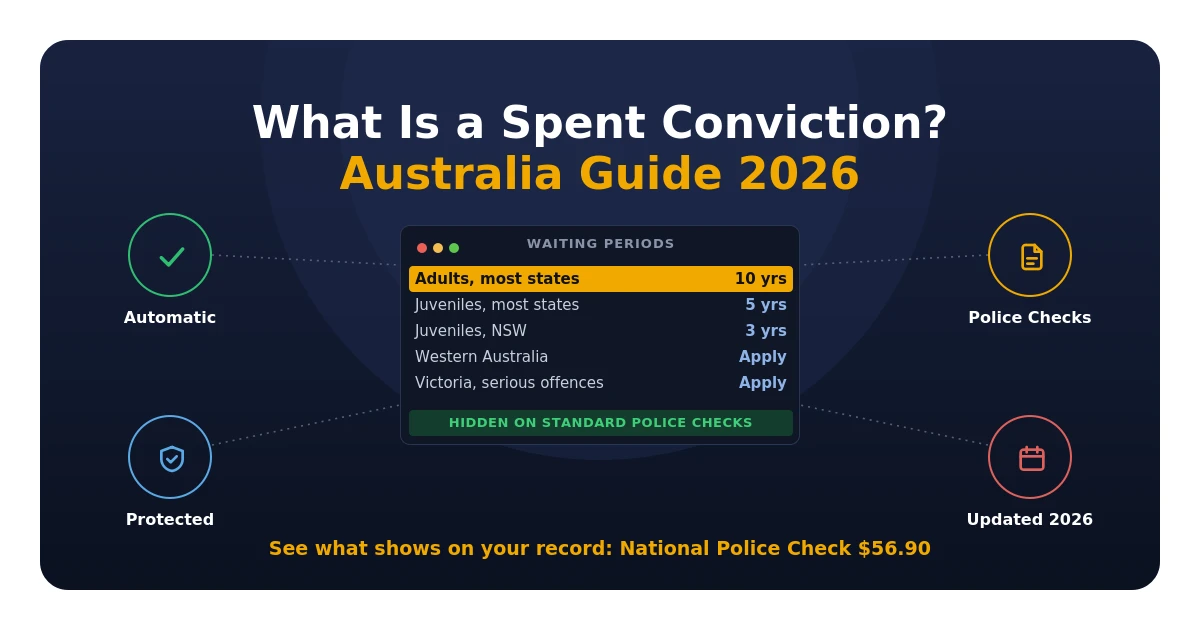
What is a spent conviction? A spent conviction is an older, less serious criminal conviction that no longer appears on a standard National Police Check, and that you don’t have to disclose once you stay crime-free for a set waiting period. In most of Australia, that period is 10 years for adults and 5 years for juveniles (3 years in NSW). Some convictions are never spent, and some roles, such as working with children or in aged care, can still see them.
Rules vary by state, so two people with the same offence can get different results on a police check. This guide covers the waiting period in every state and territory, what shows on your police check, the exceptions, and how to apply for a spent conviction where an application is needed.
Quick facts:
- Adults: usually 10 crime-free years
- Juveniles: usually 5 years (3 years in NSW)
- Automatic in most states: no application needed
- Application needed: WA, and serious convictions in Victoria
- Never spent: sexual offences and long prison sentences in most states
What Is a Spent Conviction? (Spent Conviction Meaning)
In plain terms, the spent conviction meaning is simple: the law treats an old, minor conviction as something you no longer have to carry. Once a conviction is spent:
- It is left off a standard National Police Check for most purposes.
- You do not have to disclose it to an employer, landlord or anyone else, unless an exemption applies.
- If a question asks about your criminal history, it is taken to refer only to convictions that are not spent.
- An employer who learns about it should not take it into account for a non-exempt role.
What does it mean when a conviction is spent? It does not mean the record is deleted. Police still hold it, and courts, law enforcement agencies, and exempt employers can still see it. Spent means hidden for most purposes, not erased.
Under the Commonwealth scheme, a conviction is spent when 10 years have passed (5 years for a child), the sentence was no more than 30 months in prison, you have not reoffended in that time, and no exclusion applies (AFP). Each state and territory then applies its own rules to offences recorded there.
How Long Until a Conviction Is Spent in Australia?
Most convictions become spent after 10 crime-free years for adults and 5 years for juveniles. NSW is shorter for children (3 years), WA requires an application, and every state sets its own limit on which sentences can ever be spent. Reoffending during the waiting period restarts the clock.
| Jurisdiction | Law | Adults | Juveniles | Cannot be spent automatically if | How it becomes spent |
|---|---|---|---|---|---|
| Commonwealth | Crimes Act 1914 (Part VIIC) | 10 years | 5 years | Prison over 30 months | Automatic |
| NSW | Criminal Records Act 1991 | 10 years | 3 years | Prison over 6 months; sexual offences | Automatic |
| VIC | Spent Convictions Act 2021 | 10 years | 5 years (under 21) | Prison over 30 months; sexual or serious violence offence | AutomaticApply if serious Serious convictions: Magistrates’ Court |
| QLD | Criminal Law (Rehabilitation of Offenders) Act 1986 | 10 years (convicted on indictment); 5 years otherwise | 5 years | Prison over 30 months | Automatic |
| WA | Spent Convictions Act 1988 | 10 years plus any prison term imposed | Separate youth rules | Life imprisonment | Application only Lesser: WA Police. Serious: District Court |
| SA | Spent Convictions Act 2009 | 10 years | 5 years | Adults: prison over 12 months; juveniles: over 24 months; sexual offences | Automatic |
| ACT | Spent Convictions Act 2000 | 10 years | 5 years | Prison over 6 months; sexual offences | Automatic |
| TAS | Annulled Convictions Act 2003 (“annulled”, not “spent”) | 10 years | 5 years | Prison over 6 months; sexual offences | Automatic |
| NT | Criminal Records (Spent Convictions) Act 1992 | 10 years | 5 years | Prison over 6 months; sexual offences | Automatic |
Waiting periods assume no new offences. A new conviction during the waiting period restarts the clock.
Do Spent Convictions Show on a Police Check in Australia?
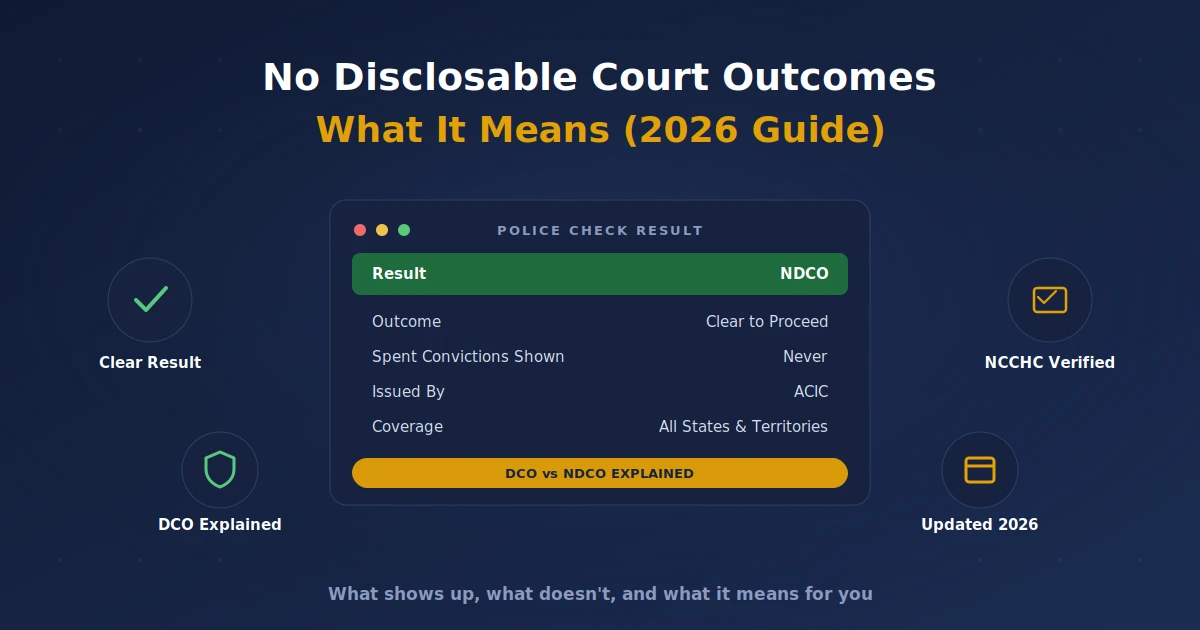
No, not on a standard check. A spent conviction is left off a National Police Check issued for general employment. If nothing else on your record is disclosable, your certificate will read No Disclosable Court Outcomes (NDCO).
The purpose you choose on the application decides what is released. Some states exclude these purposes from their spent conviction laws, so older convictions can still appear:
- Working with children, or as a teacher or teacher’s aide
- Aged care, disability support or hospital work
- Immigration detention centres and firefighting
- Firearms permits, immigration and citizenship applications
- Some government security clearances and overseas employment
- Taxi, rideshare and bus driver accreditation
The same rules apply whether you call it a police check, a police clearance or a National Police Certificate. They are all names for the same nationally coordinated criminal history check.
Spent Convictions by State: The Key Differences
The answer to “what is a spent conviction” depends on where the offence was recorded. These are the rules that most often surprise people.
Spent Convictions NSW: Fully Automatic, No Application
In NSW a conviction is spent after 10 crime-free years for adults and 3 years for children, counted from the date of conviction. A sentence of more than 6 months’ full-time imprisonment can never be spent. There is no application process, so searches for “how to apply for a spent conviction NSW” have a short answer: you cannot apply, it happens automatically.
Spent Convictions Victoria: Automatic, Immediate or by Application
Victoria’s 2021 Act has three paths. Convictions are spent immediately if no conviction was recorded or the offence was committed under age 15. Most others are spent automatically after 10 years, or 5 years for anyone under 21. Serious convictions (over 30 months’ prison, sexual or serious violence offences) need an application to the Magistrates’ Court, and that application is free.
Spent Convictions WA: The Only State Where You Must Apply
WA is the exception. Nothing is spent automatically, and the waiting period is usually 10 years plus the prison term imposed. A lesser conviction (1 year’s prison or less, or a fine under $15,000) is spent by WA Police. A serious conviction needs an order from a District Court judge. See our WA police check guide for how WA results are released.
Spent Convictions QLD: Based on the Court That Convicted You
Queensland calls the waiting period a “rehabilitation period”. It is 10 years for adults convicted on indictment (District or Supreme Court) and 5 years for everything else, provided the prison sentence was 30 months or less.
Spent Convictions ACT, SA, TAS and NT
All four are automatic after 10 years for adults and 5 for juveniles. The ACT, Tasmania and the NT exclude sentences over 6 months and sexual offences. South Australia allows up to 12 months for adults and 24 months for juveniles. Tasmania uses the word “annulled” instead of “spent”, but the effect is the same.
Exceptions: When a Spent Conviction Still Counts
A spent conviction is protected for most purposes, but not all. Three groups can still see or use it:
- Courts: a prosecutor can raise a spent conviction when a court is sentencing you for a new offence.
- Law enforcement: police agencies can share full records with each other, and the AFP asks its own job applicants to disclose spent convictions.
- Exempt screening: Working with Children Checks, and the purposes listed in the police check section above, can release older convictions.
If none of these applies, the protection is strong. Under Commonwealth law no one may take a spent conviction into account, and in the ACT it is an offence to disclose one without your consent. For employers, the rule is simple: for a non-exempt role, do not ask about spent convictions and do not use them in a hiring decision.
How to Apply for a Spent Conviction (Step by Step)
How-to description (for HowTo schema): Once you know what is a spent conviction and which law covers yours, use these steps to check whether it is already spent or make a spent conviction application in WA or Victoria.
- Find where the conviction was recorded. The state or territory of the court decides which law applies, not where you live now.
- Check the waiting period. It usually runs from the date of conviction. In WA, add the prison term imposed, and some other states start the clock after a prison term ends. Any new conviction in that time restarts the clock.
- Check whether it is automatic. In NSW, QLD, SA, the ACT, TAS, the NT, and for Commonwealth offences, an eligible conviction is spent automatically. You do not need to apply.
- WA lesser convictions: apply to WA Police. Applying for a National Police Certificate through WA Police includes a request to spend eligible WA convictions. You can also lodge a standalone application, which is free.
- WA serious convictions: apply to the District Court. This is how to get spent convictions removed in WA when the sentence was over 1 year’s prison or a fine of $15,000 or more. Legal Aid WA has a free self-help kit.
- Victoria serious convictions: apply to the Magistrates’ Court. This covers sentences over 30 months and sexual or serious violence offences, once the waiting period has passed. There is no court fee.
- Confirm the result with a new police check. Order a fresh National Police Check or AFP check to see what is now released.
If a conviction you believe is spent still appears on your certificate, you can dispute the result with the police service that released it.
Spent vs Quashed, Annulled and Expunged Convictions
These terms get mixed up, but only “expunged” removes a record entirely. A spent conviction still exists on police files.
| Term | What it means | On a standard police check? | Record still held? |
|---|---|---|---|
| Spent | An older, minor conviction protected after a crime-free waiting period | No, unless an exemption applies | Yes |
| Annulled | Tasmania’s word for spent | No, unless an exemption applies | Yes |
| No conviction recorded | Guilt found but no conviction entered (for example, a section 10 dismissal in NSW) | Spent immediately or once conditions are met in most states | Yes |
| Quashed | A court has overturned the conviction on appeal | No | Treated as if there was no conviction |
| Expunged | Removed under a special scheme, such as those for historical homosexual offences | No | No |
Get Your National Police Check With Rapid Screening
Rapid Screening is an ACIC-accredited provider, so every check is processed through the national system and released under the spent conviction laws of each state and territory. You do not need to work out the rules yourself: if a conviction is spent for the purpose you select, it is not released.
- Standard employment check: $56.90 inc. GST
- Volunteer check: $26.95 inc. GST
- Fast results: around 70% of checks are back in 2 to 4 hours
- Fully online: apply and verify your ID without visiting a police station
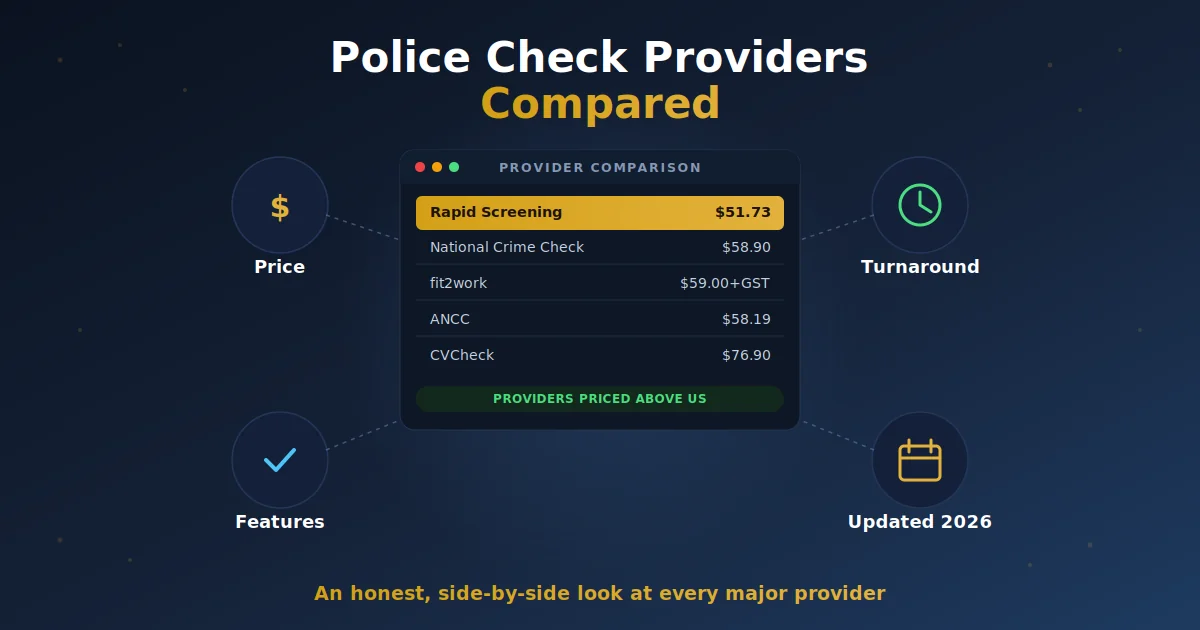
Comparing prices first? See our guide to how much a police check costs in Australia.
Get Your National Police Check
Frequently Asked Questions
What is a spent conviction in Australia?
A spent conviction is an older, less serious conviction that you no longer have to disclose and that is left off a standard police check, after a crime-free waiting period of usually 10 years for adults and 5 years for juveniles.
What does spent conviction mean on a police check?
It means the conviction is not released on your certificate for that purpose. If nothing else is disclosable, the result reads No Disclosable Court Outcomes.
How long until a conviction is spent in Australia?
Usually 10 years for adults and 5 years for juveniles, with no new offences in that time. NSW uses 3 years for children, and WA adds any prison term to the waiting period.
Do spent convictions show on a police check in Australia?
Not on a standard employment check. They can appear for exempt purposes such as working with children, aged care, disability support, firearms permits and immigration.
Can I get a conviction removed from my record?
In most cases, no. A spent conviction stays on police files but is hidden for most purposes. Only convictions that are quashed on appeal, or expunged under a special scheme, are removed from the record.
How far back does a criminal history check go?
There is no fixed cut-off. A police check covers your whole history, and older convictions drop off only once they are spent under the law of the state that recorded them.
What counts as a criminal conviction?
A conviction is a formal finding by a court that you are guilty of an offence, such as theft or drink driving. Many spent conviction laws also cover findings of guilt where no conviction was recorded.
Can I travel overseas with a criminal conviction?
Often yes, but each country sets its own entry rules. Australian spent conviction laws do not bind other countries, and some visa forms ask about every conviction, spent or not, so check the destination’s requirements before you apply.
Can you go to Australia with a spent criminal record?
Immigration and citizenship applications are exempt from spent conviction laws, so you may need to declare older convictions. The Department of Home Affairs assesses them under the character test.
Can you look up someone’s criminal history in Australia?
No. A National Police Check can only be run with the person’s informed consent and identity documents. Employers must ask the candidate to apply or consent to the check.
Conclusion
A spent conviction gives people with an old, minor record a genuine second chance. In most of Australia, it happens automatically after 10 crime-free years for adults and 5 for juveniles. WA requires an application, and Victoria’s serious convictions need a court order. The record is not deleted, and roles with children, older people or vulnerable groups can still see it.
Now that you know what is a spent conviction and how it works in your state, the simplest way to see what your record shows is to order a National Police Check. Rapid Screening applies every state’s spent conviction rules automatically, with most results back within hours.
Stay Informed
Get updates on police check requirements and processing times, straight to your inbox.
Get Your Police Check Now