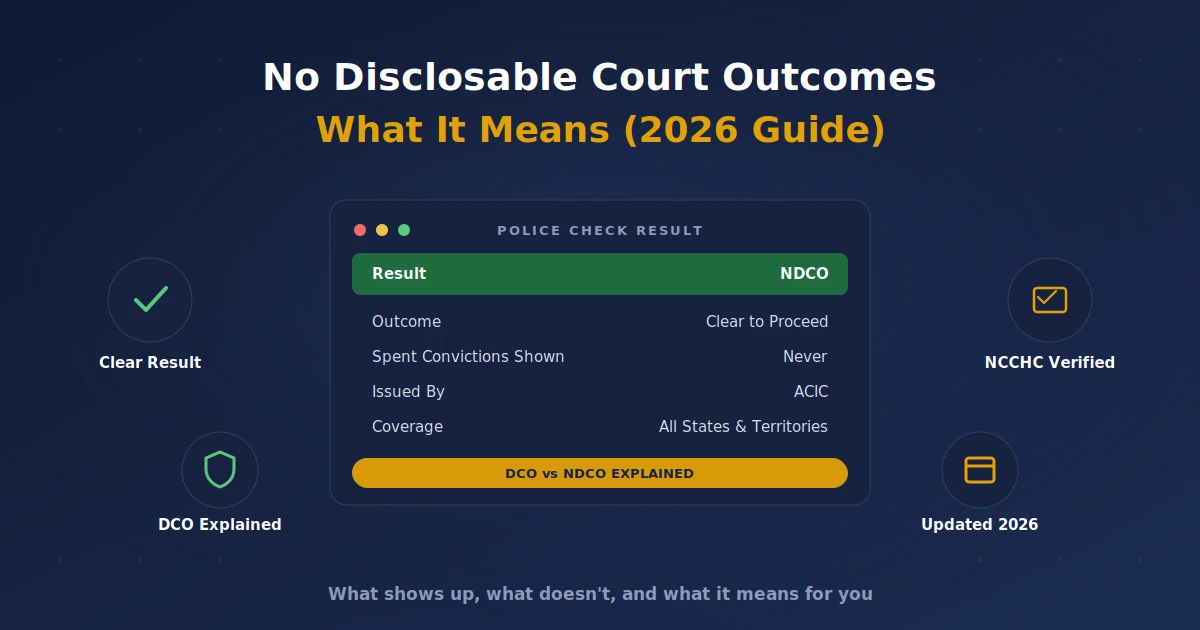
Quick Answer: No Disclosable Court Outcomes (NDCO) means your police check found no criminal history or pending charges that meet the legal threshold for disclosure. It’s the best possible result and simply confirms you’re clear to proceed. It doesn’t necessarily mean you’ve never had a run-in with the law. Some older or minor matters are legally excluded from release under Australia’s spent convictions schemes.
Just Got Your Police Check Back? Here’s What It Actually Says
If you’ve just opened your National Police Check and seen the words “No Disclosable Court Outcomes”, you’re probably wondering what that actually means for you. Is it good news? Bad news? Does it mean you’ve got a spotless record, or just that something’s been hidden from view?
The short version: it’s good news, and it’s the outcome the vast majority of Australians receive. This guide walks through exactly what the wording means, how it differs from a Disclosable Court Outcome (DCO), what actually shows up on a Nationally Coordinated Criminal History Check (NCCHC), and answers the specific questions people search for most when they’re staring at their own certificate trying to work out what it means.
What Does “No Disclosable Court Outcomes” Actually Mean?
A National Police Check in Australia is coordinated through the Australian Criminal Intelligence Commission (ACIC), which requests a search of your criminal history from every state and territory police jurisdiction. Once those searches come back, ACIC collates the results into a single certificate with one of two outcomes:
- No Disclosable Court Outcomes (NDCO): nothing in your history meets the legal threshold for release, so your certificate comes back clear.
- Disclosable Court Outcome (DCO): something in your history does meet that threshold, and the relevant details are listed on the certificate.
Here’s the bit that trips people up: NDCO doesn’t automatically mean you’ve never had any contact with police or the courts. It means nothing currently meets the criteria for disclosure. If you had a minor matter years ago that’s since become spent under your state’s Spent Convictions Act, it simply won’t appear, and that’s by design, not a loophole.
Is No Disclosable Court Outcomes Good?
Yes, unambiguously. NDCO is the outcome nearly every employer, licensing body, or volunteer organisation hopes to see. It means there’s nothing further to disclose, explain, or discuss. If you’re applying for a job, a licence, or a volunteer role and your certificate reads “No Disclosable Court Outcomes”, you’re clear to proceed with no further action required on your end.
If you were expecting a DCO and got NDCO instead, that’s not a mistake to be suspicious of; it usually means the matter you were thinking of has since become spent, or it never met the disclosure threshold in the first place (a lot of minor or very old matters simply don’t).
No Disclosable Court Outcomes vs. Disclosable Court Outcomes
Here’s how the two outcomes actually compare, side by side:
| No Disclosable Court Outcomes (NDCO) | Disclosable Court Outcome (DCO) | |
|---|---|---|
| What it means | No criminal history met the disclosure threshold | Criminal history met the threshold and was released |
| Outcome for the applicant | Clear to proceed | Subject to the requesting organisation’s assessment criteria |
| Can spent convictions appear? | No | No. Spent convictions never appear on either outcome. |
| What might still be listed | Nothing. The certificate is clear. | Convictions, pending charges, good behaviour bonds, current investigations, some traffic matters |
| Automatic disqualification? | N/A | No. Australian law prohibits blanket discrimination based on a criminal record. |
What’s Included in an NCCHC Certificate?
Regardless of which outcome you receive, every Nationally Coordinated Criminal History Check certificate follows the same basic structure:
What’s Included in an NCCHC Certificate?
Regardless of which outcome you receive, every Nationally Coordinated Criminal History Check certificate follows the same basic structure:
| Field | What It Shows |
|---|---|
| Personal details | Name, date of birth, and any confirmed aliases |
| Check purpose | The reason the check was requested, e.g. employment, volunteering, or licensing |
| Result | Either “No Disclosable Court Outcomes” or a listed Disclosable Court Outcome |
| Issuing details | Date of issue, and the ACIC-accredited body that processed the request |
| Validity note | A statement that the certificate reflects information available at the time of issue only |
What Shows Up on a Police Check in Australia?
If your result comes back as a Disclosable Court Outcome, the certificate can include any of the following, sourced from the relevant state and territory police databases:
- Court convictions, even if no penalty or sentence was actually recorded
- Pending or current criminal charges that haven’t yet been decided
- Good behaviour bonds and similar court orders
- Charges laid by police but not yet proven in court
- Current investigations where you’re named as a suspect
- Some Children’s Court findings and traffic convictions
- On-the-spot fines that proceeded to a court outcome
What it will never show, under any circumstances, is a spent conviction. Once a conviction becomes spent under your relevant state or territory legislation (the exact waiting period varies), it’s permanently excluded from release on a standard police check.
Conviction on a Police Check: What It Means
A conviction will only ever appear on your certificate if it meets your state’s disclosure threshold and hasn’t become spent. If it does appear, it’s listed as part of your Disclosable Court Outcome; it isn’t presented as a simple pass or fail. It’s then entirely up to the organisation that requested the check to weigh the relevance of that conviction against the specific role or purpose, taking into account things like how long ago it happened, whether it’s relevant to the position, and whether there’s been a genuine crime-free period since.
Importantly, Australian law prohibits employers from automatically ruling someone out purely because they have a criminal record. Tasmania and the Northern Territory even have specific anti-discrimination provisions covering this. A DCO is a starting point for a conversation, not an automatic disqualifier.
Will a Non-Conviction Show Up on a Police Check?
Generally, no. If charges against you were dropped, withdrawn, or resulted in a not-guilty finding, they typically won’t meet the disclosure threshold and won’t appear. The exception is if a matter is still current or pending; in that case, an ongoing charge can still show up even though it hasn’t been finalised, since the check reflects your record as at the date of issue, not the eventual outcome.
Does a Diversion Show Up on a Police Check?
Usually not, if a matter was dealt with through a diversion programme and didn’t result in a recorded conviction, it generally won’t appear. That said, policies differ slightly by state and by the type of diversion involved, so if you’re unsure about a specific matter, it’s worth checking directly with the relevant state police service.
How Far Back Does a Criminal History Check Go?
There’s no fixed lookback window, like “seven years” or “ten years”, that applies across Australia. Instead, whether something appears depends entirely on whether it’s become spent under the relevant Spent Convictions scheme, not simply how long ago it happened. A minor matter from decades ago could still appear if it’s never become eligible for spending, while a more recent minor matter might already be excluded.
How Long Is a Police Check Valid For?
A National Police Check has no official government-set expiry date; it reflects your record as at the date it was issued, full stop. In practice, most employers and organisations request a check issued within the last three to six months, but this varies depending on the industry and the specific requesting body. It’s always worth confirming the acceptable timeframe with whoever asked you for the check.
How to Read Your Rapid Screening Certificate
When your certificate comes back through Rapid Screening, you’ll see your result clearly stated near the top, either No Disclosable Court Outcomes, or a listed Disclosable Court Outcome with the relevant details underneath. If you believe your result is incorrect, for example, if it includes a matter you believe has been spent or details you don’t recognise, you can lodge a dispute directly with us, and we’ll help you raise it with ACIC or the relevant police agency for review.
Frequently Asked Questions
What do non-disclosable court outcomes mean?
It’s another way of describing the same thing as No Disclosable Court Outcomes. It means nothing in your criminal history met the legal threshold for release on your certificate.
What does ‘no disclosable court outcomes’ mean on a police check?
It means your police check came back clear. No criminal history or pending charges were found that meet the disclosure threshold for the purpose you applied for.
Is no disclosable court outcomes good?
Yes. It’s the best possible outcome and means you’re clear to proceed with no further explanation needed.
What is a no disclosure court outcome meaning in plain terms?
It simply means your certificate is clear. Nothing further needs to be disclosed to the organisation that requested your check.
How long do disclosable court outcomes last?
They don’t expire on the certificate itself, since it reflects a point in time. Most employers, however, only accept checks issued within the last 3–6 months.
Will a non-conviction show up on a police check?
Generally, no, dropped charges or not-guilty findings typically won’t meet the disclosure threshold, unless the matter is still current or pending.
What does “disclosable” mean?
It refers to information that meets the legal threshold for release to a third party, such as an employer, as part of a police check.
How far back does a criminal history check go?
There’s no fixed number of years. It depends on whether a matter has become spent under the relevant state legislation, not simply how old it is.
What crimes might stay permanently on your record?
More serious offences, and matters excluded from spent convictions schemes (such as certain sexual offences or matters resulting in imprisonment above a set threshold), can remain undisclosed indefinitely.
What would make you fail a police check?
There’s technically no “pass or fail”; a Disclosable Court Outcome simply means the requesting organisation will assess relevance to the role. See our full guide on what disqualifies you from an Australian police check for a detailed breakdown.
How long does a conviction stay on your record in NSW?
It depends on the offence and sentence; minor convictions generally become spent after a crime-free period (commonly around 10 years for adults, shorter for juveniles), while more serious matters may never become spent.
What shows up on a police check?
Convictions, pending charges, good behaviour bonds, some traffic and Children’s Court matters, and current investigations can all appear, provided they’re not spent.
How can I get my criminal record wiped?
You generally can’t have a record “wiped” on request, but eligible convictions become spent automatically after a set crime-free period under your state’s Spent Convictions Act.
Does a diversion show up on a police check?
Usually not if it didn’t result in a recorded conviction, though this can vary by state and diversion type.
No disclosable court outcomes near Adelaide SA / near South Australia: does location change the result?
No. A National Police Check is coordinated nationally through ACIC; regardless of which state you apply from, the process and outcome criteria are the same everywhere in Australia.
What is an NDCO police check?
NDCO is simply the shorthand term for “No Disclosable Court Outcomes”, the clear result on a National Police Check.
The Bottom Line
Seeing “No Disclosable Court Outcomes” on your police check is genuinely good news; it’s the outcome the system is designed to give the vast majority of applicants, and it means you’re clear to move forward. If your certificate does come back with a Disclosable Court Outcome instead, that’s not the end of the road either; Australian law requires a fair, individual assessment rather than an automatic knock-back.
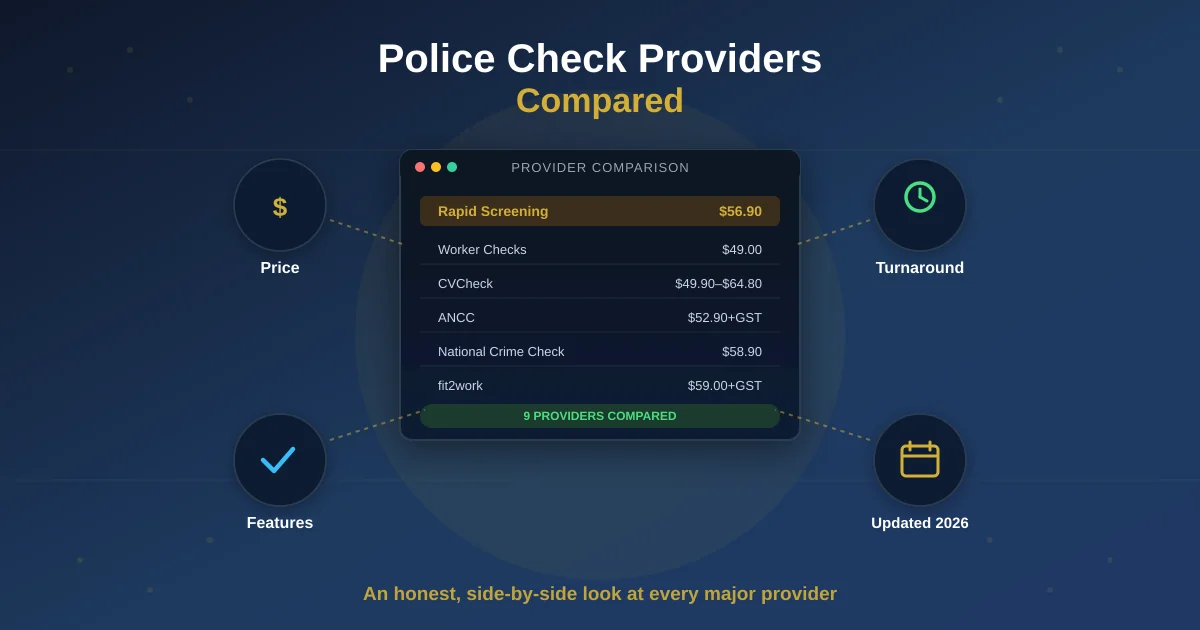
If you’re ready to apply for your own National Police Check, Rapid Screening processes 70% of results within 2-4 hours, is ACIC accredited, is fully online, and is available for employment, volunteer, and AFP-purpose checks. If you’d like to see how we compare to other accredited providers first, take a look at our police check providers comparison.
Stay Informed
Get updates on police check requirements and processing times, straight to your inbox.
Get Your Police Check Now