- Last updated:September 29, 2026
Quick Answer
A qualification check Australia employers or individuals run usually means one of four things: verifying a degree or transcript through My eQuals, contacting the issuing institution directly, using a screening provider such as Rapid Screening, WorkPro, or CVCheck to handle it for you, or a formal skills assessment through a body like VETASSESS for migration or licensing purposes.
If you’ve searched “qualification check Australia” and landed on five different answers, that’s because there isn’t one single system. Some checks happen instantly online. Others go through a government-linked assessing body and take weeks. Which one you need depends on why you’re checking, not just what the qualification is.
This guide walks through the real options, what each one actually verifies, and where a qualification check fits next to the other qualification verification services most Australian employers run.
What a Qualification Check Actually Verifies
A qualification check confirms that a credential someone has claimed—a degree, diploma, trade certificate, or professional license—was genuinely issued by the institution they say issued it. It’s a narrower thing than it sounds. A qualification check tells you the certificate is real. It doesn’t tell you whether the person was any good at the course, and it doesn’t cover criminal history, which is what a National Police Check is for, or employment history, which is what a reference check covers instead.
Employers sometimes refer to this more broadly as verifying employment credentials, which usually means the same thing: confirming a candidate’s stated education and licences match what they can actually produce from the issuing source.
Three things usually get verified:
- The academic record itself – degrees, diplomas, and certificates.
- Licences and registrations – relevant for trades, health, law, and other regulated work.
- Enrolment and completion details – dates, and sometimes results, where the employer specifically needs them.
How to Check Your Qualifications Online in Australia
If you want to check your own qualification, or an employer has asked you to provide verified proof of one, this is usually the fastest path:
- Go to My eQuals (myequals.org). It’s the official digital credentials platform for Australia and New Zealand, used by the large majority of local universities.
- Locate your institution in the participating list and request your transcript or statement.
- Share it through the platform’s verification link, rather than sending a scanned copy, so the employer can confirm it’s genuine without a phone call to your old university.
- If your institution isn’t on My eQuals, contact its registrar directly. Older records and many TAFE qualifications still require this manual step.
For a certificate that isn’t a university credential, such as a trade ticket or short course certificate, the equivalent step is contacting the issuing body directly, since there’s no single national platform covering every type of certificate the way My eQuals covers university degrees.
Qualification Check for Employers: How It Actually Works
Individually checking every candidate’s credentials by phone doesn’t scale, so most Australian employers use one of four approaches to employee skill verification:
Direct verification through My eQuals
With the candidate’s consent, an employer can request and confirm a university qualification digitally in minutes.
A screening provider that bundles it with other checks
This is where Rapid Screening sits, alongside WorkPro and CVCheck: qualification verification runs as part of the same workflow as a police check, reference check, or right-to-work check, rather than a separate process. It covers degrees, diplomas, trade and professional certifications, and both Australian and international institutions, with results stored against the candidate’s record in your business account.
A dedicated verification specialist
Providers such as Qualification Check focus specifically on primary-source verification of academic and professional credentials, including for candidates who studied overseas, which is where in-house HR teams often struggle most. This is also the point in the hiring process where it’s worth running a reference check alongside it, since a verified qualification still doesn’t tell you how someone actually performed in their last role.
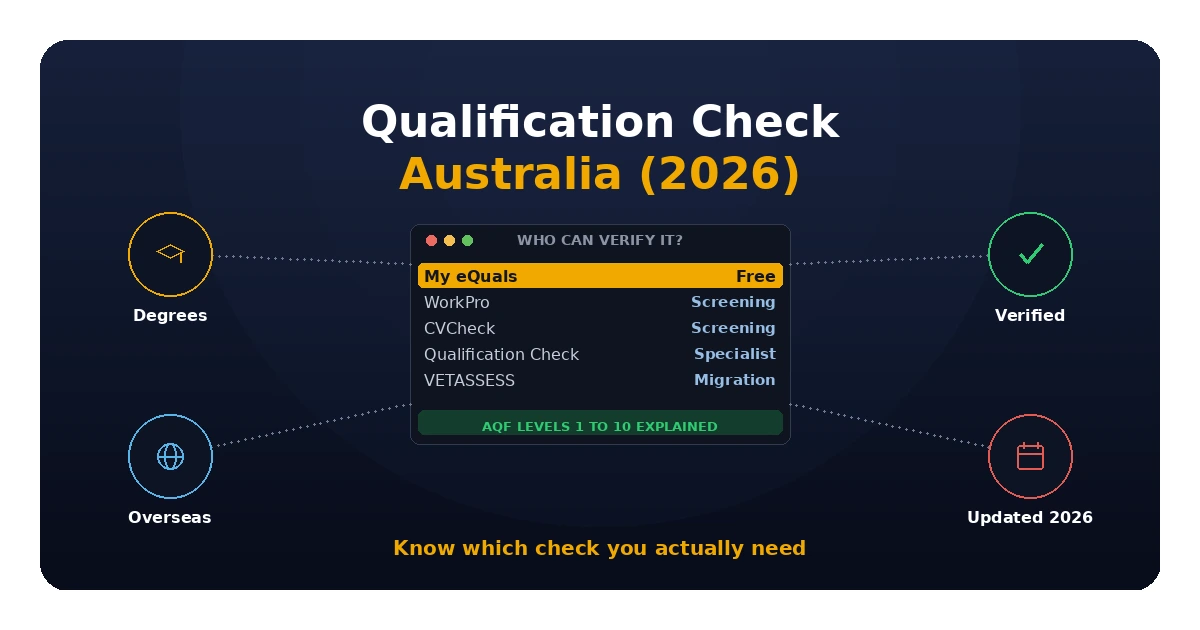
| Provider | What They Do | Best For |
|---|---|---|
| Rapid Screening | Verifies degrees, diplomas, trade and professional certifications, covering both Australian and international institutions, bundled with your other pre-employment checks | Employers who want qualification verification handled in the same workflow as a police check and reference check |
| My eQuals | Free, self-service digital transcript sharing and verification | Most Australian university qualifications, checked directly |
| WorkPro | Qualification checks bundled into broader pre-employment screening | Employers who want it handled alongside other checks |
| CVCheck | Qualification verification as part of a wider background-check suite | Businesses already using CVCheck for other checks |
| Qualification Check | Dedicated primary-source verification, including international credentials | Overseas qualifications and higher-volume corporate verification |
| VETASSESS | Formal skills and qualification assessment against the AQF | Skilled migration, licensing, and professional registration |
None of these is a substitute for the others across every use case. My eQuals is the right tool for confirming a straightforward Australian degree yourself. VETASSESS is the right tool when a qualification needs to be formally compared against the AQF for a visa or licence. For employers who’d rather not manage verification in-house, Rapid Screening and the other listed screening providers handle it as part of a broader check.
Checking a Certificate Online
For a single certificate rather than a full transcript, most Australian institutions now issue a digital version with its own verification link or QR code, and checking it is usually a matter of following that link rather than contacting anyone. If the certificate predates digital issuance, or the institution never adopted a digital system, you’re back to contacting the registrar with the certificate’s details, which typically takes a few business days rather than minutes.
Checking Foreign and Overseas Qualifications
An overseas qualification doesn’t sit on My eQuals, so it needs a different process entirely.
The Department of Education maintains Country Education Profiles, which compare qualifications from more than 125 countries against the Australian Qualifications Framework. Individuals don’t use this tool directly. Instead, each state or territory runs an Overseas Qualifications Unit, which uses that data to issue a formal comparability statement for general employment purposes.
For skilled migration or a licensed profession, a general comparability statement isn’t enough. That’s where a formal skills assessment comes in, run by an authority like VETASSESS or, for trade occupations, Trades Recognition Australia. This is a different, more rigors process than a standard qualification check, and it’s specifically what visa applications and professional registration boards require.
Is a Qualification Check Free in Australia?
Partly. My eQuals doesn’t charge graduates to share their own documents, and many universities don’t charge for a basic verification request. But a genuinely free, comprehensive qualification check, especially one covering an overseas credential or forming part of a full pre-employment background check, isn’t really a thing. Screening providers and specialist verification services charge for the labour of chasing down primary sources, and a formal skills assessment through VETASSESS or a similar body always carries a fee. If a service claims to offer a completely free, comprehensive check with no limitations, treat that as a reason to look closer at what it’s actually verifying.
Qualification Levels in Australia (AQF)
Whichever method you use to check a qualification, it helps to know where it sits on the Australian Qualifications Framework, the national system that ranks every recognised qualification from entry-level certificates through to doctorates.
| AQF Level | Qualification Type |
|---|---|
| 1-2 | Certificate I and II |
| 3-4 | Certificate III and IV |
| 5 | Diploma |
| 6 | Advanced Diploma, Associate Degree |
| 7 | Bachelor Degree |
| 8 | Bachelor Honours, Graduate Certificate, Graduate Diploma |
| 9 | Masters Degree |
| 10 | Doctoral Degree |
A qualification check confirms a credential is genuine. Comparing it against this table tells you what it’s actually worth in the Australian system, which matters if you’re assessing an unfamiliar qualification title.
Qualification Checks and Skilled Visas
If you’re navigating this as part of a 482 visa application, a couple of quick, direct answers:
Do you need a skills assessment for a 482 visa? Not always. It’s mandatory only for occupations on a specific legislative list, combined with certain passport countries, largely trade roles like chef, electrician, and motor mechanic, plus a couple of professional roles such as programme or Project Administrator. Most other 482 applicants don’t need one.
Who assesses it? Trades Recognition Australia handles most trade occupations, while VETASSESS covers a wider range of professional and managerial roles.
This page focuses on qualification verification rather than visa strategy, so for anything beyond this specific question, a registered migration agent is the right source, not a background-screening guide.
Where This Fits With Other Pre-Employment Checks
A qualification check answers one question: is the credential real? Whether the person is also who they say they are, and whether their last employer would vouch for them, comes down to the rest of your screening process. If a candidate’s story doesn’t add up despite a genuine qualification, our article on false CVs and qualifications walks through the warning signs worth watching for.
Frequently Asked Questions
How can I check my qualification online?
For most Australian university qualifications, My eQuals is the fastest option. Locate your institution, request your transcript or testamur, and share the verification link directly rather than a scanned copy.
How can I check my AQF level?
Your qualification’s level is usually stated on the certificate or testamur itself. If it isn’t, compare the qualification type (for example, Bachelor Degree or Diploma) against the AQF’s published levels, which run from Certificate I at Level 1 up to Doctoral Degree at Level 10.
How are qualifications assessed in Australia?
Domestically, most are verified directly against the issuing institution’s own records, often through My eQuals. Where a formal comparison against the Australian Qualifications Framework is required, such as for migration or professional registration, a body like VETASSESS carries out a structured skills assessment.
How do I check foreign qualifications?
The Department of Education’s Country Education Profiles provide the reference data, and your state or territory’s Overseas Qualifications Unit uses it to issue a comparability assessment. For migration or a licensed profession, a formal VETASSESS or Trades Recognition Australia skills assessment is usually required instead.
Where can I get a free qualification check in Australia?
My eQuals is free for sharing and verifying most Australian university qualifications. Overseas qualification assessments and formal skills assessments through bodies like VETASSESS carry a fee, and comprehensive employer screening services are also paid.
How do I verify my qualifications in Australia?
Start with My eQuals if your institution participates. If it doesn’t, or the qualification predates digital records, contact the issuing institution’s registrar directly with your enrolment details.
Can you get a 482 visa without a skills assessment?
Yes, for most applicants. A skills assessment is only mandatory for occupations on a specific legislative list, generally certain trade roles, combined with particular passport countries. If your occupation and passport combination isn’t listed, you typically don’t need one.
What are the levels of qualifications in Australia?
The Australian Qualifications Framework has ten levels, from Certificate I and II at the lower end through to Diploma, Bachelor Degree, Masters, and Doctoral Degree at the top.
The Bottom Line
There’s no single system behind a qualification check Australia-wide, and that’s exactly why so many people end up confused by conflicting answers. For a straightforward Australian degree, My eQuals will usually sort it out in minutes. For an overseas credential or a visa-related assessment, you’re looking at a formal process through your state’s Overseas Qualifications Unit or a body like VETASSESS instead. Knowing which category your situation falls into is most of the battle, and from there, verifying a genuine qualification check Australia employers or institutions will actually accept is a fairly short process.
Stay Informed
Get updates on police check requirements and processing times, straight to your inbox.
Get Your Police Check Now