- Last updated:August 24, 2026
Introduction: Why the Right Code Matters for Your Future
Navigating the Australian immigration landscape in 2026 is a journey filled with excitement, but it is also one paved with administrative rigours and requirements. For many visa applicants, the character requirement is the most daunting hurdle. Whether you are transitioning from a student visa to a 485 Graduate visa or finalising your path to permanent residency, you will inevitably encounter the requirement for an Australian Federal Police (AFP) certificate. If you’re unsure how this differs from a standard police check, see our NPC vs AFP Check comparison.
However, a simple police check isn’t enough. The Department of Home Affairs (DHA) is highly specific about the information it requires. This is why the AFP police check code 33 is a term every prospective migrant needs to understand. Selecting the wrong code can lead to application delays, additional costs, and in the worst cases, visa refusals due to non-compliance. At Rapid Screening, we believe that clarity is the first step towards a successful application. This guide covers what a code 33 police check actually involves, AFP police check validity, and how to ensure your submission is perfect the first time.
What is the AFP Police Check Code 33?
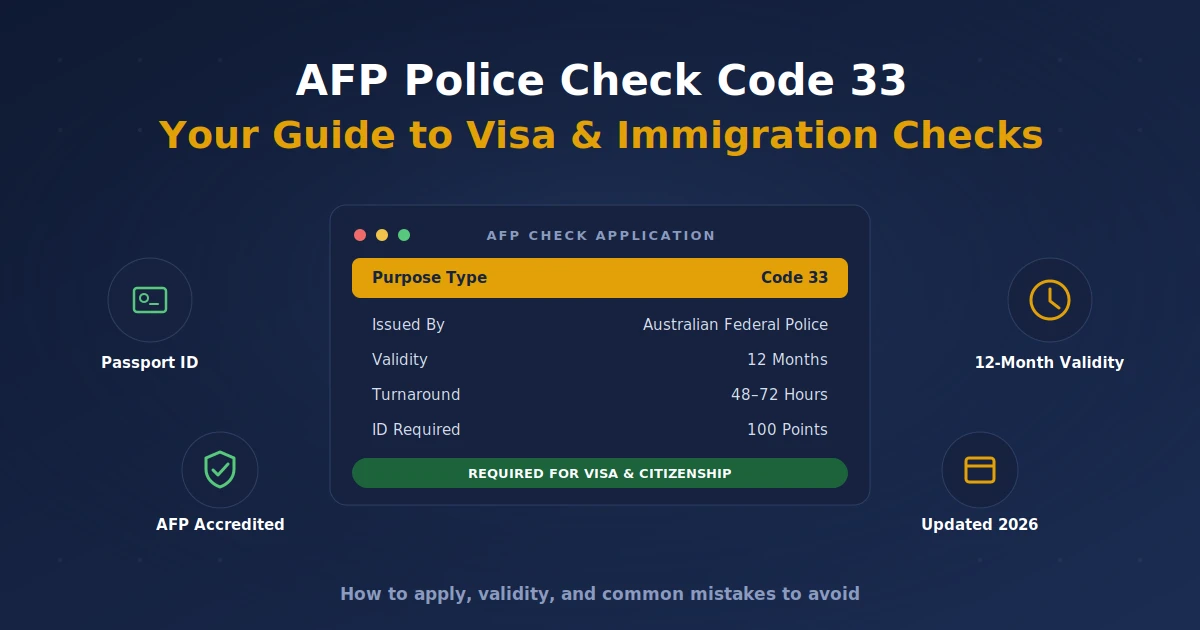
In the world of Australian background screening, purpose codes act as a filter. They tell the police agencies what type of information needs to be released and to whom. When applying for an AFP police check code 33, you are specifically requesting a check for the purpose of immigration/citizenship, for supply to the Department of Home Affairs.
Because this requirement isn’t always described the same way twice, you’ll see it referred to under a few different names depending on where you look. Whether the form or a guide calls it an afp code 33 police check, an afp national police check code 33, a code 33 afp police check, an afp national police check code 33 immigration citizenship check, an afp national police check application form code 33, an afp national police check purpose code 33, an afp national police check purpose code 33 immigration citizenship selection, an afp national police check purpose code 33 immigration/citizenship option, or an afp police check application form code 33, it’s the exact same requirement: Code 33 – Immigration/Citizenship, on the official AFP application.
The Scope of Code 33
Unlike standard employment checks, Code 33 is comprehensive. It is designed to meet the strict character test set out in Section 501 of the Migration Act 1958. When you order an AFP police check code 33, the resulting certificate will include:
- Commonwealth Offences: Any crimes committed against federal laws.
- State and Territory Offences: A consolidated view of criminal history from every jurisdiction in Australia.
- Pending Charges: Offences currently before the courts.
- Traffic Offences: Serious traffic matters that resulted in a court appearance.
The primary reason Home Affairs requires this specific code is that it ensures no relevant information is withheld under standard employment privacy filters. It provides the full disclosure necessary for the government to assess your suitability to remain in the Australian community.
AFP Code 33 vs. NCCHC
| AFP Code 33 Police Check | Standard NCCHC | |
|---|---|---|
| Issued by | Australian Federal Police | State/territory police via an ACIC-accredited body |
| Used for | Visas, citizenship, immigration purposes | Employment, licensing, volunteering |
| Accepted by Home Affairs? | Yes, this is the only accepted format | No, not accepted for migration purposes |
| Validity | No formal expiry, but generally treated as valid for 12 months | No formal expiry; the employer sets their own acceptable timeframe. |
| Turnaround | 48–72 hours (digital certificate) | 70% within 2–4 hours |
Why the AFP Police Check Code 33 is Non-Negotiable for Visas
Many applicants ask, Can’t I just use a standard National Police Check from my employer? The short answer is: no.
The Department of Home Affairs specifically mandates an AFP-issued National Police Certificate. While Rapid Screening is an accredited body for Nationally Coordinated Criminal History Checks (NCCHC), which are perfect for 99% of Australian jobs, the AFP police check code 33 is a specialised stream required for federal immigration.
Common Visas Requiring Code 33
If you are applying for any of the following, you will likely need to provide an AFP police check code 33 alongside confirming your right to work eligibility:
| Visa / Application Type | Why Code 33 Is Required |
|---|---|
| 485 Graduate Visa | The most common entry point for international students moving into the workforce |
| 189, 190 & 491 Skilled Visas | Character assessment for the points-based skilled migration system |
| Partner Visas (820/801, 309/100) | Required for the applicant, and sometimes the sponsor, as part of character clearance |
| Australian Citizenship | The final character check before citizenship is granted |
By selecting this code, you are authorising the AFP to release a certificate that is legally recognised by DHA case officers. Using Code 30 or Code 35 will often result in a Request for Further Information (RFI), stalling your visa for weeks.
Step-by-Step Guide: Applying for Your AFP Police Check Code 33
In 2026, the application process is almost entirely digital, designed to be completed in under 15 minutes. However, precision is your best friend when submitting your AFP police check code 33 application.
1. Preparation of Identity Documents
You must meet the 100-point identity check. For visa applicants, this usually involves:
- Primary (70 points): A valid passport (foreign or Australian) or a full birth certificate.
- Secondary (40 points): An Australian Driver’s Licence or a Marriage Certificate.
- Tertiary (25 points): A Medicare card, a recent utility bill, or a credit card/bank statement.
2. The Application Form
When you reach the Purpose Type section, you must navigate the dropdown menus carefully. You should select Commonwealth Employment/Purpose and then specifically choose Code 33 – Immigration/Citizenship.
3. All Names Disclosure
This is a critical area where many applicants fail. You must disclose every name you have ever been known by. This includes:
- Maiden names.
- Previous married names.
- Anglicised names or aliases used on previous documents.
- Different name orders.
If the name on your visa application does not match the name on your AFP police check code 33 certificate, Home Affairs may reject the document.
Turnaround Times and Digital Delivery in 2026
The efficiency of the AFP has improved significantly. Most digital certificates for an AFP police check code 33 are now delivered via email within 48 to 72 hours.
What Causes Delays?
If your application isn’t instant, don’t panic. Delays usually occur for two reasons:
- Manual Vetting: If you have a common name, an officer must manually verify that John Smith with a clean record is actually you and not the John Smith with a history of offences.
- Interstate Searches: If you have lived in multiple Australian states, the AFP must wait for data synchronisation from those specific state police databases.
At Rapid Screening, we always advise applicants to secure their AFP police check code 33 at least one month before their visa lodgement date to account for these potential manual reviews.
Privacy and the Spent Convictions Rule
Even with a comprehensive check like Code 33, Australia’s privacy laws still offer some protection. The Spent Convictions Scheme generally means that minor offences committed more than 10 years ago or 5 years ago may not be disclosed, provided you have not re-offended.
However, it is important to note that for certain high-level security clearances or specific migration categories, these spent convictions can sometimes still be seen by the Minister for Immigration. Transparency is always the best policy. If you are unsure, consulting with a migration agent before submitting your AFP police check code 33 can provide peace of mind.
Conclusion: Achieving Your Australian Dream
Obtaining your AFP police check code 33 is more than just a box to tick; it is an affirmation of your character and your commitment to the Australian community. While the process is digital and fast, the consequences of a mistake are high. By ensuring you select the correct purpose code, disclose all names, and meet the 100-point ID requirement, you remove the friction from your visa application.
At Rapid Screening, we are dedicated to helping you navigate the complexities of Australian compliance. While we provide the fastest National Police Checks for employment, we are also here to ensure you have the right information for your migration journey.
Once your visa is granted, you can confirm your conditions any time via a VEVO check.
Frequently Asked Questions (FAQs)
1. How long is an AFP police check code 33 valid for?
For immigration purposes, the Department of Home Affairs generally considers a police certificate valid for 12 months from the date of issue. If your visa processing takes longer than a year, you may be asked to provide a fresh check.
2. What if I am currently outside of Australia?
You can still apply for an AFP police check code 33 from overseas. The process remains the same, and your identity documents can be scanned and uploaded.
3. What is the difference between Code 33 and Code 37?
Code 33 is for Immigration/Citizenship for the Department of Home Affairs. Code 37 is specifically for residents of the Australian Capital Territory (ACT) for various local purposes. If you are applying for a visa, Code 33 is almost always the correct choice regardless of where you live.
4. Do I need fingerprints for this check?
Generally, no. A standard AFP police check code 33 is a name-based search. Fingerprint checks are usually only required if you are applying for specific types of overseas employment or if the AFP specifically requests them to resolve an identity dispute.
5. How long is AFP police check valid for?
The Department of Home Affairs generally treats an AFP police check as valid for 12 months from its date of issue, even though the certificate itself carries no printed expiry date.
6. How long is AFP valid for immigration?
The same 12-month guideline applies specifically to immigration purposes. If your visa processing extends beyond 12 months, Home Affairs may request a fresh certificate.
7. What’s the difference between an AFP police check for immigration and a standard NCCHC?
An AFP check is issued directly by the Australian Federal Police and is the only format Home Affairs accepts for visa and citizenship purposes. A standard NCCHC, while valid for employment, is not accepted for migration purposes.
Stay Informed
Get updates on police check requirements and processing times, straight to your inbox.
Get Your Police Check Now