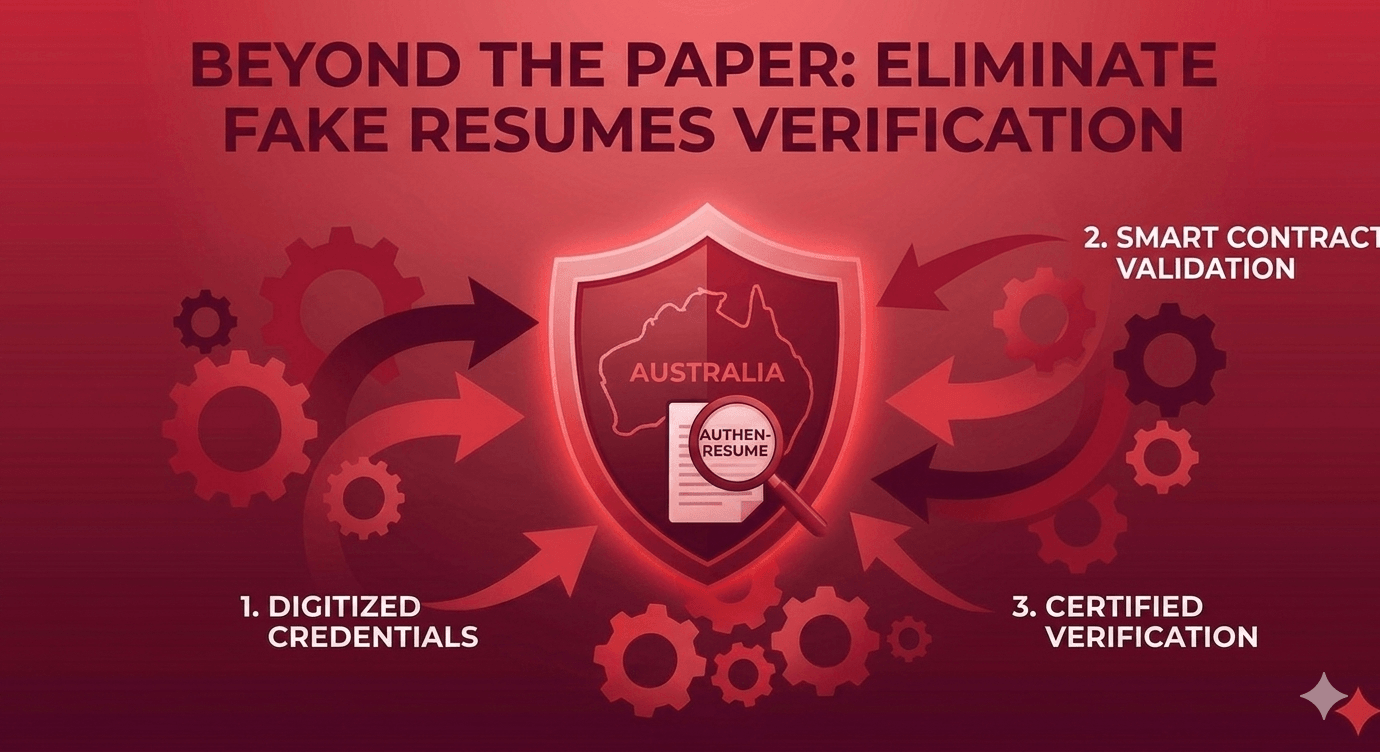
In the competitive Australian job market of 2026, a resume is often seen as a candidate’s first impression. However, as the pressure to secure top tier roles intensifies, so does the temptation to embellish the truth. Recent data suggests that over 55% of HR leaders in Australia and New Zealand have encountered resume fraud in the last three years. From inflated job titles to entirely fabricated degrees, the risks to your business are substantial. Learning how to eliminate fake resumes verification is no longer just a best practice; it is a critical safeguard for your organisation’s integrity, culture, and bottom line.
What Are The Most Common Types of Resume Embellishment?
When you set out to eliminate fake resumes verification, you need to know what you are looking for. The most frequent lies found on Australian resumes include:
•Employment Gaps: Hiding periods of unemployment by extending the dates of previous roles.
•Inflated Titles: Claiming a Manager or Director level when the actual role was entry-level or
mid tier.
•Fabricated Qualifications: Claiming degrees or certifications from prestigious institutions that were never earned.
•Skill Inflation: Listing proficiency in software or languages that the candidate has never actually
used.
•Fake References: Providing the contact details of friends or family members posing as former supervisors.
How to Eliminate Fake Resumes Verification Using Professional Screening?
The most effective way to protect your business is to move beyond a manual review of documents. In 2026, professional background checking services have become the gold standard for verifying the claims made on a CV. By using a data-driven approach, you can ensure that every hire is based on fact, not fiction.
Key Steps In a Professional Verification Process?
To truly eliminate fake resumes verification, your screening process should include:
1. Employment History Verification: Contacting former employers directly to confirm exact start and end dates, job titles, and the reason for leaving.
2. Education Verification: Reaching out to universities and RTOs (Registered Training Organisations) to confirm that the claimed qualification was indeed awarded.
3. Professional Membership Checks: Verifying that the candidate is a current member of relevant industry bodies or holds the necessary licenses (e.g., CPA, AHPRA).
4. Reference Auditing: Using automated platforms to verify the identity of referees and ensure they are legitimate professional contacts.
What are the Legal and Financial Risks of a Bad Hire?
The cost of a bad hire in Australia is estimated to be at least 30% of the employee’s first-year earnings. However, when that hire is based on a fraudulent resume, the costs can escalate rapidly. Beyond the financial loss, there are significant legal and reputational risks to consider.
What Happens When Resume Fraud Goes Undetected?
If you fail to eliminate fake resumes verification, your business could face:
•Negligent Hiring Claims: If an unverified employee causes harm to a client or colleague, your business could be held legally liable for failing to conduct due diligence.
•Operational Failure: An employee who lacks the skills they claimed on their resume will inevitably underperform, leading to project delays and team frustration.
•Cultural Damage: Discovering a liar in the ranks can severely damage team morale and trust in the leadership’s hiring process.
•Regulatory Fines: In sectors like finance, healthcare, and government, hiring unverified staff can lead to massive fines and the loss of operating licences.
How Does Technology Help Eliminate Fake Resumes Verification?
In 2026, technology is the recruiter’s best friend in the fight against fraud. Modern verification tools are designed to spot inconsistencies that the human eye might miss, providing a much higher level of assurance. To effectively eliminate fake resumes verification, look for platforms that offer:
•Real-Time Identity Matching: Using the Document Verification Service (DVS) to ensure the candidate is who they say they are before you even look at their resume.
•Automated Reference Checking: Systems that flag suspicious IP addresses or email domains used by referees, helping to spot fake references.
•Blockchain-Verified Credentials: An emerging trend in 2026 where universities issue digital, tamper-proof certificates that can be verified instantly.
•AI-Powered Inconsistency Detection: Software that cross-references a candidate’s resume against their public professional profiles (like LinkedIn) to highlight discrepancies in dates or titles.
What Role Does a Police Check Play in Resume Verification?
While a resume focuses on what a candidate has done, a police check focuses on what they shouldn’t have done. In Australia, a Nationally Coordinated Criminal History Check is a vital component of a comprehensive screening strategy.
Why Is a Criminal History Check a Non-Negotiable Step?
Even if you successfully eliminate fake resumes verification regarding education and employment, a candidate may still be hiding a disclosable court outcome that makes them unsuitable for the role. A police check ensures:
•Integrity Verification: A candidate who lies on their resume may also have a history of dishonest conduct that would appear on a police check.
•Safety and Compliance: In roles involving children, vulnerable people, or sensitive financial data, a police check is a legal requirement to ensure the safety of the community.
•Trust Building: Knowing that a candidate has a clear record (or has been transparent about their past) builds a foundation of trust from Day 1.
How to Build a Culture of Transparency in Your Hiring Process?
The best way to eliminate fake resumes verification is to prevent fraud from happening in the first place. By being clear about your screening process from the very beginning, you can deter dishonest applicants and attract high-quality, transparent talent.
What should You Include in Your Job Advertisements?
To set the right tone, your recruitment process should:
•State Your Screening Policy: Clearly mention in the job ad that all successful candidates will undergo thorough employment, education, and police checks.
•Ask for Consent Early: Include a consent clause in your application form, signalling that you take verification seriously.
•Conduct Consistent Interviews: Use behavioural interviewing techniques to probe into the details of a candidate’s claimed experience; fraudsters often struggle to provide specific, consistent examples.
How to Choose a Partner to Help Eliminate Fake Resumes Verification?
Most Australian businesses do not have the time or resources to conduct deep-dive verifications in-house. Partnering with an accredited background checking provider is the most efficient way to secure your hiring process. When selecting a provider to help you eliminate fake resumes verification, look for:
•Local Expertise: A provider that understands the Australian education system and employment laws.
•Speed and Accuracy: Look for a partner that can return 70% of results within 2 to 4 business hours, ensuring your hiring process doesn’t stall.
•Secure Technology: Ensure they use bank grade encryption and comply with the Australian Privacy Principles (APPs).
Conclusion
At Rapid Screening, we are dedicated to helping Australian businesses hire with confidence. Our advanced verification platform delivers the speed and accuracy you need to secure your next star hire, with 70% of our results returned within just 2 to 4 business hours. Don’t leave your company’s future to chance, verify every claim and hire with certainty today.
Frequently Asked Questions (FAQs)
1. Is it illegal to lie on a resume in Australia?
While lying on a resume is not a specific crime in itself, it can lead to charges of obtaining a financial advantage by deception if it results in employment. In some sectors, like the government, it can also lead to significant fines or even jail time.
2. How do you verify a degree from an overseas university?
Professional screening providers have access to international databases and networks that allow them to verify qualifications from thousands of institutions worldwide, though these checks typically take longer than local ones.
3. Can I verify a candidate’s previous salary?
In Australia, while you can ask for a candidate’s salary history, many employers are moving away from this practice. Verification usually focuses on job titles and dates of employment rather than specific remuneration.
4. What happens if a candidate provides a fake reference?
Modern eliminating fake resumes verification tools can often spot fake references by checking the IP address of the respondent or verifying their professional identity on platforms like LinkedIn. If a fake reference is discovered, it is usually grounds for immediate disqualification.
5. Do I need a candidate’s permission to check their background?
Yes. Under the Privacy Act 1988, you must obtain the candidate’s express written consent before conducting any background checks, including employment, education, or police checks.
6. How far back should employment verification go?
Most Australian employers verify the last 5 to 10 years of employment history, or the last three significant roles, depending on the seniority of the position.
7. Can a police check help eliminate fake resumes verification?
Yes. A police check can reveal a history of fraud or dishonesty that might not be apparent from a resume alone, providing a more complete picture of a candidate’s character and integrity.
Stay Informed
Get updates on police check requirements and processing times, straight to your inbox.
Get Your Police Check Now