
Top Police Check Providers in Australia Compared (July 2026)
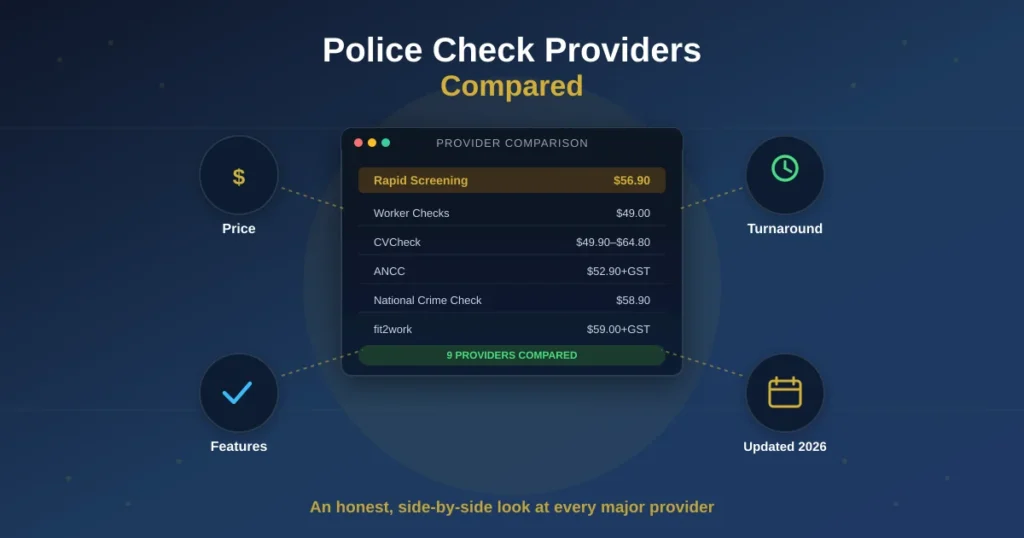
If you’ve searched for police check providers in Australia, you’ve probably noticed something strange: dozens of websites all offering to get you the same document, at prices ranging from $21 to $99, with turnaround claims anywhere from 15 minutes to 10 business days. So which one do you actually pick? Here’s the part almost none of these sites tell you upfront: it doesn’t matter which ACIC-accredited provider you use; the certificate you get back is legally identical. Every one of them draws from the same national database and issues the same document, officially called a Nationally Coordinated Criminal History Check (NCCHC). There’s no premium version and no watered-down budget version. What you’re actually paying for is speed, service, and how painless the process is, not a better result. Why Does The Price Vary So Much For The Same Check? Short answer: because you’re not paying the government a variable fee, you’re paying the provider’s service margin. The Australian Criminal Intelligence Commission (ACIC) runs the National Police Checking Service, and it accredits third-party companies to submit applications and issue results on its behalf. Those companies compete on: None of that changes what’s printed on your certificate. It changes how quickly and smoothly you get it. Police Check Provider Comparison Police Check Provider Comparison Pricing verified directly from provider websites and help centres. Provider Price (inc. GST) Turnaround Business portal Mobile Volunteer discount Rapid Screening OUR PICK $56.90 70% in 1–3 hrs Bulk/corporate accounts ✓ 100% online ✓ $26.95 CVCheck $76.90 ~95% in 10 days ✓ Enterprise + API ✓ Yes Not confirmed ANCC $58.19 70% in 24 hrs ✓ Co-branded ✓ Yes ✓ $27.39 National Crime Check $58.90 Not stated Bulk discounts Not confirmed ✓ $29.90 Checked $64.00 70% in 1 hr (express) ✓ Individual + corp ✓ Yes ✓ $34.00 fit2work $64.90 70% in 15 min ✓ Yes ✓ Yes ✓ $27.39 State Police ~$54.00 5–10+ days ✗ No Limited Some states discount How Did We Verify the Top Police Check Providers’ Comparison? Pricing and turnaround figures were sourced directly from each provider’s website and public help center articles as of July 2026. Providers update pricing without notice, so we’d recommend confirming the current figure directly with the provider before you apply. A Closer Look at Each Provider Every provider below is ACIC-accredited and issues the same legally valid certificate. Here’s what actually sets them apart: price, speed, and the extras bundled in. Rapid Screening Rapid Screening sits in the mid-price range at $56.90 for employment and $26.95 for volunteer checks, with 70% of results returned within 1 – 3 hours. It also issues AFP-purpose checks directly at $72.93 and offers bulk/corporate account options for businesses managing multiple applicants. CVCheck CVCheck is one of the largest and longest-running providers, processing hundreds of thousands of checks a year with an enterprise API for large organisations. Its pricing is the one inconsistency we found in our research; two different official pages list $49.90 and $64.80, respectively, so it’s worth double-checking at checkout. ANCC ANCC (Australian National Character Check) positions itself as a discount, high-volume provider, with a $52.90 employment rate and a track record of 70% of results returned within 24 hours. It also offers a business portal with trade pricing for organisations processing checks regularly. National Crime Check National Crime Check sits close to the middle of the market at $58.90 for employment and $29.90 for volunteer checks, with bulk discounts available for employers, though it doesn’t publish specific turnaround statistics the way most competitors do. Crime Check Australia Crime Check Australia is the most expensive provider in this comparison at $99 for an employment check and $69 for a volunteer check but backs that with same-day service; results are typically emailed within an hour. Checked Checked built its brand around a 1-hour guarantee: if your express-processed check isn’t lodged with the government within one business hour, they refund the express fee. Around 70% of applications hit that window. Its base price isn’t published on the site, so you’ll need to check out to see the final figure. fit2work fit2work (operated by Equifax) charges $59.00 + GST standard, dropping to $24.90 + GST for students and volunteers, and claims up to 70% of checks return within just 15 minutes, one of the fastest published figures in the market. The AFP The AFP (government baseline) is only relevant if you specifically need an AFP-issued National Police Certificate required for a visa, immigration, or certain Commonwealth roles. It costs $56 (GST exempt) online or $113 if fingerprints are required but takes 5–10 business days at best and up to 30 if fingerprinting is involved. How to Choose? If speed and credibility are your top priorities, Rapid Screening and fit2work both publish fast instant-return rates, each clearing around 70% of applications well inside a few hours. You get your money back on the express fee if it’s not met. If price is what matters most, CVCheck’s lower advertised rate ($49.90) and ANCC ($52.90) are the most affordable options we found among directly accredited providers, though CVCheck’s pricing appeared inconsistently across their own site, so it’s worth confirming the figure at checkout before you commit. If you’re managing checks for a team, look at whether the business portal is genuinely free. Rapid Screening bundles its business portal at no extra cost; several other providers reserve better rates or full portal access for enterprise accounts, so ask before assuming it’s included. If you need a check for immigration, visa, or Commonwealth employment purposes, none of the accredited providers above can help; you’ll need an AFP-issued National Police Certificate directly through the Australian Federal Police. Conclusion Every certificate on this list carries the exact same legal weight, so the best provider is really just the one whose price and turnaround best fit your situation, not a better or more trustworthy result. If you need something back today and don’t want to overpay, that’s a short list. If you’re processing checks for a team, prioritise a free
How to Avoid Delays in Police Check Australia?
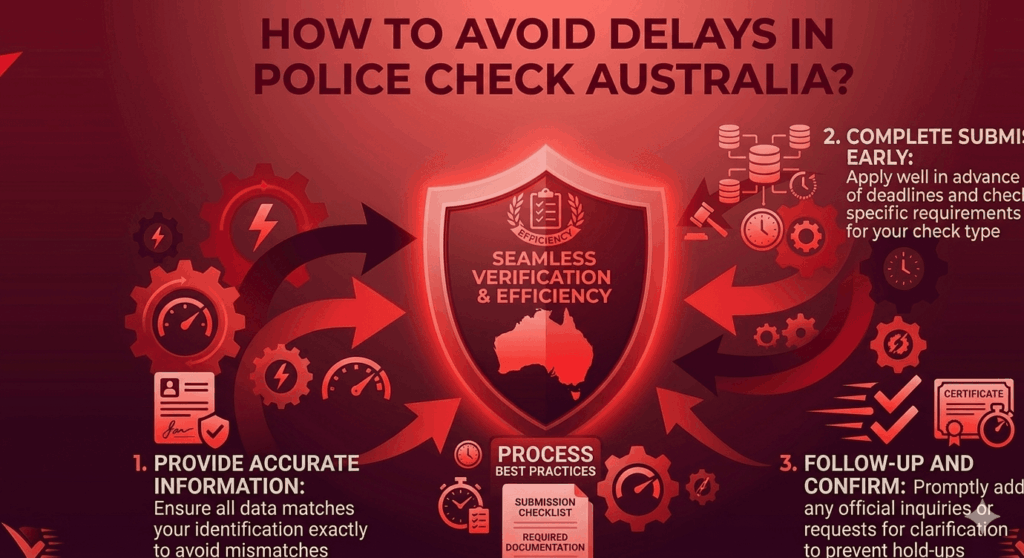
In the fast paced Australian job market, you should know how to avoid delays in police check Australia and how it is often the final gatekeeper between you and your new career. Whether you are applying for a role in healthcare, finance, or government, the speed of your background screening can make or break your start date. While the majority of checks are returned within hours, a significant minority experience frustrating hold ups. Learning how to streamline your background screening is an essential skill for any job seeker or HR professional. The National Police Checking Service (NPCS) is a highly efficient, automated system, but it is not infallible. Small errors in your application or complex personal histories can trigger a manual review, which can extend the process from hours to weeks. Why Do Police Check Delays Happen? To understand how to streamline your background screening, you first need to understand why they occur. The process is not a simple yes/no search. It involves matching your personal details against millions of records held by state and territory police jurisdictions across the country. 1. The Manual Review Referral Approximately 30% of all police check applications are flagged for manual review. This happens when the automated system finds a potential match between your details and a record in the database. It doesn’t necessarily mean you have a criminal record; it could be a false positive caused by: •Having a common name. •Sharing a date of birth with someone who has a record. •Having a similar address history to a person of interest. 2. Data Entry Errors The most common reason for a delay that is within your control is incorrect data entry. Even a single typo in your middle name or a digit wrong in your date of birth can cause the system to stall. 3. Incomplete Address History The NPCS requires a full five-year address history. If there are gaps in your timeline or if you provide vague addresses, the system may flag your application for further investigation. Top Strategies to Avoid Delays in Police Check Australia If you are in a rush, follow these proven strategies to ensure your application sails through the system. 1. Double Check Every Single Detail The first rule of streamlining your background screening is accuracy. Before you hit submit, review your application line by line. •Names: Use your full legal name as it appears on your birth certificate or passport. Do not use nicknames or shortened versions. •Previous Names: You must disclose all previous names, including maiden names, previous married names, or names changed by deed poll. •Date of Birth: Ensure the day, month, and year are correct. 2. Provide High-Quality ID Documents The Document Verification Service (DVS) is an automated system that verifies your ID in real-time. If your ID photos are blurry, cropped, or have a glare, the DVS will fail, and a human will have to manually verify your documents. This can also become a vital factor when you have to avoid delays in police check Australia. 3. Be Precise with Your Address History When the system asks for your five-year address history, it means exactly five years. •Include the unit number, street number, street name, suburb, state, and postcode. •If you lived overseas during the last five years, you must include those international addresses as well. Common Mistake Impact on Turnaround Time Fast-Track Solution Using a Nickname 1–15 Business Days (Manual Review) Use your full legal name exactly as it appears on your ID. Blurry ID Photo 4–24 Hours (Manual ID Check) Use a high-resolution smartphone photo with no glare. Missing Previous Names 5–15 Business Days (Police Referral) Disclose every name you have ever been known by. Gaps in Address History 2–10 Business Days (Investigation) Provide a continuous 5-year history with no gaps. Applying via Post Office 10–20 Business Days (Postal Delay) Use an ACIC-accredited online provider like Rapid Screening. The Importance of Choosing the Right Provider A major factor in streamlining your background screening is the platform you use to apply. While you can apply through the police or the post office, these traditional methods are often the slowest. Why Online Accredited Providers are Faster ACIC-accredited bodies like Rapid Screening have direct, secure API links to the National Police Checking Service. This means: •Instant Submission: Your application is sent to the police database the moment you finish it. •Real-Time ID Verification: We use the DVS to verify your identity in seconds, not days. •Automated Notifications: You are alerted immediately if there is an issue with your application, allowing you to fix it before it causes a major delay. Western Australia and Queensland In states like Western Australia and Queensland, there is a constant high demand for site ready clearances. Rapid Screening is specifically optimised to handle these high volume requirements, helping workers get to site without unnecessary waiting. The Role of False Positives in Delays One of the most frustrating aspects of background screening is dealing with things you can’t control, like having a common name. If your name is “David Jones,” there is a high probability that someone else with that name has a criminal record. When this happens, the system cannot automatically clear you. It must send your file to a police officer who will compare your other details to the person with the record. While you can’t change your name, providing as much detail as possible, such as your place of birth, can help the officer clear the false positive more quickly. Advanced Tips for HR Managers If you are an employer or HR manager, your goal is to get your new hires onboarded as quickly as possible. Implementing a structured screening process is the best way to ensure consistency and speed. HR can also help a new hire to avoid delays in police check Australia. 1. Standardise the Onboarding Checklist Provide your candidates with a clear list of what they need before they start the application. This includes a list of acceptable ID documents and a
Getting a Government Accredited Police Check in Australia
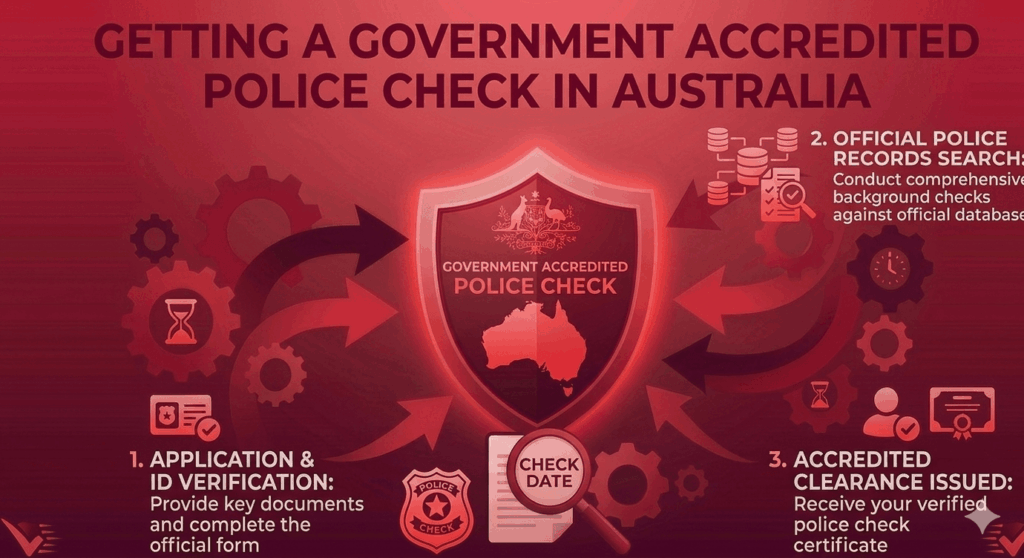
In this comprehensive guide, we will explore everything you need to know about obtaining a Government Accredited Police Check, why it matters, and how you can secure yours in record time through Rapid Screening. Navigating the world of criminal history clearances can often feel like a bureaucratic maze. With various terms like National Police Check, AFP Clearance, and Nationally Coordinated Criminal History Check being used interchangeably, it is easy to get confused. However, the core requirement remains the same: a reliable, secure, and official verification of an individual’s disclosable criminal history. What is a Government Accredited Police Check? A Government Accredited Police Check is an official process that involves searching the records of all Australian police jurisdictions to identify any disclosable court outcomes or pending charges associated with an individual. In Australia, these checks are primarily coordinated through the Australian Criminal Intelligence Commission (ACIC) or the Australian Federal Police (AFP). When you apply for a check through an accredited body like Rapid Screening, you are accessing a secure system that communicates directly with the National Police Checking Service (NPCS). This ensures that the information provided is accurate, up-to-date, and legally recognised by employers and regulatory bodies across the country. The Role of the ACIC and AFP It is important to distinguish between the two main types of government-authorised checks: 1.Nationally Coordinated Criminal History Check (NCCHC): Managed by the ACIC, this is the most common check used for employment, licensing, and volunteer purposes. It is facilitated by accredited bodies that have undergone rigorous vetting to ensure they meet strict security and privacy standards. 2.Australian Federal Police (AFP) Check: These are typically required for specific purposes such as immigration, overseas employment, or working for Commonwealth government agencies. For the vast majority of Australian workers, a nationally coordinated criminal history check obtained through an ACIC-accredited provider is the standard requirement. Why You Need a Government Accredited Police Check The requirement for a police clearance is no longer limited to high security roles. Today, it is a standard part of the onboarding process in almost every sector. Here are the primary reasons why you might be asked to provide one: •Employment Screening: Employers use these checks to mitigate risk and ensure the safety of their workplace, clients, and assets. •Regulatory Compliance: Industries such as aged care, childcare, and healthcare have mandatory requirements for staff to hold valid clearances. •Volunteer Work: To protect vulnerable members of the community, non-profit organisations require volunteers to undergo screening. •Licensing and Accreditation: Many professional bodies require a Government Accredited Police Check before granting licenses to practice in fields like real estate, security, or finance. Comparison of ACIC vs. AFP Police Checks Feature Nationally Coordinated Criminal History Check (ACIC) Australian Federal Police (AFP) Check Primary Purpose General employment, volunteering, and licensing. Immigration, Commonwealth employment, overseas visas. Facilitator ACIC-accredited bodies (like Rapid Screening). Australian Federal Police. Data Source All Australian police jurisdictions. All Australian police jurisdictions. Turnaround Time Often within hours (via Rapid Screening). Typically 5–15 business days. ID Requirements 4 documents (including one photo ID). 100-point ID check. The Importance of Using an Accredited Provider When it comes to sensitive personal data, where you get your check matters just as much as the check itself. Using a Government Accredited Police Check provider like Rapid Screening offers several critical advantages: 1. Enhanced Security and Privacy Accredited bodies must adhere to the Privacy Act 1988 and strict ACIC security protocols. This means your personal information, including your birth certificate, passport, and criminal history, is encrypted and handled with the highest level of confidentiality. 2. Speed and Efficiency Traditional methods of obtaining a police check, such as visiting a local police station, can take weeks. In contrast, an online police clearance through Rapid Screening leverages advanced technology to deliver results in a fraction of the time. In fact, 70% of our checks are returned within just 2 to 4 business hours. 3. Compliance and Validity A check from an unaccredited or third party source that doesn’t have direct ACIC access may not be accepted by your employer. By choosing an accredited provider, you ensure that your certificate is valid and meets all Australian legal standards. How the Process Works Obtaining your official police clearance has never been easier. Gone are the days of printing forms and waiting in queues. Here is how the modern, 100% online process works with Rapid Screening: Step 1: Online Application You will be asked to provide basic personal details, including your full name, date of birth, and five years of address history. Step 2: Identity Verification To maintain the integrity of the system, you must prove your identity. We use the Document Verification Service (DVS), a national online system that allows real time verification of government issued documents. You will typically need to provide: •One commencement document. •One primary use in the community document. •Two secondary uses in the community documents. Step 3: Payment Our pricing is transparent and competitive. A standard Nationally Coordinated Criminal History Check is available for just $51.73 + GST. We accept all major credit cards and secure online payment methods. Step 4: Processing and Results Once submitted, your application is sent to the National Police Checking Service. If there are no potential matches, your result is often returned within hours. You will receive a secure link to download your digital certificate immediately. State-Specific Requirements for Police Checks While the nationally coordinated criminal history check is a national document valid across all states and territories, some industries or local regulations may have specific nuances. New South Wales (NSW) In NSW, police checks are frequently required for those working in the vibrant hospitality and security sectors. Whether you are in Sydney or regional NSW, our online service ensures you meet state requirements without delay. Victoria (VIC) Victoria has stringent requirements for those working in the Working with Children and Aged Care sectors. A national criminal history check is often the first step in these multi-layered screening processes. Queensland (QLD) From the mining hubs to
Online Police Check South Australia: Fast Track to Clearance
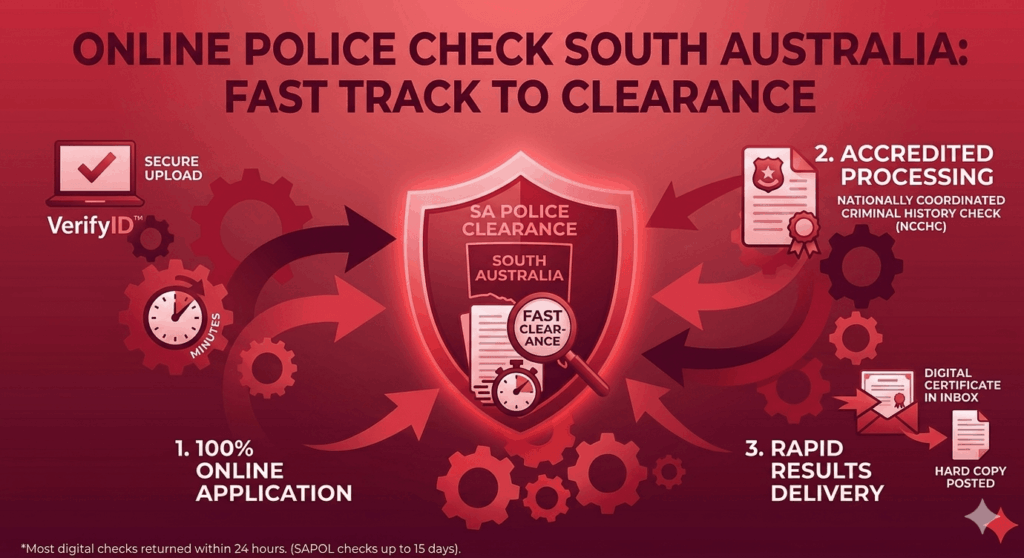
In today’s fast-paced world, efficiency and convenience are paramount, especially when it comes to essential documentation like police checks. For residents of South Australia, obtaining an online police check South Australia has become the preferred method, offering a streamlined process that bypasses traditional complexities. Whether you’re applying for a new job in Adelaide, volunteering in Mount Gambier, or seeking professional accreditation, understanding how to secure a police check online is crucial. This comprehensive guide will walk you through the process, highlight its benefits, and address specific considerations for South Australia and Victoria. The convenience of an Online Police Check in South Australia The days of lengthy paperwork, manual submissions, and extended waiting periods for a police check are largely behind us. Thanks to accredited online providers like Rapid Screening, residents can now complete their online police check from the comfort of their home or office. This digital transformation not only saves time but also enhances the overall user experience, making the process accessible to everyone with an internet connection. An online police check is a Nationally Coordinated Criminal History Check (NCCHC) that provides a summary of an individual’s disclosable criminal history in Australia. These checks are essential for a wide range of purposes, including employment, volunteer work, licensing, and immigration. The online application process typically involves: •Digital Application Form: Filling out a secure online form with personal details. •Identity Verification: Utilizing advanced Document Verification Service (DVS) technology for real-time identity confirmation. •Secure Payment: Making a payment through a secure online portal. •Electronic Delivery: Receiving the official certificate via email, often within hours. This modern approach ensures that your application for an online police check is processed quickly and securely, reflecting the commitment of providers to efficiency and data protection. Why Choose an Online Police Check? The shift towards online police checks is driven by several compelling advantages over traditional methods. These benefits are particularly pronounced for individuals and businesses seeking rapid and reliable results. Key Advantages of Online Police Checks Feature Online Process Traditional Process Speed of Application Minutes Hours (travel, waiting) Identity Verification Real-time DVS Manual 100-point check at post office/police station Turnaround Time 70% in 2-4 hours Days to weeks Accessibility 24/7, anywhere with internet Limited to business hours and physical locations Convenience From home/office Requires travel and appointments Security Encrypted platforms, DVS Physical document handling, potential for loss As the table illustrates, the online method significantly outperforms traditional approaches in terms of speed, convenience, and accessibility. This is especially beneficial for urgent applications or for individuals residing in remote areas of South Australia where access to physical application centers might be limited. Understanding Police Checks in South Australia For those specifically seeking an online police check South Australia, it’s important to understand the local context. While the NCCHC is a national standard, certain state specific requirements or common practices may influence how and when these checks are used. In South Australia, police checks are frequently required for roles in: •Child-Related Employment: Including teachers, childcare workers, and youth group leaders. •Vulnerable Person-Related Employment: Such as aged care workers and disability support staff. •Licensing and Registration: For various professions and trades. •Volunteer Positions: Especially those involving direct contact with the public. South Australia also has its own screening unit, the Department for Human Services (DHS) Screening Unit, which conducts specific checks for child-related work, vulnerable person-related work, and disability services. While these are separate from a standard NCCHC, a current police check is often a prerequisite or a component of these more specialized screenings. Police Check Australia Victoria Online: A Comparative Look Many individuals move between states or apply for roles across different jurisdictions, leading to questions about the portability and consistency of police checks. If you’re considering a police check Australia Victoria online, you’ll find the process remarkably similar to South Australia. Victoria, like South Australia, relies on the Nationally Coordinated Criminal History Check. Accredited providers offer a seamless online application experience, utilizing DVS for identity verification and delivering results electronically. The key similarities include: •National Standard: Both states accept the NCCHC, ensuring consistency across Australia. •Online Accessibility: The ability to apply and receive results entirely online. •Fast Turnaround: Quick processing times are a hallmark of online services in both regions. •Accredited Providers: Reliance on ACIC-accredited organizations for legitimate checks. Aspect South Australia (SA) Victoria (VIC) Primary Screening Body ACIC-accredited providers, SA Police ACIC-accredited providers, Victoria Police Specialised Checks DHS Screening Unit (Child, Vulnerable Person, Disability) Working With Children Check (WWCC), NDIS Worker Screening Check Common Use Cases Education, Healthcare, Aged Care, Licensing Education, Healthcare, Aged Care, Public Sector Local Focus Adelaide, Mount Gambier, Port Augusta Melbourne, Geelong, Ballarat While the underlying NCCHC is consistent, understanding these nuances can help you navigate specific requirements, especially if your role demands additional state-based screenings like Victoria’s Working With Children Check (WWCC). Ensuring a Smooth Online Application Process To ensure your online police check South Australia or police check Australia Victoria online application proceeds without a hitch, consider the following tips: •Accurate Information: Double-check all personal details for accuracy to avoid delays. •Valid ID: Have your identity documents ready for DVS verification. This typically includes a primary ID (e.g., passport, driver’s license) and secondary IDs. •Purpose of Check: Clearly state the purpose of your police check (e.g., employment, volunteer) as this can sometimes influence processing. •Accredited Provider: Always use an ACIC-accredited provider like Rapid Screening to ensure your check is legitimate and widely accepted. Rapid Screening simplifies the process, offering a user-friendly platform that guides you through each step, from application to identity verification and secure delivery of your certificate. Our commitment to speed and security means you can get your online police check with confidence. Conclusion Obtaining an online police check South Australia is a straightforward and efficient process that caters to the demands of modern life. With the ability to apply, verify identity, and receive results entirely online, individuals across South Australia can quickly secure the necessary documentation for employment, volunteering, or licensing. Similarly, those seeking a police
How Long Does a Police Check Last For?
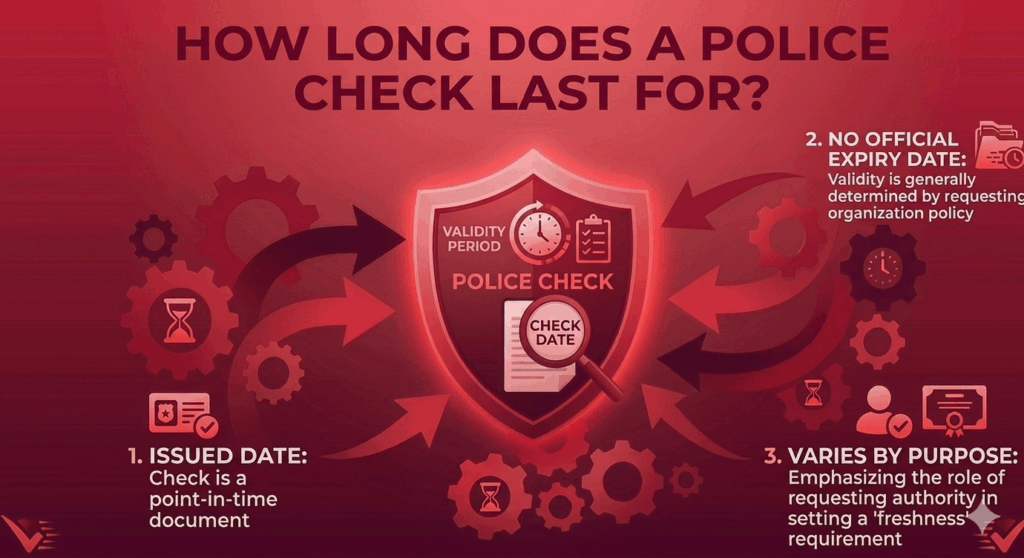
When applying for a new job, a volunteer position, or a visa in Australia, you will likely be asked to provide a National Police Check. This document is a crucial part of the background screening process, ensuring that individuals meet the character requirements for various roles. However, one of the most common questions applicants and employers ask is: how long a police check remains valid? Understanding the validity of a police clearance is essential to avoid delays in your employment or application process. In this comprehensive guide, we will explore the rules surrounding police check expiration, industry-specific requirements, and what you need to know depending on your location, including specific details for Queensland. The Short Answer The most straightforward answer to the question of how long does a police check last for is that it technically has no official expiry date. A Nationally Coordinated Criminal History Check (NCCHC) is considered a point in time document. This means that the results reflect your criminal history exactly as it was on the date the certificate was issued. Because a person could potentially commit an offence the day after receiving their clearance, the certificate cannot guarantee a clean record indefinitely. Therefore, the decision on how long does a police check last for ultimately falls to the organization, employer, or government body requesting the document. They determine their own acceptable timeframes based on their internal risk management policies and industry regulations. Standard Employer Requirements Across Australia While there is no universal expiration date, most Australian employers follow standard industry practices when deciding on the validity of a police check. Generally, organizations prefer recent checks to ensure the information is as current as possible. In most corporate and general employment sectors, a police check is considered valid if it was issued within the last three to six months. Some more lenient organizations may accept a certificate that is up to twelve months old, provided the applicant has not had any recent legal issues. If you are presenting a police check that is older than a year, it is highly likely that you will be asked to apply for a new one through an accredited provider like Rapid Screening. Industry-Specific Validity Periods Different industries have varying levels of risk, which directly impacts their policies on background checks. Below is a breakdown of common sectors and their typical requirements. Industry / Sector Typical Acceptable Age of Police Check Renewal Frequency General Corporate Employment 3 to 6 months Only upon changing jobs Aged Care & NDIS Less than 3 months for new hires Every 3 years (legislated) Healthcare & Medical 3 to 6 months Every 1 to 3 years Finance & Banking Less than 3 months Every 1 to 2 years Government & Defence Less than 3 months Annually or per project Visa & Immigration Up to 12 months Per application As seen in the table above, sectors dealing with vulnerable populations or sensitive financial data have much stricter requirements. For instance, workers in the aged care sector are legally required to renew their police checks every three years, regardless of whether they have changed employers. How Long Does a Police Check Last QLD? If you are based in the Sunshine State, you might be wondering: how long does a police check last qld? The rules in Queensland align with the rest of Australia. The Queensland Police Service (QPS) and the Australian Criminal Intelligence Commission (ACIC) issue point-in-time certificates. Therefore, the answer to how long does a police check last qld depends entirely on the employer or organization requesting it. However, Queensland has specific screening systems for certain professions that operate alongside standard police checks. •Blue Card System: If you work with children in Queensland, you must hold a Blue Card. Unlike a standard police check, a Blue Card has a strict validity period of three years. It involves continuous monitoring, meaning if you commit an offence during those three years, your card can be suspended or cancelled. •Yellow Card (Disability Worker Screening): Similar to the Blue Card, the NDIS Worker Screening Check (formerly the Yellow Card in QLD) is valid for five years and includes continuous monitoring. If you are applying for a standard corporate role in Brisbane or the Gold Coast, the general rule of three to six months will usually apply. Always confirm with your prospective employer to ensure your current certificate meets their specific criteria. Factors That Influence Police Check Validity When an employer determines how long does a police check last, they consider several risk factors. Understanding these can help you anticipate whether you need to apply for a new certificate. •Nature of the Role: Positions involving financial management, access to sensitive data, or interaction with vulnerable people require highly current background checks. •Company Policy: Many large corporations have strict internal compliance policies that mandate background checks be no older than 90 days at the time of onboarding. •Legislative Requirements: Certain industries are bound by state or federal laws that dictate exactly how long does a police check last for before a mandatory renewal is required. •Breaks in Employment: If you leave a company and return a year later, you will almost certainly need to provide a fresh police check, even if your previous one is on file. Why You Shouldn’t Use an Old Police Check Attempting to use an outdated police check can cause unnecessary delays in your hiring process. Employers use these documents to mitigate risk and ensure workplace safety. Providing a certificate from two years ago does not give them the assurance they need regarding your recent conduct. Furthermore, with modern online services, obtaining a new check is no longer a tedious process. At Rapid Screening, we process 70% of Nationally Coordinated Criminal History Checks within two to four hours. Because the process is 100% online and utilizes advanced Document Verification Service (DVS) technology, there is no reason to risk your job application by submitting an expired document. How to Get a Fast and Reliable Police Check If you
Your Business Needs an Express Identity Verification Service
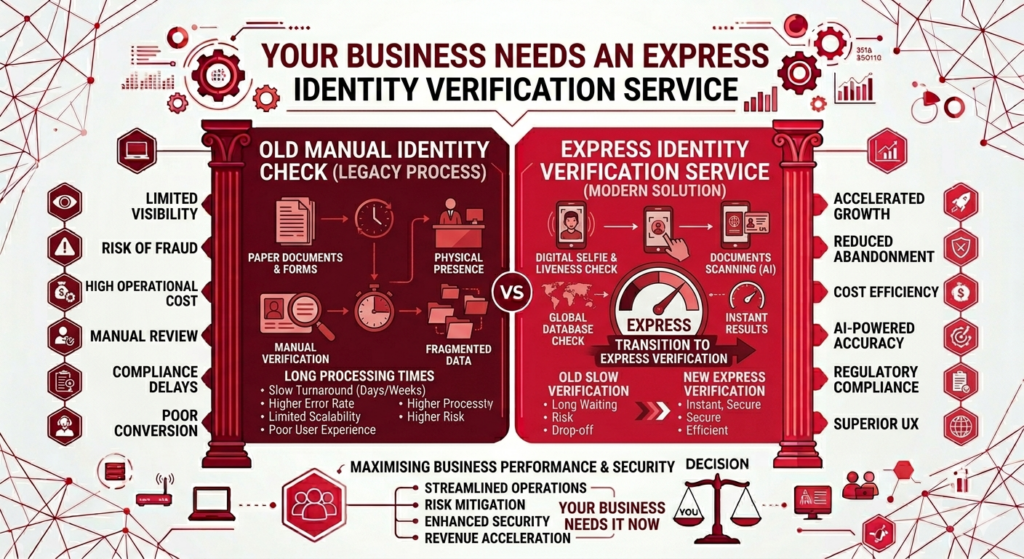
In the rapidly evolving digital landscape of 2026, the traditional methods of verifying identity are no longer sufficient. For Australian businesses, the ability to confirm a person’s identity quickly and accurately is not just a matter of convenience; it is a critical component of security, compliance, and customer trust. This is where an express identity verification service becomes a game changer. Whether you are onboarding new employees, verifying customers for financial transactions, or ensuring compliance in regulated industries, the speed and reliability of your verification process can significantly impact your bottom line. What is an Express Identity Verification Service? An express identity verification service is a technology-driven solution designed to verify an individual’s identity in real-time or near real-time. Unlike manual processes that involve physical document checks and lengthy wait times, these services utilize advanced digital tools to cross reference identity data against official government databases. In Australia, this often involves the Document Verification Service (DVS), which allows accredited providers to check biographic information on identity documents against the original government records instantly. How does the technology behind express verification work? The core of an express identity verification service lies in its integration with secure, government-backed systems. When a candidate or customer submits their details, such as a driver’s licence number or passport details, the service sends an encrypted request to the DVS. The DVS then returns an immediate match or no match result. This process is often enhanced with biometric checks, such as facial recognition and liveness tests, to ensure that the person presenting the document is its rightful owner. This multi-layered approach provides a level of assurance that manual checks simply cannot match. Why is Speed Essential in Identity Verification? In 2026, fast is the new standard. Candidates and customers expect seamless digital experiences, and any delay in the verification process can lead to frustration and abandonment. For businesses, speed is equally important for maintaining operational momentum and reducing the risk of fraud. What are the business benefits of real-time verification? Implementing an express identity verification service offers several key advantages: •Accelerated Onboarding: Reduce the time to hire by verifying new employees‘ identities in minutes rather than days. •Reduced Fraud Risk: Real time checks against government databases make it significantly harder for fraudsters to use stolen or forged identities. •Improved Customer Experience: Provide a frictionless experience for customers, increasing conversion rates and brand loyalty. •Operational Efficiency: Automating the verification process frees up your HR and compliance teams to focus on more strategic tasks. •Scalability: Easily handle high volumes of verifications during peak periods without increasing your administrative overhead. How Does an Express Identity Verification Service Ensure Compliance? Compliance with Australian regulations is a top priority for any business handling personal data. The Australian Privacy Principles (APPs) and the Privacy Act 1988 set strict standards for how identity information must be collected, stored, and used. What regulatory standards do these services meet? A reputable express identity verification service is built with compliance at its core. By using government-accredited systems like the DVS, these services ensure that the verification process meets the highest standards of accuracy and security. Furthermore, they employ robust encryption and data handling protocols to protect sensitive information, helping your business stay compliant with the latest privacy laws. In 2026, with the rollout of the Australian Government’s Digital ID system, using an accredited service is more important than ever to ensure your business remains on the right side of the law. What Industries Benefit Most from Express Identity Verification? While identity verification is important for all businesses, certain sectors in Australia have a higher reliance on speed and accuracy due to the nature of their operations and the regulatory environment they inhabit. Which sectors require the fastest verification turnaround? •Financial Services and Fintech: For KYC (Know Your Customer) and AML (Anti-Money Laundering) compliance, real-time verification is essential for opening accounts and processing transactions. •Healthcare and Aged Care: Ensuring that staff and volunteers are who they say they are is critical for the safety of vulnerable people. •Real Estate and Property Management: Verifying the identities of tenants and buyers quickly helps to streamline transactions and prevent fraud. •Gig Economy and Sharing Platforms: Rapidly onboarding drivers, couriers, and service providers is key to maintaining a responsive and reliable platform. •Education and Childcare: Protecting students and children requires rigorous and fast background checks for all staff and visitors. How to Choose the Right Express Identity Verification Service? Not all verification services are created equal. When selecting a partner for your express identity verification service, it is important to look for a provider that offers the right balance of speed, security, and ease of use. What features should you look for in a provider? When evaluating your options, consider the following essential features: 1.DVS Accreditation: This is the gold standard for identity verification in Australia. 2.Biometric Integration: Look for services that include facial recognition and liveness checks for added security. 3.User-Friendly Interface: The process should be simple for both your team and the people being verified. 4.Mobile Compatibility: Ensure the service works seamlessly on smartphones, as this is how most people will complete their checks. 5.Robust API and Integrations: The service should integrate easily with your existing HRIS, ATS, or CRM systems. 6.Transparent Pricing: Look for a provider with clear, volume-based pricing and no hidden fees. 7.Local Australian Support: Having access to a local team that understands the Australian regulatory landscape is invaluable. What is the Process for Using an Express Identity Verification Service? One of the biggest advantages of a modern, digital service is its simplicity. The process is designed to be as straightforward as possible, ensuring high completion rates and minimal administrative burden. Providing services in QLD, TAS and others states as well. What are the steps for a candidate or customer? The typical workflow for an express identity verification service involves: •Invitation: The business sends a secure link to the individual via email or SMS. •Document Capture: The individual uses their smartphone camera to take a photo
The Power of Scalable Hiring Verification Tools
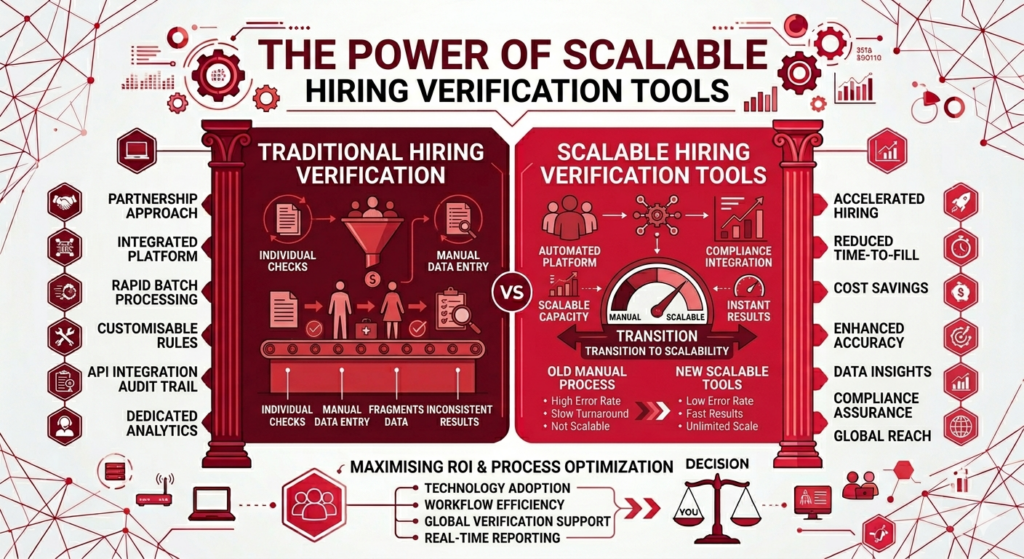
In the dynamic Australian job market of 2026, the ability to hire quickly without compromising on security is a significant competitive advantage. As businesses scale, traditional manual background checks often become a bottleneck, leading to lost talent and increased operational risk. To stay ahead, forward thinking HR departments are turning to scalable hiring verification tools to automate compliance and streamline the onboarding journey. Whether you are a high-growth startup in Sydney or a national enterprise with thousands of employees, these tools are essential for maintaining a secure and efficient workforce. What are Scalable Hiring Verification Tools? Scalable hiring verification tools are advanced software solutions designed to handle the background screening process for any number of candidates simultaneously. Unlike manual methods that require individual data entry and follow-up, these tools leverage automation, API integrations, and centralized dashboards to manage identity verification, police checks, and reference checks at scale. In Australia, these tools are built to interface directly with government databases, such as the National Police Checking Service (NPCS), ensuring that results are both rapid and accurate. How do these tools support high volume recruitment? The core strength of scalable hiring verification tools lies in their ability to remove administrative friction. By automating the invitation process and using real-time tracking, HR teams can oversee hundreds of background checks from a single interface. These tools often feature bulk upload capabilities and automated reminders, ensuring that candidates complete their requirements promptly. For an Australian business, this means the difference between waiting weeks for a manual check and receiving verified results in a matter of hours, regardless of the number of applicants. Why is Scalability Crucial for Modern Background Checks? As your business grows, your hiring needs will inevitably fluctuate. A verification process that works for five hires a month will likely break when you need to hire fifty. Scalability ensures that your quality of hire and compliance standards remain consistent, even during periods of rapid expansion or seasonal peaks. What are the risks of using non-scalable verification methods? Relying on non-scalable methods can lead to several critical issues for Australian organizations: •Increased Time to Hire: Manual processes are slow and prone to human error, causing delays that can lead top candidates to accept offers elsewhere. •Compliance Gaps: When teams are overwhelmed, it is easier for a required check to be missed or for an expired document to go unnoticed. •Higher Operational Costs: Manual verification requires significant staff time, which becomes increasingly expensive as hiring volume grows. •Poor Candidate Experience: A clunky, slow verification process can damage your employer brand and frustrate potential hires. •Data Security Risks: Handling sensitive identity documents via email or physical copies increases the risk of data breaches and non-compliance with the Privacy Act. How Do Scalable Hiring Verification Tools Integrate with HR Technology? One of the most significant advantages of modern scalable hiring verification tools is their ability to integrate seamlessly with your existing HR tech stack. This creates a unified workflow where background checks are a natural extension of the recruitment process. What are the benefits of ATS and HRIS integrations? By connecting your verification tools with an Applicant Tracking System (ATS) or Human Resources Information System (HRIS), you can achieve: 1.Automated Triggers: A background check can be automatically initiated as soon as a candidate reaches a specific stage in your hiring pipeline. 2.Single Source of Truth: All verification results are stored directly within the candidate’s profile, making it easy for hiring managers to access information. 3.Reduced Data Entry: Candidate information is synced between systems, eliminating the need for double handling and reducing the risk of errors. 4.Real-Time Status Updates: Recruiters can see the progress of a check without ever leaving their primary HR platform. 5.Streamlined Onboarding: Once verified, candidate data can flow directly into your payroll and employee management systems. What Features Define the Best Scalable Hiring Verification Tools? Not all verification platforms are created equal. To truly support a growing business, scalable hiring verification tools must offer a specific set of features that prioritize speed, security, and ease of use. What should Australian HR leaders look for in a tool? When evaluating potential solutions, consider these essential features: •ACIC Accreditation: Ensure the provider is accredited by the Australian Criminal Intelligence Commission for official police checks. •Bulk Processing Capabilities: The ability to invite and track large groups of candidates with minimal manual effort. •Mobile Optimised Candidate Portal: A seamless experience that allows candidates to upload documents and provide consent from their smartphones. •Real-Time Identity Verification: Using technology like the Document Verification Service (DVS) to verify IDs instantly. •Customisable Workflows: The flexibility to set different screening requirements for different roles or departments. •Robust Reporting and Analytics: Insights into turnaround times, completion rates, and compliance status across the organization. •Australian Based Support: Access to local experts who understand the specific regulatory landscape in Australia. How Do Scalable Hiring Verification Tools Enhance Data Security? In 2026, data privacy is more than just a legal requirement; it is a matter of trust. Scalable hiring verification tools are designed with security at their core, providing a much safer alternative to traditional document handling. What security protocols protect sensitive candidate data? Leading platforms employ several layers of protection: •End-to-End Encryption: Ensuring that data is unreadable to unauthorized parties both during transmission and while stored. •Secure Cloud Hosting: Utilizing Australian-based servers that comply with international security standards like ISO 27001. •Multi-Factor Authentication (MFA): Adding an extra layer of security for HR staff accessing the verification dashboard. •Audit Trails: Keeping a detailed log of who accessed what information and when, which is crucial for compliance audits. •Automated Data Retention Policies: Ensuring that sensitive information is only kept for as long as necessary, in line with Australian privacy laws. What Industries Benefit Most from Scalable Hiring Verification Tools? While any growing business can benefit, certain sectors in Australia have a particularly high need for scalable hiring verification tools due to the nature of their work and regulatory environment. Which sectors rely on high volume, verified hiring?
What Documents Are Needed for Police Check Australia?
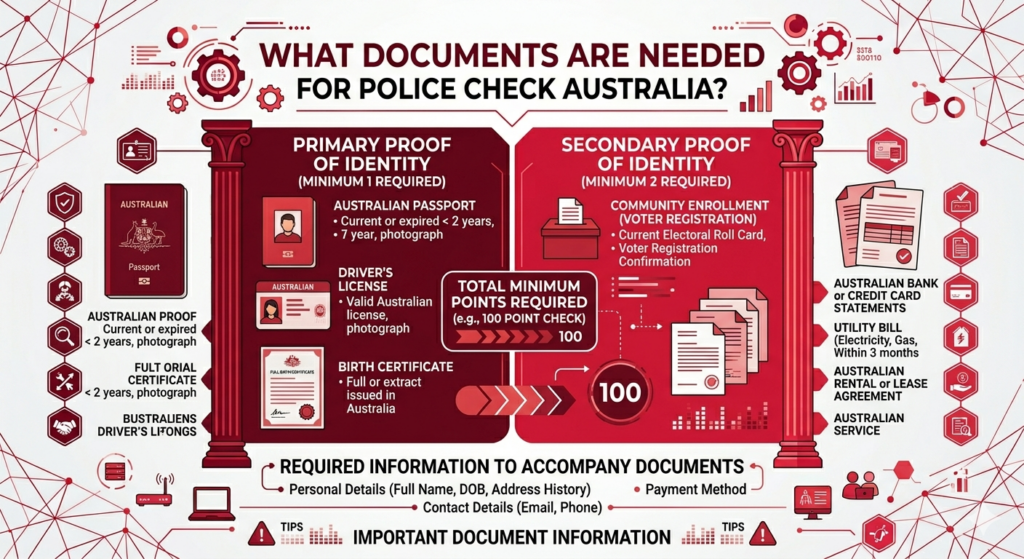
Navigating the requirements for a background check can often feel like a complex puzzle. Whether you are applying for a new job, seeking a volunteer position, or fulfilling visa requirements, understanding what documents are needed for police check Australia is the first and most crucial step. In Australia, the process is highly regulated to ensure the highest standards of security and identity verification. This guide provides a comprehensive breakdown of the identification requirements mandated by the Australian Criminal Intelligence Commission (ACIC) and the Australian Federal Police (AFP), ensuring your application is processed swiftly and without hitches. What is the 4 Document Rule for a Nationally Coordinated Criminal History Check? When applying through an ACIC-accredited body like Rapid Screening, you must adhere to a specific 4 document rule. This framework is designed to establish a digital breadcrumb trail of your identity in Australia. The ACIC requires a combination of documents from four distinct categories to verify who you are. Failing to provide the correct combination is the most common reason for application delays. We also provide services in other states such as VIC and QLD. What are the four categories of required documents? To satisfy the identity requirements, you must provide one document from each of the first two categories and two from the third. Specifically, you need: 1.One Commencement of Identity Document: To establish your birth or arrival in Australia. 2.One Primary Use in the Community Document: To show your identity is active in the Australian community. 3.Two Secondary Use in the Community Documents: To further corroborate your identity through various official records. What Documents Qualify as Commencement of Identity? The commencement document is the foundation of your identity profile. It proves your legal right to be in Australia. For most applicants, this is the most critical document to locate before starting the online application. What are common examples of commencement documents? The most widely accepted commencement documents include: •Full Australian Birth Certificate: Must be a full certificate, not an extract or a commemorative version. •Current Australian Passport: Even if you were born overseas, a current Australian passport serves as a commencement document. •Australian Citizenship Certificate: For those who have naturalised. •Valid Australian Visa: This can be a VEVO (Visa Entitlement Verification Online) printout or a visa label in a foreign passport. •ImmiCard: Issued by the Department of Home Affairs to certain visa holders. What Documents Are Considered Primary Use in the Community? Once your commencement is established, you need a Primary document. This category focuses on government-issued identification that you use in your daily life within Australia. These documents almost always require a photograph of the applicant. What are the most used primary documents? Most Australians use one of the following as their primary document: •Australian Driver’s Licence: This is the most common primary document. It must be current and can be a learner’s permit or provisional licence. •Current Foreign Passport: Must be accompanied by a valid Australian Visa (which would have been your commencement document). •Proof of Age Card: Issued by a state or territory government agency. •Shooter or Firearm Licence: Must be a current, full licence. •Student Identification Card: For applicants under 18, a current school ID with a photo and signature is often acceptable. What Are Secondary Use in the Community Documents? The final piece of the puzzle involves providing two secondary documents. These are used to verify that your identity is consistently used across different sectors of society, such as healthcare, finance, or government services. What secondary documents can I provide? There is a broad range of acceptable secondary documents, making this category the most flexible. Common examples include: •Medicare Card: A staple for almost all Australian residents. •Australian Electoral Commission (AEC) Enrolment: Proof that you are registered to vote. •Bank Card or Credit Card: Only the front of the card is needed; ensure your name matches your other IDs. •Working with Children Check (WWCC) Card: Or a similar vulnerable person’s check card. •Government Agency ID Card: Such as a tertiary student ID or a public service ID. •Utility Bill: A recent (less than 3 months old) electricity, gas, or water bill showing your current residential address. How Do Document Requirements Differ for an AFP Check? While the ACIC-coordinated check uses the 4-category system, the Australian Federal Police (AFP) often uses a 100-point system for their National Police Certificates. It is vital to know which check your employer or the Department of Home Affairs requires, as what documents are needed for police check Australia question has a slightly different answer for the AFP. What is the 100-point ID system? The AFP system assigns points to different documents. You must reach a total of at least 100 points. For example: •70 Points: Birth Certificate, Citizenship Certificate, or Passport (Primary documents). •40 Points: Driver’s Licence, Public Service ID, or Tertiary Student ID (Secondary documents with photo). •25 Points: Medicare Card, Credit Card, or Utility Bill (Supporting documents). Document Type ACIC Category AFP Points (Approx) Australian Passport Commencement 70 Points Driver’s Licence Primary 40 Points Medicare Card Secondary 25 Points Utility Bill Secondary 25 Points What If I Have Changed My Name? If the names on your documents do not match, for example, if you have married or changed your name by deed poll, you must provide additional evidence. This is a critical part of what documents are needed for police check Australia process to ensure all records are correctly linked to you. What documents prove a change of name? You will need to provide an official linking document, such as: •Marriage Certificate: Issued by a state or territory Registry of Births, Deaths and Marriages (church-issued certificates are generally not accepted). •Change of Name Certificate: Issued by an Australian Registry of Births, Deaths and Marriages. •Divorce Decree: If you have reverted to a maiden name. Why Is a Selfie Often Required During the Process? In the digital age, simply uploading scans of documents isn’t enough to prevent identity fraud. Most accredited providers, including Rapid Screening, now require
Is There Really a free Australian Police Check?
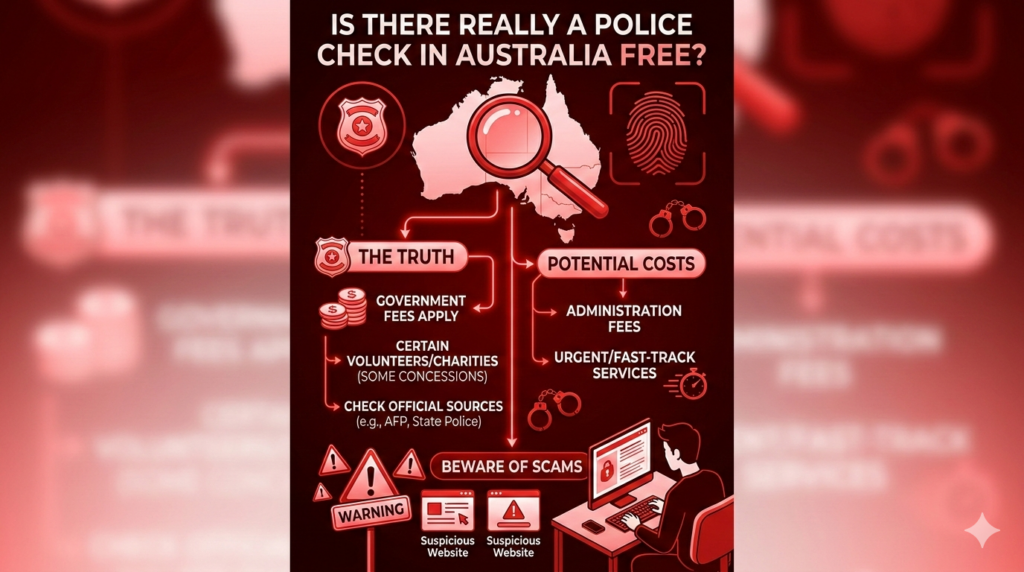
We all love a bargain. In 2026, where a standard oat latte sets you back $8 and rent is… well, let’s not talk about rent… searching for a free Australian police check makes total sense. You’re likely on the cusp of an exciting new job, a volunteer role, or a promotion, and the last thing you want is another onboarding fee. But here’s the straight talk: if you’re looking for a 100% official, ACIC-accredited National Police Check for general employment without spending a cent, you’re chasing a unicorn. At Rapid Screening, we’re all about transparency and wit, so let’s dive into why the free check is a myth, why cheap can be dangerous, and how you can get the best value for your professional future. The Million Dollar Question: Can You Get a Police Check in Australia free? The short answer is: No, not for general employment. The Australian Criminal Intelligence Commission (ACIC), which manages the National Police Checking Service, charges a fee for every single search against their database. Whether you go through a state police branch or a private provider like us, that wholesale cost exists. Why a free Australian police check Doesn’t Exist for Workers The infrastructure required to maintain, update, and secure the criminal records of millions of Australians is massive. When you submit a check, you are paying for: Because these costs are baked into the system, anyone promising a free Australian police check is likely either misinformed or worse malicious. The Free Trap: Why Your Data is the Real Currency If you stumble across a website or an app promising a free Australian police check, your internal scam-o-meter should be hitting the red zone. In 2026, data is more valuable than gold. The Risk of Identity Theft To perform a police check, you have to provide your 100 points of ID. This includes your passport, driver’s licence, and Medicare card. If a non-accredited site offers a free Australian police check, they are essentially asking you to hand over the keys to your entire digital life. They might not give you a certificate, but they might sell your data to the highest bidder on the dark web. Fake Certificates Some free sites might generate a PDF that looks like an official certificate. However, in 2026, most employers will use digital verification. If your HR manager scans the QR code on a fake free certificate and it leads nowhere, you won’t just lose the job; you might face legal consequences for presenting a fraudulent document. Volunteer Checks: Closest Thing to a free Australian police check? If your hunt for a free Australian police check is for a community service role, you’re in luck, sort of. The government recognizes the value of volunteers and offers a significant concession on the base fee. Volunteer Concessions Most Australian states, if you are volunteering for a 100% unpaid role in a non-profit organization, the cost of the check is drastically reduced. In some specific cases, the organization might pay the fee on your behalf. In that scenario, it is a free Australian police check for you, even though someone else is footing the bill. Limitations of Volunteer Checks It’s important to note that a volunteer check is legally different from an employment check. You cannot use a volunteer clearance to get a paid job at a bar, a bank, or a hospital. If you try to save money by using a volunteer check for a paid role, it will be flagged as invalid during the compliance audit. The Opportunity Cost: Why Value Trumps Free In 2026, time is the one thing we can’t buy more of. If you spend three days searching for a free Australian police check, you’ve already lost money. The Cost of Waiting Standard manual checks can take 10 to 15 business days. If your new job pays $1,500 a week, and you’re waiting two weeks for a cheap check to clear, that check has effectively cost you $3,000 in lost wages. The Rapid Screening Advantage At Rapid Screening, we don’t offer a free Australian police check, but we do offer a check that pays for itself in speed. Getting your results on Monday morning so you can start work on Monday afternoon is a much better financial move than waiting weeks for a budget option. How to Get Your Check Reimbursed If you’re still determined to get a free Australian police check, the most common way is through employer reimbursement. Instead of looking for a service that doesn’t charge, look for an employer that covers the cost. Asking the Right Questions When you receive your job offer, ask: Does the company have a preferred provider for background screening, or should I provide my own and submit the receipt for reimbursement? Many mid to large companies in Australia have a budget for this and are happy to pay for a high quality, fast check from Rapid Screening because it gets you onto the floor and working sooner. Tax Deductibility If your employer won’t pay for it, remember that in many cases, the cost of a police check required for your current job is a tax deductible work expense. While it’s not exactly a free Australian police check, you’ll get a portion of the cost back at tax time, which softens the blow. State vs. National: Does Location Affect the Price? Whether you are looking for a free Australian police check in NSW, Victoria, or WA, the rules remain consistent. Because the check is Nationally Coordinated, it searches every state and territory database regardless of where you apply. One Search, All States You don’t need a separate check for every state you’ve lived in. One National Police Check covers everything. This efficiency is why the ACIC fees are mandatory; they are maintaining a massive, interconnected web of data that keeps the whole country safe. Why 2026 Technology Makes Free Even Less Likely In the 2020s, background screening was a bit of a Wild West. In 2026, the
Mastering the Maze: Police Check Requirements in 2026
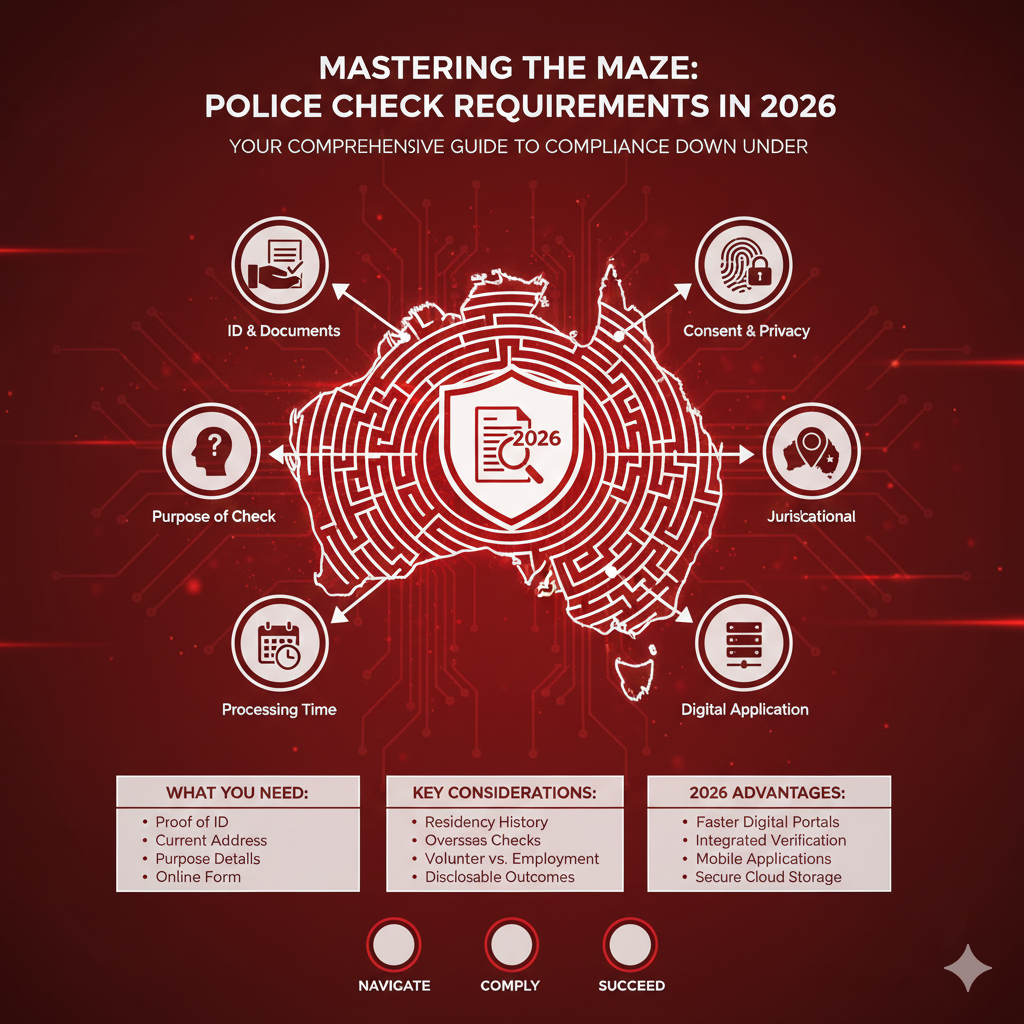
Welcome to 2026, where the new normal of the professional world is built on a foundation of verified trust. Whether you’re a nurse entering a busy Melbourne hospital, a tech consultant in Sydney, or a volunteer in rural Queensland, you’ve likely encountered the background check hurdle. In today’s fast-moving economy, navigating the maze of police check requirements shouldn’t be the hardest part of landing your new role. At Rapid Screening, we know that compliance can feel like a chore. However, in an era where digital identity and cybersecurity are paramount, these checks are the vital safeguards that protect our workplaces and communities. Understanding the current landscape of a Nationally Coordinated Criminal History Check (NCCHC) is the first step to ensuring your career stays on the fast track. Modern police check requirements: A 2026 Overview The way we verify identity has changed significantly over the last few years. While the core mission remains the same, identifying disclosable court outcomes (DCOs), the method is now almost entirely digital. In 2026, paper forms and physical witnesses are relics of the past. At its heart, meeting police check requirements is about proving two things: who you are and that your history is compatible with your intended role. The Australian Criminal Intelligence Commission (ACIC) oversees the national system, ensuring that a check in Tasmania carries the same weight as one in the Northern Territory. Essential police check requirements The 100 point ID system is the backbone of identity security in Australia. To fulfill your police check requirements, you must provide a combination of documents that prove your identity beyond a shadow of a doubt. The Identity Document Hierarchy The ACIC requires documents from four distinct categories. You must provide one commencement document, one primary document, and two secondary documents. Category Points Examples of Acceptable Documents Commencement 70 Australian Passport, Full Birth Certificate, or ImmiCard. Primary 40 Australian Driver’s Licence, Marriage Certificate, or Proof of Age Card. Secondary 25 Medicare Card, Bank Statement, Credit Card, or Utility Bill. Secondary 25 Australian Student ID, Foreign Passport (with valid visa). Failure to meet these police check requirements perfectly is the number one reason applications are delayed. The names on all four documents must be consistent. If your passport is in your maiden name and your driver’s licence is in your married name, you must provide a marriage certificate as a linking document to bridge the gap. Biometric Verification: The New Frontier of police check requirements In 2026, we’ve moved beyond the need to visit a Justice of the Peace or a police station for identity verification. Rapid Screening utilizes cutting edge Liveness technology. How It Works When you apply, you will be prompted to take a selfie or a short video of your face using your smartphone or webcam. Our AI then compares this real-time biometric data against the photo on your passport or driver’s licence. This ensures: The 70/30 Rule: Managing Your Timeline If you’re in a rush to start a new job, the waiting game can be stressful. To manage your expectations, it is vital to understand the 70/30 Rule used by the ACIC. The 70% (Instant): Most applicants (roughly 70%) have a unique name and no criminal record. For these individuals, results are usually returned within 1 to 2 hours of submission. The 30% (Manual Referral): About 30% of checks are flagged for manual referral. This happens if you have a common name or if a potential match is found in the police database. If your application is referred, it is sent to one or more police agencies for a human officer to review. This can take anywhere from 1 to 15 business days. While different states might have subtle variations in police check requirements for certain roles, the referral process is a standard national safety measure. No provider can speed this up once it is in the hands of the police. Industry Specific Needs: Why the Purpose Matters When you fill out your application, you must specify the Purpose of the Check. This isn’t just a survey; it legally dictates what information the police are allowed to release to you and your employer. 1. NDIS and Aged Care Following the regulatory updates of 2025, those working in aged care or with the NDIS face some of the strictest scrutiny. These checks often look specifically for exclusionary offenses related to the safety of vulnerable persons. 2. Finance and Fintech With the rise of sophisticated digital fraud in 2026, the finance sector requires checks that specifically include Dishonesty offenses. An employer in this field needs to know that the people handling their digital assets have a verified history of integrity. 3. Volunteers Did you know that police check requirements are slightly different for volunteers? If you are working for a 100% unpaid, community based role, you may be eligible for a discounted Volunteer Check. Note that you cannot use a volunteer check for a paid position later, it is role specific. Common Pitfalls: Why Applications Get Stuck Even with the best technology, human error is the biggest hurdle. To ensure you breeze through your application, avoid these common mistakes: Why Choose Rapid Screening in 2026? We know you have choices when it comes to compliance. Rapid Screening police check stands out because we balance lightning fast tech with authentic, local human support. Conclusion Mastering police check requirements doesn’t just get you through the hiring process, it demonstrates your professional readiness and commitment to safety. By preparing your documents, understanding the biometric process, and choosing a trusted partner like Rapid Screening, you turn a complex administrative task into a quick win for your career. Frequently Asked Questions (FAQs) Q) Can I use a digital copy of my Medicare card? In 2026, most digital government IDs are accepted. However, we recommend having a clear photo of the physical card as a backup for our biometric scanner. Q) Why was my check referred to the police? About 30% of checks are referred. This is usually due to a