
Top Police Check Providers in Australia Compared (July 2026)
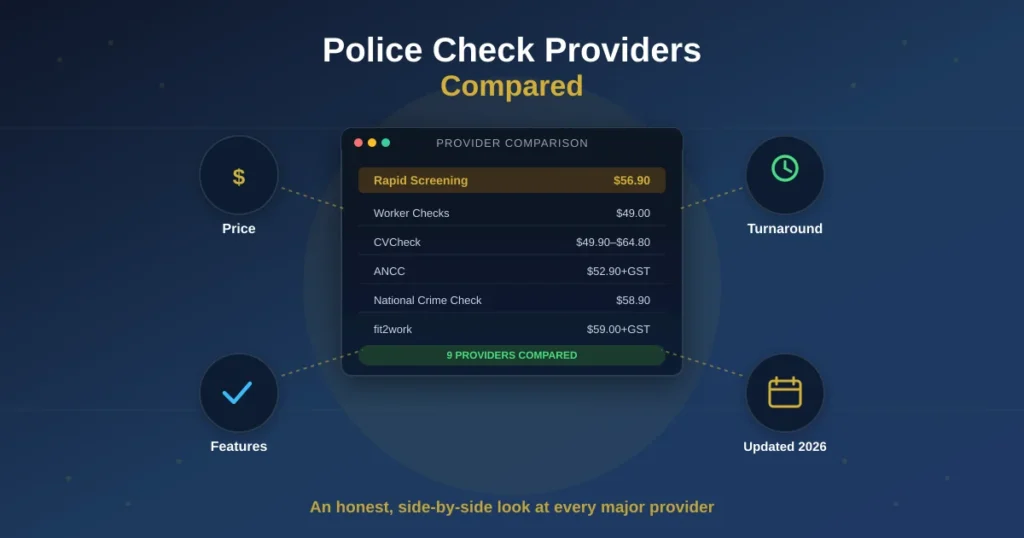
If you’ve searched for police check providers in Australia, you’ve probably noticed something strange: dozens of websites all offering to get you the same document, at prices ranging from $21 to $99, with turnaround claims anywhere from 15 minutes to 10 business days. So which one do you actually pick? Here’s the part almost none of these sites tell you upfront: it doesn’t matter which ACIC-accredited provider you use; the certificate you get back is legally identical. Every one of them draws from the same national database and issues the same document, officially called a Nationally Coordinated Criminal History Check (NCCHC). There’s no premium version and no watered-down budget version. What you’re actually paying for is speed, service, and how painless the process is, not a better result. Why Does The Price Vary So Much For The Same Check? Short answer: because you’re not paying the government a variable fee, you’re paying the provider’s service margin. The Australian Criminal Intelligence Commission (ACIC) runs the National Police Checking Service, and it accredits third-party companies to submit applications and issue results on its behalf. Those companies compete on: None of that changes what’s printed on your certificate. It changes how quickly and smoothly you get it. Police Check Provider Comparison Police Check Provider Comparison Pricing verified directly from provider websites and help centres. Provider Price (inc. GST) Turnaround Business portal Mobile Volunteer discount Rapid Screening OUR PICK $56.90 70% in 1–3 hrs Bulk/corporate accounts ✓ 100% online ✓ $26.95 CVCheck $76.90 ~95% in 10 days ✓ Enterprise + API ✓ Yes Not confirmed ANCC $58.19 70% in 24 hrs ✓ Co-branded ✓ Yes ✓ $27.39 National Crime Check $58.90 Not stated Bulk discounts Not confirmed ✓ $29.90 Checked $64.00 70% in 1 hr (express) ✓ Individual + corp ✓ Yes ✓ $34.00 fit2work $64.90 70% in 15 min ✓ Yes ✓ Yes ✓ $27.39 State Police ~$54.00 5–10+ days ✗ No Limited Some states discount How Did We Verify the Top Police Check Providers’ Comparison? Pricing and turnaround figures were sourced directly from each provider’s website and public help center articles as of July 2026. Providers update pricing without notice, so we’d recommend confirming the current figure directly with the provider before you apply. A Closer Look at Each Provider Every provider below is ACIC-accredited and issues the same legally valid certificate. Here’s what actually sets them apart: price, speed, and the extras bundled in. Rapid Screening Rapid Screening sits in the mid-price range at $56.90 for employment and $26.95 for volunteer checks, with 70% of results returned within 1 – 3 hours. It also issues AFP-purpose checks directly at $72.93 and offers bulk/corporate account options for businesses managing multiple applicants. CVCheck CVCheck is one of the largest and longest-running providers, processing hundreds of thousands of checks a year with an enterprise API for large organisations. Its pricing is the one inconsistency we found in our research; two different official pages list $49.90 and $64.80, respectively, so it’s worth double-checking at checkout. ANCC ANCC (Australian National Character Check) positions itself as a discount, high-volume provider, with a $52.90 employment rate and a track record of 70% of results returned within 24 hours. It also offers a business portal with trade pricing for organisations processing checks regularly. National Crime Check National Crime Check sits close to the middle of the market at $58.90 for employment and $29.90 for volunteer checks, with bulk discounts available for employers, though it doesn’t publish specific turnaround statistics the way most competitors do. Crime Check Australia Crime Check Australia is the most expensive provider in this comparison at $99 for an employment check and $69 for a volunteer check but backs that with same-day service; results are typically emailed within an hour. Checked Checked built its brand around a 1-hour guarantee: if your express-processed check isn’t lodged with the government within one business hour, they refund the express fee. Around 70% of applications hit that window. Its base price isn’t published on the site, so you’ll need to check out to see the final figure. fit2work fit2work (operated by Equifax) charges $59.00 + GST standard, dropping to $24.90 + GST for students and volunteers, and claims up to 70% of checks return within just 15 minutes, one of the fastest published figures in the market. The AFP The AFP (government baseline) is only relevant if you specifically need an AFP-issued National Police Certificate required for a visa, immigration, or certain Commonwealth roles. It costs $56 (GST exempt) online or $113 if fingerprints are required but takes 5–10 business days at best and up to 30 if fingerprinting is involved. How to Choose? If speed and credibility are your top priorities, Rapid Screening and fit2work both publish fast instant-return rates, each clearing around 70% of applications well inside a few hours. You get your money back on the express fee if it’s not met. If price is what matters most, CVCheck’s lower advertised rate ($49.90) and ANCC ($52.90) are the most affordable options we found among directly accredited providers, though CVCheck’s pricing appeared inconsistently across their own site, so it’s worth confirming the figure at checkout before you commit. If you’re managing checks for a team, look at whether the business portal is genuinely free. Rapid Screening bundles its business portal at no extra cost; several other providers reserve better rates or full portal access for enterprise accounts, so ask before assuming it’s included. If you need a check for immigration, visa, or Commonwealth employment purposes, none of the accredited providers above can help; you’ll need an AFP-issued National Police Certificate directly through the Australian Federal Police. Conclusion Every certificate on this list carries the exact same legal weight, so the best provider is really just the one whose price and turnaround best fit your situation, not a better or more trustworthy result. If you need something back today and don’t want to overpay, that’s a short list. If you’re processing checks for a team, prioritise a free
What is the Cost of a Police Check in Australia? | 2026 Guide

When a candidate applies for a position, volunteers, or moves to Australia, they are generally compelled to go through a police check. The cost of a police check is one of many commonly raised queries, regardless of knowing that it is an extremely straightforward process. All you need to know about police check costs in Australia is explained in this extensive guide, including the many kinds, suppliers, and factors that impact their ultimate cost. Considering the cost will help you prepare efficiently and avoid unwanted postponements or costs, whether you’re a single application or a company performing bulk checks. What Is a Police Check? Any criminal convictions or offenses that a person may have committed in Australia that are subject to disclosure are listed in a police check, also called a Nationally Coordinated Criminal History Check (NCCHC). State police departments issue it directly, or authorized organisations like Rapid Screening, which act on behalf of the Australian Criminal Intelligence Commission (ACIC), may do so. Police background checks are typically necessary for: The cost of a police check might vary depending on a number of important aspects, as we discuss below, even if the procedure is the same across the country. What Does a Police Check Contain? Data about disclosable rulings from courts, pending charges, and occasionally criminal traffic infractions are all included in a typical Australian police check. It is an overview of a person’s criminal history that could affect their eligibility for a job, a license, or immigration. Certain offenses may have more weight than others, depending on the function or sector, particularly when vulnerable people are involved. For instance, a person’s application for a job in senior care or childcare may be rejected if they have prior convictions related to misuse or harm. Average Cost of a Police Check in Australia In Australia, police check fees usually vary from $40 to $80, depending on the application process and location. The average price is broken down as follows: – Accredited Agency: $45 – $60– State Police (Online): $50 – $65– State Police (In-Person): $60 – $80– Volunteer Check: $0 – $30 (if eligible) Factors That Affect the Cost of Police Check 1. Type of Application 2. Application Channel Whether you apply in person, online, or through a third-party agency will also affect the cost of the police check. Compared to interacting directly with state police, accredited online services such as Rapid Screening may provide lower costs and quicker turnaround times. 3. Processing Speed For an extra charge, certain companies provide expedited or priority processing. Depending on the provider, this could cost an additional $10 to $30. 4. Location or Jurisdiction Even though the check applies nationwide, some state police offices charge much higher fees, even for in-person applications. For example: Choosing a national supplier might result in more uniform pricing across states. Comparison Between Online and In-Person Applications Online checks through Rapid Screening typically range from $45 to $55. People prefer them because they offer speed, easy digital document uploads, and 24/7 access to application services. In-person police station applications cost more ($60–$80), include paperwork, have longer queues, and are only available during business hours. While they offer direct support, many find the convenience of online options outweighs this. Express services, available through some agencies, offer turnaround within 24 to 48 hours but come at a higher cost ($60–$85). Are There Any Hidden Costs? In general, the price of a police check is disclosed. However, depending on your needs, additional costs can be mandatory: It is always a good idea to carefully read the terms and conditions or consult with a screening agency before delivering your application to avoid extra fees. How to Save on Police Check Costs You can lower the cost of your police check through the application of these tips: Is a Police Check Refundable if Rejected or Cancelled? Even if the applicant cancels or authorities reject the police check due to insufficient identity, the provider usually keeps the fee after processing the request. Therefore, it makes sense to use a reliable firm that offers ID assistance, like Rapid Screening. How Long Is a Police Check Valid? The majority of organisations believe that a police check is good for three to twelve months, depending on the position, even though there is no official expiration date. Organisations may ask you for a new check if you work with sensitive groups or if your last check was over a year ago. This suggests that even while the cost might seem one-time, many professionals will need to renew their police checks frequently throughout their employment. Why Choose Rapid Screening? You are selecting one of Australia’s most reputable, ACIC-accredited police check companies when you apply through Rapid Screening. This explains why hundreds of people choose us each year: Numerous industries, including government, healthcare, education, and finance have chosen Rapid Screening as their service provider. No matter whether you manage a team or are an individual, the software adapts to your demands and makes it easier to comply with federal as well as state legislation. Their clear pricing structure, absence of additional costs, and commitment to data protection set them apart in the Australian background checking sector. Rapid Screening speeds up the application procedure and lowers the cost of the police check, regardless of whether you’re applying as an individual or as a business. Conclusion Although cost differs based on the supplier, application type, and method, the majority of Australians can easily pay and obtain a police check. Understanding the entire cost up front helps you stay compliant with no unpleasant surprises whether applying for jobs, volunteer opportunities, or immigration. To get the best deal: By paying a small money for a police check, you can make sure that you are seen as a reliable applicant, stay in accordance with industry standards, and have access to professional prospects. It’s an affordable and safe way to have your background investigated. Acquiring your police check with Rapid Screening ensures reasonable costs, prompt processing,
Gig Economy Worker Background Check in Australia 2026
Australia’s gig economy now employs over 4.6 million people — rideshare drivers, freelance tradies, healthcare locums, delivery couriers, remote IT contractors, and more. Yet most platforms and businesses still lack a structured gig economy worker background check process. This gap creates serious liability, safety, and compliance risk — and in regulated sectors, it can result in heavy penalties. Key Statistics at a Glance 4.6M+gig workers in Australia as of 2025 68%of platforms have no mandatory screening policy 2–4 hrsRapid Screening result turnaround (70% of checks) $51.73+GST per NCCHC — ACIC accredited 1. What Is a Gig Economy Worker Background Check? A gig economy worker background check is a pre-engagement screening process applied to independent contractors, freelancers, and platform-based workers before they are permitted to deliver services — especially in roles involving access to homes, vulnerable people, sensitive data, or financial assets. Unlike traditional employment screening, gig worker checks must be fast, flexible, and fully digital to match the on-demand nature of platform work. The foundation of any compliant gig worker screening in Australia is the Nationally Coordinated Criminal History Check (NCCHC), issued through the Australian Criminal Intelligence Commission (ACIC). Depending on the platform and sector, checks may also include: • Nationally Coordinated Criminal History Check (NCCHC) — searches disclosable court outcomes across all Australian jurisdictions • Right to Work / VEVO Check — confirms the worker is legally permitted to work in Australia • Identity Verification via DVS — real-time government ID cross-check to prevent fraud • Working with Children Check (WWCC) — mandatory for gig workers engaging with minors • Credit Check — relevant for finance, fintech, and accounting contractors • Reference Check — structured employment history verification for high-trust roles 2. Why the Gig Economy Creates Unique Screening Challenges? Traditional employment screening is designed for a linear process: one employer, one candidate, one background check, one outcome. The gig economy breaks this model entirely. Here is why: High Volume, Rapid Turnover Platforms like Uber, DoorDash, Airtasker, and hipages onboard hundreds of new contractors weekly across NSW, VIC, QLD, SA, WA, and beyond. Manual or paper based processes simply cannot keep pace, creating dangerous gaps between onboarding and verification. Workers Serve Multiple Platforms A single gig worker may simultaneously work for three or four platforms. Without a portable, verifiable background check result, each platform must screen independently, creating duplication of cost and effort or worse, assuming another platform has screened adequately. Access to Vulnerable People and Private Property Many gig roles, aged care support workers, childcare casuals, home cleaning, in-home tutoring, involve direct access to vulnerable individuals or private residences. A thorough gig economy worker background check is not just best practice in these contexts: it is a legal obligation in several Australian states. Regulatory Exposure for Platform Operators The NDIS Quality and Safeguards Commission, the Aged Care Quality and Safety Commission, and various state-based child safety regulators all require platforms to verify that workers engaging in relevant roles hold valid criminal history clearances. Non-compliance can result in deregistration, fines, and civil liability. 3. Which Gig Sectors in Australia Require Background Checks? The requirement for a strong business case, for a gig economy worker background check varies by sector. Here is a breakdown of the six most common gig industries in Australia and their screening obligations: Gig Sector Screening Requirement 🚗 Rideshare & Delivery Uber, DoorDash, Menulog drivers require police checks for platform access in most Australian states. 🔧 Trades & On-Demand Airtasker, hipages, and ServiceSeeking workers often need checks before undertaking home-entry tasks. 👩⚕️ Healthcare Locums Agency nurses, allied health, and NDIS support workers need mandatory NCCHCs under national standards. 💻 Remote Freelancers IT contractors and consultants accessing sensitive client systems often need cleared background checks. 🏗️ Construction Casuals Casual labourers on regulated sites (especially government projects) require verified criminal clearances. 🧒 Childcare Casuals Relief educators and casual childcare assistants require a police check alongside their Working with Children Check. 4. State-by-State Obligations for Gig Worker Screening in Australia A Rapid Screening NCCHC is valid across all eight Australian states and territories, making it the most efficient single check for gig platforms operating nationally. However, state-specific obligations can layer on top. Here is what gig platforms and contractors need to know in each jurisdiction when arranging a gig economy worker background check: • New South Wales (NSW): Gig workers in childcare, aged care, and NDIS must hold a current NCCHC. Rideshare and taxi drivers require a police check under Transport for NSW regulations. WWCC required for any role with children. • Victoria (VIC): Working with Children Checks managed by DFFH. NDIS and healthcare gig workers must hold a current NCCHC. Rideshare workers in Melbourne must pass a national police check for accreditation. • Queensland (QLD): Blue Card (WWCC) required for education and childcare gig roles. Police checks required for rideshare drivers. NDIS workers need a current NCCHC under Queensland screening guidelines. • South Australia (SA): DHS Screenings are mandatory for NDIS and child-related gig roles. Police checks required for taxi and rideshare drivers under SACAT licensing regulations. • Western Australia (WA): WA Working with Children Checks managed by the Department of Communities. Mining and resources FIFO casuals frequently required to hold current police clearances for site access. • Tasmania (TAS): Registration to Work with Vulnerable People required for gig workers in healthcare and education. A current NCCHC from an accredited provider satisfies most employment requirements. • Northern Territory (NT): Ochre Cards required for gig workers engaging with children. Mandatory NCCHC for healthcare and NDIS support roles. • Australian Capital Territory (ACT): Working with Vulnerable People registration applies to education, disability, and healthcare gig contractors. Government-contracted gig workers often require NCCHC under Commonwealth procurement rules. 5. How to Conduct a Gig Economy Worker Background Check: Step-by-Step
How to Book Employee Background Check Services?
Every year, thousands of Australian employers face the same problem: a costly bad hire that a proper background check would have caught. Whether you’re onboarding one new employee or scaling a workforce of 500, knowing exactly how to book employee background check services — quickly, legally, and cost-effectively, can save you significant time, money, and reputational risk. Key Statistics 73% of Australian employers affected by a bad hire $34K+ average cost of a bad hire in Australia 2–4 hrs Rapid Screening turnaround for 70% of checks $51.73 +GST per NCCHC — competitive market pricing What Are Employee Background Check Services? In Australia, employee background check services refer to a suite of pre-employment verification processes that help employers confirm a candidate’s identity, criminal history, work history, and professional credentials before making a hiring decision. The cornerstone of this process is the Nationally Coordinated Criminal History Check (NCCHC), issued through the Australian Criminal Intelligence Commission (ACIC). Unlike a simple reference call, a properly structured background check gives you documented, legally defensible evidence that you fulfilled your duty of care as an employer. For regulated industries like aged care, childcare, NDIS, healthcare, and government, conducting background checks is not optional — it is mandated. What Can a Background Check Include? Why Australian Employers Must Book Employee Background Check Services Australia’s Fair Work Act, the Privacy Act 1988, and various state-specific legislation collectively create a framework where employers have a genuine obligation to conduct appropriate due diligence. Failing to book employee background check services before a hire can expose your business to: Legal Reminder: Under the Privacy Act 1988 and Australian Privacy Principles (APPs), you must obtain written consent from a candidate before conducting any background check. Always use a compliant consent form before initiating a check. Beyond compliance, background checks are simply good business hygiene. Research consistently shows that candidates who pass thorough pre-employment screening are more likely to remain in their roles longer, perform at a higher level, and align with your company’s values. Which Industries Need to Book Employee Background Check Services? While every employer in Australia can benefit from screening, the following industries face mandatory or strongly recommended requirements: How to Book Employee Background Check Services Booking background check services in Australia has never been simpler, especially when you book employee background check services through an accredited provider like Rapid Screening: Comparison: How Rapid Screening Stacks Up Against Other Options Not all background check providers in Australia are equal. Below is an honest comparison of the key ways employers can book employee background check services, from traditional methods to modern online solutions. Feature Rapid Screening ★ Paper Check Australia Post Generic Online ACIC & AFP Accredited ✔ Yes ✔ Yes Varies Varies Turnaround Time 2–4 hours (70%) 2–4 weeks 1–3 weeks 1–5 days 100% Online Process ✔ Yes ✘ No ✘ In-person Partial DVS Identity Verification ✔ Real-time ✘ No Limited Varies Cost per NCCHC $51.73 + GST ~$42–$60 ~$45–$55 ~$50–$80 Bulk / Business Portal ✔ Yes ✘ No ✘ No Some Valid All States & Territories ✔ All 8 ✔ Yes ✔ Yes ✔ Yes 24/7 Online Access ✔ Yes ✘ Business hrs ✘ Business hrs Varies Dedicated Business Support ✔ Responsive ✘ No Limited Ticket-based State-by-State Guide to Booking Background Check Services in Australia A Rapid Screening NCCHC draws on police records from all Australian jurisdictions, making it valid nationally regardless of where your candidate lives. Here is what employers in each state and territory need to know: Expert Tips to Get the Most Out of Your Background Check Services 1. Book Early in the Hiring Process A common mistake is waiting until a verbal offer has been made to initiate the background check. Make background checks a standard step in your interview process, include a consent form with your application form or at the second-interview stage. 2. Use a Business Account for Multiple Hires If your organisation regularly needs to book employee background check services, Rapid Screening’s Business Essentials account reduces administrative burden. You can send check invitations directly to candidates and maintain centralised compliance records. 3. Understand What Clear Actually Means A clear result means there are no disclosable court outcomes, not that the person has no criminal history. Some convictions are spent under the Spent Convictions Act. Ensure your HR team understands results and how to act on them fairly and lawfully. 4. Don’t Rely on Self-Reported Information Alone Candidates sometimes misremember or misrepresent their history. Even the most well-intentioned candidate may have an outstanding pending charge. An ACIC-accredited check is the only way to verify criminal history objectively. 5. Keep Records Securely Under the Privacy Act, you must store background check results securely and only use them for the purpose collected. Have a clear data retention policy. Rapid Screening’s portal keeps records accessible and auditable without requiring manual management of sensitive documents. Conclusion Hiring the right person is one of the most important decisions any Australian business makes. When you take the time to properly book employee background check services through an ACIC-accredited provider, you are not just ticking a compliance box, you are actively protecting your team, your clients, and the reputation you have worked to build. The process no longer needs to be slow, paper-heavy, or expensive. With Rapid Screening, Australian employers across NSW, VIC, QLD, SA, WA, TAS, NT, and ACT can complete the entire background check process online, in minutes, with results in as little as 2 to 4 hours, at one of the most competitive prices in the country. Whether you are a sole trader hiring your first employee, an HR manager running a seasonal intake of 50 staff, or a government department managing ongoing compliance screening, Rapid Screening has a tailored solution that fits your workflow, your budget, and your obligations under Australian law. Frequently Asked Questions Q: What is included in employee background check services in Australia? A standard Australian employee background check typically includes a Nationally Coordinated Criminal History Check (NCCHC), real-time identity verification via
Employment Verification for New Hires in Australia
In today’s dynamic Australian job market, securing the right talent is paramount for business success. However, the hiring process extends far beyond interviews and resumes. A critical, often underestimated, step is employment verification for new hires. This isn’t just a formality; it’s a strategic imperative that safeguards your business, ensures compliance, and ultimately builds a stronger, more reliable workforce. For Australian businesses, understanding the nuances of robust employment verification for new hires is key to mitigating risks and fostering a productive environment. Why Employment Verification for New Hires is More Critical Than Ever in Australia The Australian employment landscape is constantly evolving, marked by increasing regulatory scrutiny, a competitive talent pool, and the persistent threat of misrepresentation. Employers face significant challenges in ensuring that their new hires are not only skilled but also trustworthy and compliant with legal requirements. Without thorough employment verification for new hires, businesses expose themselves to a range of risks, including: •Financial Loss: Hiring individuals with fraudulent credentials or a history of misconduct can lead to theft, fraud, or poor performance, directly impacting your bottom line. •Reputational Damage: A single bad hire can tarnish your company’s image, erode customer trust, and create a negative workplace culture. •Legal and Compliance Penalties: Australian law mandates certain checks, particularly in sensitive industries. Failing to conduct these can result in hefty fines and legal action. •Workplace Safety Concerns: In roles involving vulnerable people or sensitive information, inadequate screening can compromise the safety and security of others. Rapid Screening understands these challenges. Our mission is to provide Australian businesses with fast, secure, and comprehensive solutions for employment verification for new hires, ensuring you make informed hiring decisions every time. Navigating the Australian Regulatory Landscape Australia has a robust framework governing employment practices, and background screening is no exception. Employers must be aware of their obligations to ensure fair, non-discriminatory, and compliant screening processes. Key considerations include: •Privacy Act 1988: This act governs the collection, use, storage, and disclosure of personal information, including data gathered during employment verification. Employers must obtain consent and handle information securely. •Fair Work Act 2009: This act provides a national workplace relations framework, and while it doesn’t directly dictate background checks, it influences how information obtained during screening can be used in employment decisions. •Australian Standard AS 4811:2022 – Workforce Screening: This updated standard provides best practice guidelines for workforce screening, addressing risk management in the hiring process. It’s a crucial reference for any Australian business serious about comprehensive employment verification for new hires. •Digital ID Act: The Australian government is expanding its Digital ID system, which will significantly impact identity verification processes. By December 2026, the system will include private sector relying parties and accredited Digital ID providers. This initiative aims to reduce the need for traditional ‘100-point ID checks’ by offering a secure, convenient, and voluntary method for individuals to prove their identity online The Rapid Screening Advantage: Streamlining Employment Verification for New Hires At Rapid Screening, we pride ourselves on delivering a superior experience for employment verification for new hires. Our platform is built on the pillars of speed, security, and simplicity, offering a distinct advantage over traditional methods and many competitors. Here’s what sets us apart: •Industry-Leading Speed: 70% of our Nationally Coordinated Criminal History Checks are returned within 2 to 4 hours. This rapid turnaround is crucial in a fast paced hiring environment, allowing you to onboard talent quicker. •100% Online Process: Our entire process, from application to tracking, is conducted online. This eliminates paperwork, reduces administrative burden, and provides 24/7 access from anywhere in Australia. •Accredited and Trusted: We are accredited by both the Australian Criminal Intelligence Commission (ACIC) and the Australian Federal Police (AFP). This accreditation ensures our processes meet the highest standards of compliance and security. •Secure Technology: We utilize Document Verification Service (DVS) for real-time identity verification and advanced encryption to protect sensitive data, ensuring the integrity of every employment verification for new hires. •Comprehensive Service Offering: Beyond criminal history checks, we offer a suite of services tailored for thorough employment screening, including reference checks and credit checks. •Dedicated Support: Our responsive customer support team is available to assist you throughout the process, providing guidance and resolving queries efficiently. Key Components Effective employment verification for new hires involves a multi-faceted approach. Here are the core components that Australian businesses should consider: Criminal History Checks A Nationally Coordinated Criminal History Check (NCCHC) is often the cornerstone of employment verification. It provides a comprehensive overview of an applicant’s disclosable court outcomes and pending charges from all Australian police jurisdictions. This check is vital for roles requiring a high degree of trust, access to vulnerable populations, or handling sensitive information. Rapid Screening offers one of the fastest and most convenient ways to obtain these checks, valid across all Australian states and territories, including Western Australia (WA), Tasmania (TAS), and other states as well. Reference Checks Beyond simply confirming dates of employment, effective reference checks delve into a candidate’s past performance, work ethic, and professional conduct. This component of employment verification for new hires provides invaluable insights into how a candidate might perform in your organisation. Right to Work Checks & Digital ID Ensuring a new hire has the legal right to work in Australia is a fundamental compliance requirement. This involves verifying visa and residency status. The advent of the Digital ID Act is set to revolutionize this process, offering a more secure and efficient way to confirm identity and eligibility. Businesses that embrace Digital ID solutions will be at the forefront of modern employment verification for new hires. Comparison: Rapid Screening vs. Traditional Employment Verification Methods Feature Traditional Methods Rapid Screening Processing Speed Often slow, taking days or even weeks Industry-leading: 70% in 2-4 hours Application Process Paper-based, manual forms, in-person visits 100% Online, 24/7 access Identity Verification Manual 100-point ID checks, prone to human error DVS identity verification, advanced encryption Compliance & Accreditation Varies, often reliant on manual checks ACIC & AFP accredited, fully compliant Cost Efficiency Hidden
How to Avoid Delays in Police Check Australia?
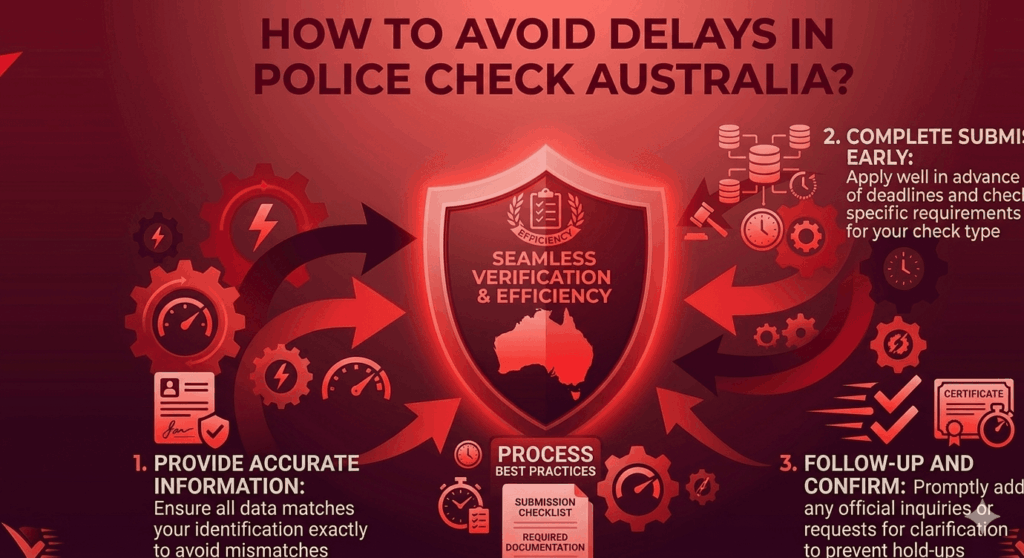
In the fast paced Australian job market, you should know how to avoid delays in police check Australia and how it is often the final gatekeeper between you and your new career. Whether you are applying for a role in healthcare, finance, or government, the speed of your background screening can make or break your start date. While the majority of checks are returned within hours, a significant minority experience frustrating hold ups. Learning how to streamline your background screening is an essential skill for any job seeker or HR professional. The National Police Checking Service (NPCS) is a highly efficient, automated system, but it is not infallible. Small errors in your application or complex personal histories can trigger a manual review, which can extend the process from hours to weeks. Why Do Police Check Delays Happen? To understand how to streamline your background screening, you first need to understand why they occur. The process is not a simple yes/no search. It involves matching your personal details against millions of records held by state and territory police jurisdictions across the country. 1. The Manual Review Referral Approximately 30% of all police check applications are flagged for manual review. This happens when the automated system finds a potential match between your details and a record in the database. It doesn’t necessarily mean you have a criminal record; it could be a false positive caused by: •Having a common name. •Sharing a date of birth with someone who has a record. •Having a similar address history to a person of interest. 2. Data Entry Errors The most common reason for a delay that is within your control is incorrect data entry. Even a single typo in your middle name or a digit wrong in your date of birth can cause the system to stall. 3. Incomplete Address History The NPCS requires a full five-year address history. If there are gaps in your timeline or if you provide vague addresses, the system may flag your application for further investigation. Top Strategies to Avoid Delays in Police Check Australia If you are in a rush, follow these proven strategies to ensure your application sails through the system. 1. Double Check Every Single Detail The first rule of streamlining your background screening is accuracy. Before you hit submit, review your application line by line. •Names: Use your full legal name as it appears on your birth certificate or passport. Do not use nicknames or shortened versions. •Previous Names: You must disclose all previous names, including maiden names, previous married names, or names changed by deed poll. •Date of Birth: Ensure the day, month, and year are correct. 2. Provide High-Quality ID Documents The Document Verification Service (DVS) is an automated system that verifies your ID in real-time. If your ID photos are blurry, cropped, or have a glare, the DVS will fail, and a human will have to manually verify your documents. This can also become a vital factor when you have to avoid delays in police check Australia. 3. Be Precise with Your Address History When the system asks for your five-year address history, it means exactly five years. •Include the unit number, street number, street name, suburb, state, and postcode. •If you lived overseas during the last five years, you must include those international addresses as well. Common Mistake Impact on Turnaround Time Fast-Track Solution Using a Nickname 1–15 Business Days (Manual Review) Use your full legal name exactly as it appears on your ID. Blurry ID Photo 4–24 Hours (Manual ID Check) Use a high-resolution smartphone photo with no glare. Missing Previous Names 5–15 Business Days (Police Referral) Disclose every name you have ever been known by. Gaps in Address History 2–10 Business Days (Investigation) Provide a continuous 5-year history with no gaps. Applying via Post Office 10–20 Business Days (Postal Delay) Use an ACIC-accredited online provider like Rapid Screening. The Importance of Choosing the Right Provider A major factor in streamlining your background screening is the platform you use to apply. While you can apply through the police or the post office, these traditional methods are often the slowest. Why Online Accredited Providers are Faster ACIC-accredited bodies like Rapid Screening have direct, secure API links to the National Police Checking Service. This means: •Instant Submission: Your application is sent to the police database the moment you finish it. •Real-Time ID Verification: We use the DVS to verify your identity in seconds, not days. •Automated Notifications: You are alerted immediately if there is an issue with your application, allowing you to fix it before it causes a major delay. Western Australia and Queensland In states like Western Australia and Queensland, there is a constant high demand for site ready clearances. Rapid Screening is specifically optimised to handle these high volume requirements, helping workers get to site without unnecessary waiting. The Role of False Positives in Delays One of the most frustrating aspects of background screening is dealing with things you can’t control, like having a common name. If your name is “David Jones,” there is a high probability that someone else with that name has a criminal record. When this happens, the system cannot automatically clear you. It must send your file to a police officer who will compare your other details to the person with the record. While you can’t change your name, providing as much detail as possible, such as your place of birth, can help the officer clear the false positive more quickly. Advanced Tips for HR Managers If you are an employer or HR manager, your goal is to get your new hires onboarded as quickly as possible. Implementing a structured screening process is the best way to ensure consistency and speed. HR can also help a new hire to avoid delays in police check Australia. 1. Standardise the Onboarding Checklist Provide your candidates with a clear list of what they need before they start the application. This includes a list of acceptable ID documents and a
Data Privacy Rules in Employee Background Verification
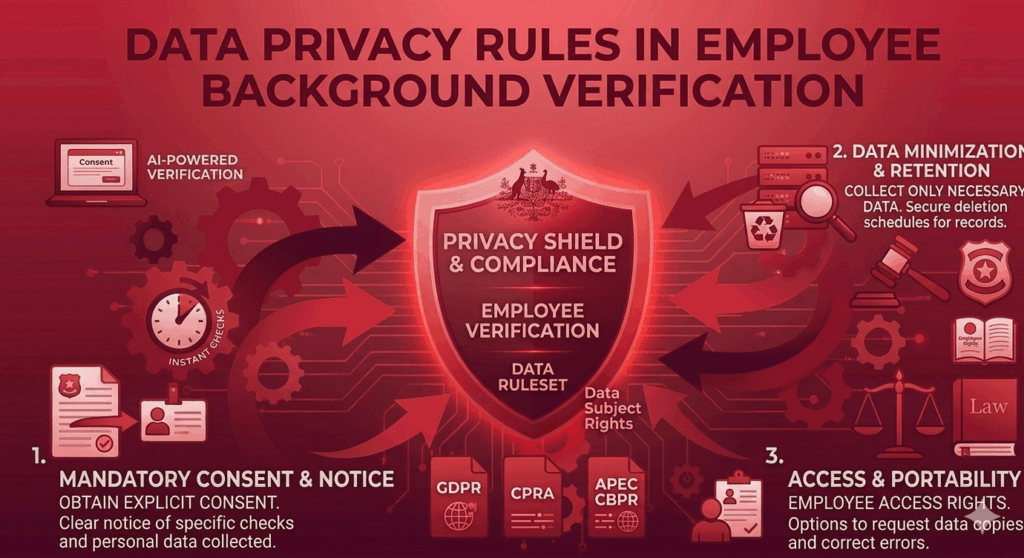
In an era where data is often described as the new oil, the responsibility of handling it has never been greater. For Australian businesses, the recruitment process involves collecting some of the most sensitive information an individual can provide: their criminal history, financial records, and personal identity documents. Understanding the official data handling standards, including the Data Privacy Rules in Employee Background Verification, is not just a matter of legal compliance; it is a fundamental part of building a culture of trust and integrity. As cyber threats evolve and privacy regulations tighten, employers must be more vigilant than ever. A single data breach or a mishandled background check can lead to devastating consequences, from multi-million dollar fines to a permanent loss of candidate trust. The Foundation: The Privacy Act 1988 and the APPs The primary legislation governing how personal information is handled in Australia is the Privacy Act 1988. Central to this Act are the 13 Australian Privacy Principles (APPs), which set out the standards for the collection, use, disclosure, and storage of personal data. When it comes to official data handling standards, the APPs provide a clear roadmap for employers. While there is an employee records exemption in the Act, it is often misunderstood. Adhering to the Data Privacy Rules in Employee Background Verification is crucial to ensure compliance. This exemption generally applies to the handling of records for current or former employees in relation to their employment. However, it does not typically apply to the recruitment phase or to the handling of data for unsuccessful candidates. Employers need to familiarize themselves with the Data Privacy Rules in Employee Background Verification to avoid potential legal issues and maintain candidate trust. Key Privacy Principles for Background Screening 1.Openness and Transparency: You must have a clearly defined privacy policy that explains how you handle background check data. 2.Collection of Solicited Personal Information: You should only collect information that is reasonably necessary for the role. 3.Notification of Collection: You must inform the candidate that their data is being collected and for what purpose. 4.Security of Personal Information: You are legally obligated to protect the data from unauthorised access, modification, or disclosure. Essential Data Privacy Rules in Employee Background Verification To maintain a compliant and secure screening process, Australian employers must adhere to several critical rules. 1. Informed Consent is Non-Negotiable One of the most important official data handling standards is the requirement for explicit, written consent. You cannot legally initiate a police check, credit check, or any other sensitive verification without the candidate’s permission. This consent must be informed, meaning the candidate understands exactly what information is being sought and how it will be used. 2. The Principle of Data Minimisation Just because you can check something doesn’t mean you should. Data minimisation is a core tenet of modern privacy law. Employers should only collect the specific data points necessary to assess a candidate’s suitability for a particular role. For example, a high-level security clearance might require a deep dive into financial history, whereas a retail role likely does not. 3. Secure Storage and Encryption Under the official data handling standards, sensitive documents like birth certificates, passports, and criminal history results must be stored in a secure environment. This means using encrypted digital storage and ensuring that access is restricted to only those who need to know. Data Type Sensitivity Level Key Privacy Requirement Criminal History (Police Check) High Explicit consent; secure disposal after use. Identity Documents (Passport/DL) High Encrypted storage; verification via DVS. Financial/Credit History Medium-High Only for relevant roles; strict access control. Reference Check Notes Medium Subject to APP 12 (Access and Correction). Medical/Health Information High Only if relevant to inherent job requirements. The Role of Accredited Providers in Data Security Choosing the right partner for your background screening is a critical part of complying with data privacy rules in employee background verification. When you use an ACIC-accredited provider like Rapid Screening, you are leveraging a platform that has been built from the ground up with security in mind. Why Accreditation Matters for Privacy Accredited bodies must undergo rigorous auditing by the Australian Criminal Intelligence Commission (ACIC). This ensures that their systems meet the highest standards for: •Data Encryption: Protecting information both in transit and at rest. •Access Control: Ensuring that only authorised personnel can view sensitive results. •Audit Trails: Maintaining a record of who accessed what data and when. By using an accredited provider, you are not just getting a faster check; you are ensuring that you are meeting your legal obligations under the official data handling standards. Navigating the Employee Records Exemption As mentioned earlier, the employee records exemption is a common point of confusion. It is vital for HR professionals to understand that this exemption is narrow. It only applies to acts or practices that are directly related to a current or former employment relationship. In the context of official data handling standards, this means: •During Recruitment: The exemption does not apply. You must follow the APPs for all candidates. •Unsuccessful Candidates: You must handle their data according to the APPs, which usually means destroying or de-identifying the information once the hiring decision is made. •Successful Hires: Once the candidate becomes an employee, the information may become part of their employee record, but it must still be handled with extreme care. The Importance of Data Disposal A key part of the official data handling standards that is often overlooked is the secure disposal of information. Once a background check has served its purpose, the sensitive data should not be kept indefinitely. For unsuccessful candidates, the best practice is to securely delete their background check results and identity documents as soon as the recruitment process is finalised. For successful hires, you should only retain the information that is necessary for the ongoing management of their employment. Best Practices for Compliance with Data Privacy Rules in Employee Background Verification To ensure your organisation remains on the right side of the law and maintains the trust of its candidates,
How to Request Urgent Police Clearance Certificate Australia?
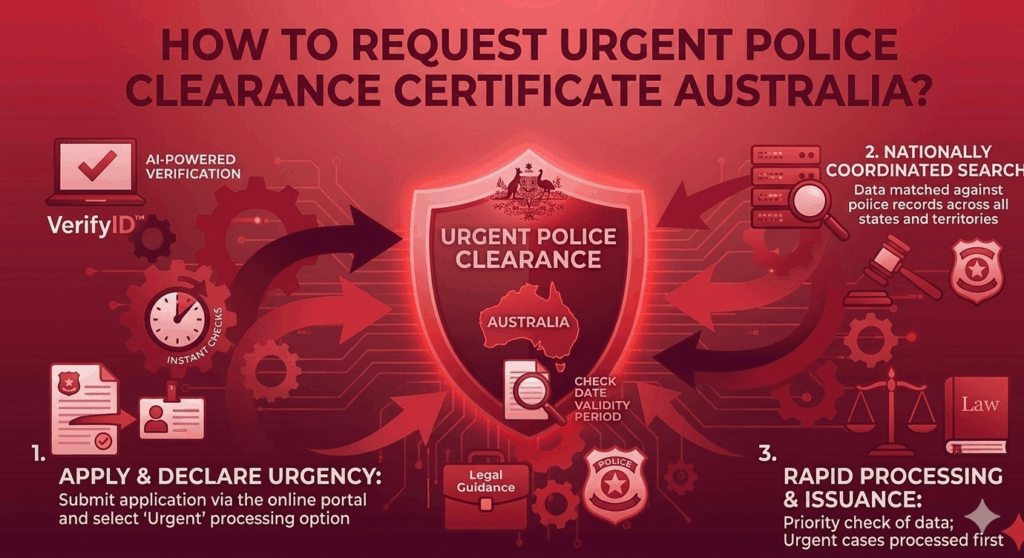
In the competitive world of Australian employment, timing is everything. You’ve just aced the interview, the salary is perfect, and the start date is next Monday. But there’s one final hurdle: you need a police clearance, and you need it now. For many, the sudden need to request urgent police clearance certificate Australia services can be a source of significant stress. Whether it’s for a last-minute job offer, a volunteer role, or a professional license, waiting weeks for a certificate is simply not an option. The good news is that the days of waiting in long queues at the local police station or waiting for weeks for a paper certificate in the mail are largely over. With the right approach and the right provider, you can secure your clearance in a matter of hours. In this comprehensive guide, we will walk you through the most efficient ways to request urgent police clearance certificate Australia wide, what causes delays, and how to ensure your application is processed as quickly as possible. Why You Might Need an Urgent Police Clearance The need for speed in background screening is more common than you might think. Australian industries are moving faster than ever, and employers often require site ready or onboarding ready candidates. Common scenarios where you might need to fast-track your police clearance include: •Last-Minute Job Offers: Many companies, especially in the tech, hospitality, and retail sectors, have rapid hiring cycles. •Contracting and Freelancing: If you are a contractor, you may need a fresh clearance for every new project or site you visit. •Visa and Immigration Deadlines: If you are applying for a visa or permanent residency, a missing police check can stall your entire application. •Regulatory Compliance: Roles in aged care, NDIS, and childcare have strict legal requirements that must be met before you can even step onto the premises. The Fastest Way to Request Urgent Police Clearance Certificate Australia When time is of the essence, the method you choose to apply for your check is the single most important factor. 1. Avoid the Traditional Paper Route Applying through a local police station or via a post office is generally the slowest method. These processes often involve manual data entry, physical document verification, and postal delivery times. If you apply through these channels, you could be waiting anywhere from 10 to 15 business days. 2. Use an ACIC-Accredited Online Provider The fastest way to get your results is through an Australian Criminal Intelligence Commission (ACIC) accredited body like Rapid Screening. These providers have direct, secure access to the National Police Checking Service (NPCS). When you apply through an online platform: •70% of results are returned within 2 to 4 hours. •The process is 100% digital, from ID upload to certificate delivery. •You can apply 24/7 from your phone or computer. Application Method Typical Turnaround Time Best For Online Accredited Provider (e.g., Rapid Screening) 2–4 Hours (70% of cases) Urgent employment, last-minute onboarding. Australian Federal Police (AFP) Online 48 Hours – 5 Business Days Immigration, Commonwealth roles. State Police Station (In-Person) 10–15 Business Days Those without digital ID or internet access. Post Office (Paper Application) 10–20 Business Days Non-urgent, traditional applications. Understanding the Manual Review Delay While most people who apply will receive their results quickly, about 30% of applications are flagged for manual review. This is the most common reason for a delay, and it is important to understand that no provider can skip this step once it has been triggered by the government system. What is a Manual Review? A manual review occurs when the automated system finds a potential match between your details and someone in the national criminal database. This doesn’t necessarily mean you have a criminal record; it could simply mean you have a common name or a similar date of birth to someone who does. When this happens, the application is sent to the relevant state police jurisdiction for a human officer to manually verify the information. This process can take anywhere from 1 to 10 business days. How to Minimise the Risk of Delays While you can’t prevent a manual review if your name is a match, you can ensure your application doesn’t get delayed for other reasons: •Double-Check Your Details: Ensure your name, date of birth, and address history are 100% accurate. •Clear ID Photos: If your ID photos are blurry or cropped, the provider will have to contact you for new ones, adding hours or days to the process. •Disclose Previous Names: If you have changed your name through marriage or deed poll, you must include all previous names. As the most populous states, TAS and WA police departments handle a high volume of checks. If your application goes to manual review in these states, it may take slightly longer during peak hiring seasons. The Importance of Real-Time Identity Verification One of the reasons Rapid Screening can offer such fast results is our use of the Document Verification Service (DVS). This is a national online system that allows us to verify your government issued documents in real-time. When you apply through our platform, the DVS confirms your identity instantly, allowing your application to be sent to the police database immediately. This eliminates the need for a human to manually check your ID, which is a major bottleneck in traditional application methods. Tips for a Successful Urgent Application If you are in a rush and need to fast-track your application, follow these expert tips to ensure a smooth and rapid process: 1. Have Your Documents Ready Before you start the online application, gather your four required ID documents. Typically, this includes: •Commencement Document: Full Australian Birth Certificate or valid Passport. •Primary Document: Australian Driver’s License or Marriage Certificate. •Secondary Documents: Medicare card, credit card, or student ID. 2. Use a Smartphone for ID Uploads Our platform is mobile-optimised. Using your phone’s camera to take photos of your ID is often faster and results in higher-quality images than using a desktop scanner. Clear, high-resolution images
Navigating the Legal Requirements for Employee Background Checks in Australia
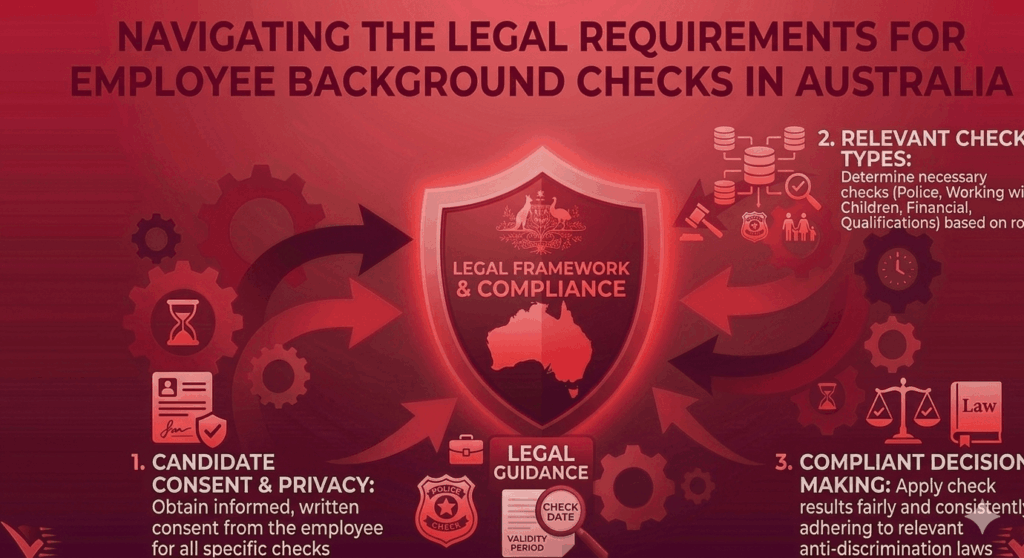
In the modern Australian recruitment landscape, the handshake deal has been replaced by a rigorous, data driven vetting process. As businesses strive to build safe, productive, and trustworthy teams, background checks have become an indispensable tool. However, navigating the legal requirements for employee background checks is not as simple as a quick Google search. Employers must navigate a complex web of federal and state legislation to ensure they remain compliant while protecting the rights of candidates. Understanding the official screening rules is critical for any HR professional, business owner, or hiring manager. Failure to comply with these regulations can lead to severe legal repercussions, including discrimination claims, privacy breaches, and significant reputational damage. In this guide, we will break down the essential legal frameworks, the types of checks available, and the best practices for maintaining legal employee verification Australia standards. The Legal Framework: What Governs Background Checks? In Australia, there is no single Background Check Act. Instead, the process is governed by several key pieces of legislation that work together to balance an employer’s right to know with a candidate’s right to privacy and fair treatment. 1. The Privacy Act 1988 (Cth) The Privacy Act 1988 is the primary legislation governing the collection, use, and disclosure of personal information. Under this Act, the Australian Privacy Principles (APPs) set out the standards for how APP entities must handle sensitive data. When conducting background checks, employers must ensure that the information collected is reasonably necessary for the role and that it is handled securely. 2. The Fair Work Act 2009 (Cth) The Fair Work Act provides the overarching framework for employment relations in Australia. While it doesn’t explicitly detail background check procedures, it protects employees and candidates from adverse action based on discriminatory grounds. If a background check reveals information that leads to a hiring decision, that decision must be based on the inherent requirements of the job. 3. Anti-Discrimination Legislation Both federal and state based ant -discrimination laws prohibit discrimination based on race, age, gender, religion, and, crucially for background checks, criminal record, unless it directly impacts the candidate’s ability to perform the role. Essential Legal Requirements for Employee Background Checks in Australia To stay on the right side of the law, employers must adhere to several core principles during the screening process. Informed Consent is Mandatory Perhaps the most important of the official screening rules is obtaining explicit, written consent from the candidate. You cannot legally conduct a criminal history check, credit check, or even a detailed reference check without the individual’s permission. This consent should be: •Informed: The candidate must know exactly what checks are being performed. •Specific: Consent for a police check does not automatically grant consent for a credit check. •Voluntary: While you can make a check a condition of employment, the candidate must still technically have the choice to refuse (though this may result in their application not proceeding). Relevance to the Role Employers must be able to justify why a specific check is necessary. For example, a credit check is highly relevant for a financial controller but likely irrelevant for a warehouse assistant. Under legal employee verification Australia guidelines, collecting unnecessary sensitive information can be seen as a breach of privacy. Type of Check Legal Justification / Relevance Governing Body/Source National Police Check Assessing integrity and risk, especially for vulnerable sectors. ACIC / State Police Working with Children Check Mandatory for roles involving child-related work. State-based regulatory bodies Right to Work (VEVO) Ensuring compliance with the Migration Act 1958. Dept. of Home Affairs Qualification Verification Confirming the candidate has the necessary skills/licenses. Educational Institutions Credit History Check Relevant for roles with significant financial responsibility. Credit Reporting Bodies Types of Background Checks and Their Specific Rules Navigating the official screening landscape requires understanding the specific rules for different types of screening. 1. Nationally Coordinated Criminal History Checks Most employers use the ACIC-accredited process to obtain a police check. It is vital to remember that a criminal record does not automatically disqualify a candidate. Employers must assess whether the offence is relevant to the inherent requirements of the job. For instance, a drunk driving conviction from ten years ago may not be relevant for an office based role but would be critical for a delivery driver. 2. Working with Children Checks (WWCC) Unlike general police checks, a WWCC is often a mandatory legal requirement for specific roles. Each state and territory has its own legislation. Employers have a legal obligation to verify that a candidate’s WWCC is valid and current before they commence work. 3. Entitlement to Work (VEVO Checks) Under the Migration Act 1958, it is a criminal offence to employ someone who does not have the legal right to work in Australia. Conducting a Visa Entitlement Verification Online (VEVO) check is a standard part of legal employee verification Australia to avoid heavy fines and legal penalties. 4. Reference Checks While common, reference checks still carry legal weight. Employers should stick to questions about the candidate’s performance and conduct in previous roles. Asking about a candidate’s personal life, political views, or health status during a reference check can inadvertently lead to discrimination claims. The Role of Spent Convictions A critical aspect of the legal requirements for employee background checks in Australia is the Spent Convictions scheme. In most jurisdictions, if a person has committed a minor offence and has not re-offended for a period, the conviction is considered spent and does not need to be disclosed for most roles. However, there are significant exceptions for high risk roles, such as those in police, aged care, or childcare. Best Practices for Maintaining Legal Employee Verification Australia Standards To ensure your business remains compliant with the legal requirements for employee background checks in Australia, implementing a structured and transparent screening policy is essential. Here are the best practices that every Australian employer should follow: 1. Develop a Clear Background Check Policy Don’t leave your screening process to chance. Create a written policy that outlines: •Which roles require
Getting a Government Accredited Police Check in Australia
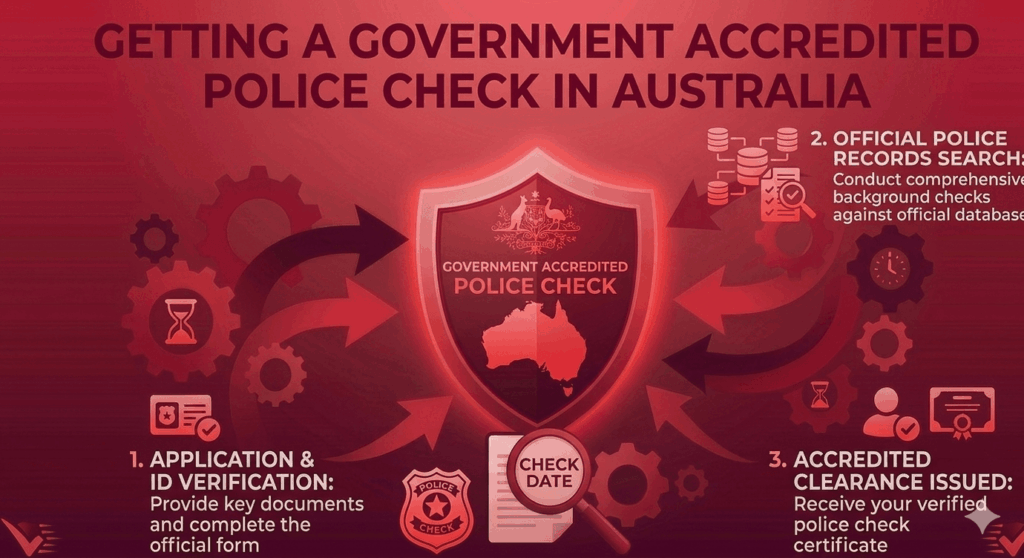
In this comprehensive guide, we will explore everything you need to know about obtaining a Government Accredited Police Check, why it matters, and how you can secure yours in record time through Rapid Screening. Navigating the world of criminal history clearances can often feel like a bureaucratic maze. With various terms like National Police Check, AFP Clearance, and Nationally Coordinated Criminal History Check being used interchangeably, it is easy to get confused. However, the core requirement remains the same: a reliable, secure, and official verification of an individual’s disclosable criminal history. What is a Government Accredited Police Check? A Government Accredited Police Check is an official process that involves searching the records of all Australian police jurisdictions to identify any disclosable court outcomes or pending charges associated with an individual. In Australia, these checks are primarily coordinated through the Australian Criminal Intelligence Commission (ACIC) or the Australian Federal Police (AFP). When you apply for a check through an accredited body like Rapid Screening, you are accessing a secure system that communicates directly with the National Police Checking Service (NPCS). This ensures that the information provided is accurate, up-to-date, and legally recognised by employers and regulatory bodies across the country. The Role of the ACIC and AFP It is important to distinguish between the two main types of government-authorised checks: 1.Nationally Coordinated Criminal History Check (NCCHC): Managed by the ACIC, this is the most common check used for employment, licensing, and volunteer purposes. It is facilitated by accredited bodies that have undergone rigorous vetting to ensure they meet strict security and privacy standards. 2.Australian Federal Police (AFP) Check: These are typically required for specific purposes such as immigration, overseas employment, or working for Commonwealth government agencies. For the vast majority of Australian workers, a nationally coordinated criminal history check obtained through an ACIC-accredited provider is the standard requirement. Why You Need a Government Accredited Police Check The requirement for a police clearance is no longer limited to high security roles. Today, it is a standard part of the onboarding process in almost every sector. Here are the primary reasons why you might be asked to provide one: •Employment Screening: Employers use these checks to mitigate risk and ensure the safety of their workplace, clients, and assets. •Regulatory Compliance: Industries such as aged care, childcare, and healthcare have mandatory requirements for staff to hold valid clearances. •Volunteer Work: To protect vulnerable members of the community, non-profit organisations require volunteers to undergo screening. •Licensing and Accreditation: Many professional bodies require a Government Accredited Police Check before granting licenses to practice in fields like real estate, security, or finance. Comparison of ACIC vs. AFP Police Checks Feature Nationally Coordinated Criminal History Check (ACIC) Australian Federal Police (AFP) Check Primary Purpose General employment, volunteering, and licensing. Immigration, Commonwealth employment, overseas visas. Facilitator ACIC-accredited bodies (like Rapid Screening). Australian Federal Police. Data Source All Australian police jurisdictions. All Australian police jurisdictions. Turnaround Time Often within hours (via Rapid Screening). Typically 5–15 business days. ID Requirements 4 documents (including one photo ID). 100-point ID check. The Importance of Using an Accredited Provider When it comes to sensitive personal data, where you get your check matters just as much as the check itself. Using a Government Accredited Police Check provider like Rapid Screening offers several critical advantages: 1. Enhanced Security and Privacy Accredited bodies must adhere to the Privacy Act 1988 and strict ACIC security protocols. This means your personal information, including your birth certificate, passport, and criminal history, is encrypted and handled with the highest level of confidentiality. 2. Speed and Efficiency Traditional methods of obtaining a police check, such as visiting a local police station, can take weeks. In contrast, an online police clearance through Rapid Screening leverages advanced technology to deliver results in a fraction of the time. In fact, 70% of our checks are returned within just 2 to 4 business hours. 3. Compliance and Validity A check from an unaccredited or third party source that doesn’t have direct ACIC access may not be accepted by your employer. By choosing an accredited provider, you ensure that your certificate is valid and meets all Australian legal standards. How the Process Works Obtaining your official police clearance has never been easier. Gone are the days of printing forms and waiting in queues. Here is how the modern, 100% online process works with Rapid Screening: Step 1: Online Application You will be asked to provide basic personal details, including your full name, date of birth, and five years of address history. Step 2: Identity Verification To maintain the integrity of the system, you must prove your identity. We use the Document Verification Service (DVS), a national online system that allows real time verification of government issued documents. You will typically need to provide: •One commencement document. •One primary use in the community document. •Two secondary uses in the community documents. Step 3: Payment Our pricing is transparent and competitive. A standard Nationally Coordinated Criminal History Check is available for just $51.73 + GST. We accept all major credit cards and secure online payment methods. Step 4: Processing and Results Once submitted, your application is sent to the National Police Checking Service. If there are no potential matches, your result is often returned within hours. You will receive a secure link to download your digital certificate immediately. State-Specific Requirements for Police Checks While the nationally coordinated criminal history check is a national document valid across all states and territories, some industries or local regulations may have specific nuances. New South Wales (NSW) In NSW, police checks are frequently required for those working in the vibrant hospitality and security sectors. Whether you are in Sydney or regional NSW, our online service ensures you meet state requirements without delay. Victoria (VIC) Victoria has stringent requirements for those working in the Working with Children and Aged Care sectors. A national criminal history check is often the first step in these multi-layered screening processes. Queensland (QLD) From the mining hubs to